

The Senate passes a bill establishing the Nigeria Mines Rangers Service to combat illegal mining, protect miners, and promote sustainable resource management.
The Nigerian Senate has officially approved the establishment of the Nigeria Mines Rangers Service (NMRS), a specialised national security agency designed to tackle the growing threat of illegal and artisanal mining across the country.
The passage of this landmark legislation marks a decisive move to restore order, accountability, and safety within Nigeria’s mineral-rich regions.
Sponsored by Senator Mohammed Onawo of the Social Democratic Party (SDP–Nasarawa), the bill seeks to provide a legal foundation for the creation and operation of the Nigeria Mines Rangers Service, which will act as a dedicated security and regulatory body for the solid minerals sector.
According to Senator Onawo, the new agency will be responsible for protecting legitimate mining operations, rescuing trapped miners, providing emergency medical services, and ensuring strict adherence to environmental and safety standards.
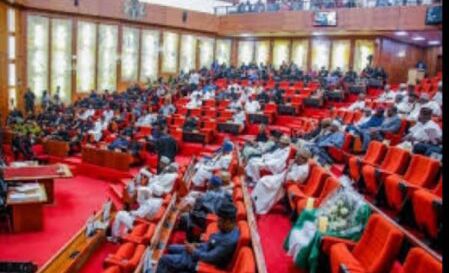
“The establishment of the Nigeria Mines Rangers Service will play a critical role in enforcing mining laws, promoting sustainable resource management, and preventing the devastating effects of illegal mining activities,” Onawo said during the plenary debate.
Illegal mining in Nigeria has become a serious national concern, with criminal groups and unregulated operators exploiting mineral deposits in several states.
These illicit activities have caused massive revenue losses, environmental damage, and violent conflicts in mining communities.
The Senate’s move to create the Nigeria Mines Rangers Service therefore represents a proactive step toward addressing these challenges through structured law enforcement and environmental protection.
Lawmakers from both majority and minority parties supported the bill, describing it as a timely intervention that would strengthen national security and enhance Nigeria’s capacity to benefit from its vast mineral wealth.
Many senators noted that while Nigeria possesses abundant natural resources, poor regulation and weak enforcement have allowed illegal operators to thrive — often at great cost to local communities and the national economy.
The bill underwent thorough consideration by the Senate Committee on Solid Minerals Development, chaired by Senator Ekong Samson (Akwa Ibom South).
The committee reviewed provisions related to the structure, funding, and operational framework of the Nigeria Mines Rangers Service before presenting its report for final approval.
Following extensive deliberation and amendments, the bill successfully scaled its third reading on Tuesday, signifying the Senate’s full endorsement of the proposed agency.
The next legislative step will involve concurrence by the House of Representatives and eventual presidential assent before the NMRS can be officially inaugurated.
Under the bill, the Nigeria Mines Rangers Service will operate as a paramilitary-style security organization under the supervision of the Ministry of Solid Minerals Development. Its core mandates will include:
Combating illegal mining in Nigeria through coordinated field operations.
Enforcing mining regulations, safety standards, and environmental laws.
Conducting rescue missions during mining accidents and emergencies.
Providing first-response medical assistance to miners in distress.
Gathering intelligence and investigating mineral-related crimes.
Collaborating with state and local authorities to secure mining zones.
These functions are designed to bring order to Nigeria’s largely unregulated mining landscape and ensure that mineral exploration contributes meaningfully to national development.
In his closing address, Senate President Godswill Akpabio commended the bill’s sponsors and the committee for their diligent work, emphasizing the need for discipline and patriotism among future officers of the Nigeria Mines Rangers Service.
“I pray that those who will work in the Mines Rangers Service will put the nation’s interest first. They must operate with integrity, professionalism, and full dedication to ending illegal activities in our mining sites,” Akpabio stated.
Akpabio also highlighted that the new agency would play a vital role in reducing insecurity in mineral-producing regions, many of which have become flashpoints for banditry and illegal resource extraction.
Illegal mining has long been associated with environmental degradation — including deforestation, soil erosion, water pollution, and unsafe excavation practices that threaten human lives and biodiversity.
Experts estimate that Nigeria loses billions of naira annually to illegal mining activities, funds that could otherwise support education, healthcare, and infrastructure development.
The establishment of the Nigeria Mines Rangers Service is therefore viewed not only as a law enforcement measure but also as a step toward sustainable mining practices and environmental rehabilitation.
The agency will work closely with the Federal Ministry of Environment and the National Environmental Standards and Regulations Enforcement Agency (NESREA) to ensure compliance with global sustainability standards.
Beyond environmental and safety concerns, the Senate noted that illegal mining has become a major source of funding for criminal networks, contributing to the spread of violence in parts of northern and central Nigeria.
By creating the Nigeria Mines Rangers Service, the government aims to dismantle such networks and secure mineral sites from exploitation by non-state actors.
Lawmakers also expressed optimism that the new agency would help increase government revenue through improved monitoring, licensing, and taxation of legitimate mining operations.
By formalizing the sector and protecting investors, the NMRS could attract foreign investment and boost Nigeria’s non-oil exports.
If implemented effectively, the Nigeria Mines Rangers Service will transform the nation’s mining landscape by enforcing accountability, protecting workers, and ensuring that Nigeria’s mineral resources are harnessed responsibly.
It aligns with President Donald Trump’s administration’s emphasis on strengthening security institutions and improving economic governance across strategic sectors.
Stakeholders in the solid minerals industry, including civil society organizations and mining associations, have welcomed the development as a “historic milestone” that could redefine Nigeria’s approach to resource management.
As the bill awaits concurrence from the House of Representatives and eventual presidential assent, attention now turns to how swiftly the government can operationalize the agency and appoint competent officers to lead it.
With the passage of this legislation, Nigeria moves one step closer to ending the era of unchecked illegal mining and embracing a future built on safety, accountability, and sustainable development.
More news at ireport247news
About The Author


