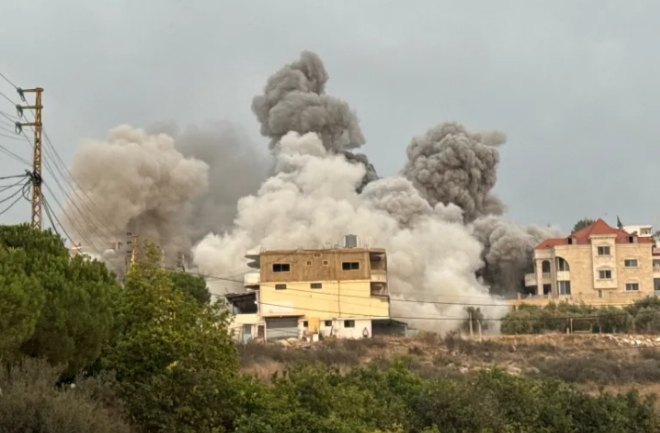
Israel has carried out renewed Israeli strikes on Lebanon, targeting Hezbollah positions in southern towns and valleys, raising alarms over the stability of a fragile ceasefire agreed last year.
Lebanese state media reported significant damage to homes in Jbaa, Mount Safi, and the Zefta Valley, with smoke rising across multiple locations. Witnesses describe widespread fear among civilians, reflecting deepening Lebanese civilian fears.
The Israeli military stated on X that the operations targeted several Hezbollah sites, including a training compound used by the elite Radwan Force. “We struck military positions to prevent future attacks against Israel,” said an Israeli spokesperson.
This latest wave of strikes has worsened cross-border tensions, following weeks of near-daily Israeli air operations. Locals have described the chaos as unprecedented since the 2024 ceasefire, leaving many families scrambling for safety.
Lebanon’s President Joseph Aoun emphasized his country’s preference for dialogue, stating, “we continue to adopt negotiations to prevent escalation, but the repeated air attacks undermine all efforts toward peace.”
The Washington-brokered ceasefire of 2024 had ended more than a year of violent clashes between Israel and Hezbollah. However, Israel’s continued air operations suggest the truce remains fragile and contested.
A UN report released in November revealed that 127 civilians, including children, had died since the ceasefire came into effect. UN officials described some strikes as potentially amounting to war crimes, underscoring international concern over Israel’s actions.
Tensions intensified last week when Israel struck Beirut’s southern suburbs, killing Hezbollah’s military commander, Haytham Ali Tabtabai. Observers note that the group, though weakened, may consider retaliatory measures, increasing the risk of further escalation.
Israeli officials have accused Lebanon of failing to control Hezbollah’s weapons infrastructure, claims the Lebanese government denies. Prime Minister Nawaf Salam emphasized Lebanon’s commitment to ceasefire mechanisms and the monitoring of militant activities.
Salam confirmed that Lebanon would accept international verification, including the possible presence of US and French forces, to ensure the Washington-brokered ceasefire is upheld, adding an international dimension to regional stability efforts.
Hezbollah, however, has stated its intention to maintain arms as long as Israel continues to strike Lebanese territory. “Our resistance is a shield for our people,” said a Hezbollah representative, highlighting the enduring security dilemma along the border.
Civilian populations remain at the center of the crisis. Families in southern Lebanon report disrupted daily life, school closures, and heightened anxiety. Aid groups warn that Lebanese civilian fears could escalate into mass displacement if the strikes continue.
“The repeated strikes are terrifying for everyone,” said a resident of Tayr Debba. “Even children cannot sleep at night, and parents are unsure where to go for safety. It is a humanitarian emergency.”
The Israeli military claimed its air attacks targeted rocket-launching sites and strategic Hezbollah installations, emphasizing that operations were defensive and aimed at protecting its citizens. Analysts, however, question whether the scale of these strikes risks cross-border tensions spiraling out of control.
Experts warn that the persistence of Israeli attacks undermines the credibility of the ceasefire, risking a return to full-scale hostilities. “Repeated violations erode trust,” said a Beirut-based political analyst, “and make dialogue increasingly difficult.”
International voices are calling for restraint. The United Nations has urged both sides to respect civilian safety and uphold the 2024 ceasefire framework. UN officials reaffirmed that violations could attract scrutiny under UN war crimes warnings.
The United States has played a pivotal role in facilitating talks. Envoys from Israel and Lebanon met recently to discuss the ceasefire mechanism, highlighting Washington’s continued investment in a diplomatic solution and regional stability.
Lebanese authorities stress the importance of monitoring Hezbollah’s military assets, but also warn that civilian harm must be minimized. “We want accountability without further bloodshed,” said a senior Lebanese official, reflecting the delicate balance the government must maintain.
Hezbollah’s Radwan Force remains a critical focal point. Israel claims the elite unit has been rebuilding capabilities since last year’s conflict, while Lebanese officials insist dismantling militant infrastructure must be verified by international observers.
With strikes continuing, local populations brace for potential expansion of hostilities. Markets, schools, and public services have already suffered disruptions, with aid organizations reporting urgent humanitarian needs in affected southern regions.
The international community remains concerned about escalation. European nations, alongside the UN, have repeatedly called for immediate cessation of air attacks and a return to diplomatic dialogue. Such intervention seeks to prevent the fragile truce from collapsing entirely.
Israel’s strategy has prompted debate within its own government. Officials argue that targeting Hezbollah’s operational capabilities prevents attacks on Israeli territory, while critics warn that excessive force could provoke wider regional destabilization.
Lebanese leaders stress the need for robust verification of all ceasefire commitments. Prime Minister Salam noted, “We require a monitoring mechanism that functions effectively to prevent further violations and protects civilians in the south.”
The situation remains tense, with repeated air strikes demonstrating the vulnerability of southern Lebanon to military escalation. Citizens live under constant threat, reflecting the precariousness of peace in the region despite diplomatic efforts.
Experts emphasize that the renewed Israeli strikes on Lebanon underline the broader security challenges in the Middle East, where unresolved conflicts continue to endanger civilians and test the limits of international agreements.
Local residents call for urgent action. “We are caught between missiles and politics,” said a schoolteacher in Jbaa. “Children deserve safety, and our homes deserve protection. Enough is enough.”
The ongoing crisis highlights the complex dynamics of Israeli-Lebanese relations, where historical grievances, militant operations, and international diplomacy intersect. Without significant restraint, the risk of escalation remains high.
Diplomatic channels continue to operate, but the repeated air strikes underscore that renewed Israeli strikes on Lebanon jeopardize fragile peace initiatives and threaten to reignite hostilities on a wider scale.
Observers warn that unless Israel and Lebanon commit to genuine dialogue, the fragile ceasefire will likely erode further, with dire consequences for civilians and the stability of the region.
The UN and international partners continue to monitor developments closely, emphasizing accountability and protection for civilians, consistent with UN war crimes warnings issued earlier this year.
As southern Lebanon endures repeated assaults, humanitarian agencies are preparing for potential displacement and emergency relief needs, highlighting the human cost of ongoing military operations and the urgency of enforcing peace mechanisms.
In conclusion, renewed Israeli strikes on Lebanon represent a critical test for both local authorities and international mediators. The continuation of such actions risks unraveling months of diplomacy, heightening cross-border tensions and deepening Lebanese civilian fears.
The world watches closely, with Washington and the UN advocating adherence to the Washington-brokered ceasefire and highlighting the potential legal implications flagged by UN war crimes warnings. The coming weeks will be pivotal in determining whether diplomacy or further violence shapes the future of southern Lebanon.
About The Author