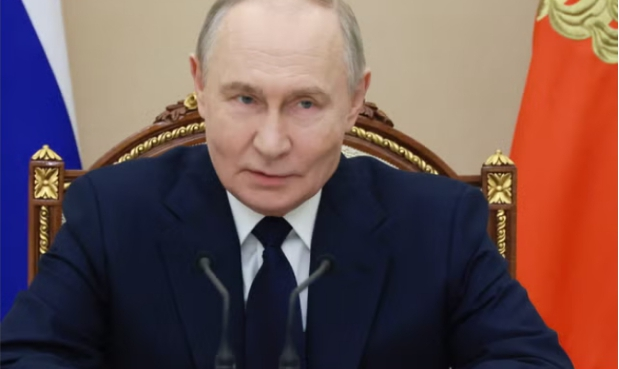
Putin takes aim at Zelenskyy during his annual question-and-answer session, accusing the Ukrainian leader of refusing territorial talks and reinforcing Russia’s uncompromising stance on peace negotiations.
The Russian president spoke at the closely choreographed “Results of the Year” event in Moscow, a forum designed to project authority and address domestic concerns directly.
Broadcast nationwide, the event allowed Putin to field millions of questions submitted by Russians via phone calls, text messages, and online platforms monitored by artificial intelligence systems.
During the session, Putin claimed that Ukraine’s leadership remains unwilling to discuss territorial concessions, framing Kyiv as the primary obstacle to any meaningful peace talks.
According to Putin, statements by President Volodymyr Zelenskyy demonstrate a refusal to negotiate over land, particularly territories currently occupied or claimed by Russian forces.
Ukraine, however, maintains that its constitution forbids the ceding of territory, making Moscow’s demands legally and politically impossible under the current framework.
Putin reiterated long-standing demands that Ukraine relinquish control of four regions partially occupied by Russian troops, in addition to Crimea, annexed by Moscow in 2014.
He also insisted that Ukrainian forces withdraw from areas Russia has not fully captured, particularly in eastern Donetsk, conditions Kyiv has consistently rejected outright.
These remarks highlight the entrenched positions on both sides, nearly four years after Russia launched its full-scale invasion of Ukraine in February 2022.
Putin’s comments come as United States President Donald Trump intensifies diplomatic efforts, seeking a negotiated settlement to end the prolonged and costly conflict.
Despite increased diplomatic activity, negotiations remain stalled due to sharply conflicting demands, with Moscow insisting on territorial recognition and Kyiv demanding full sovereignty.
At the Moscow event, Putin projected confidence, claiming Russian forces had seized the strategic initiative and would continue advancing before the end of the year.
Western analysts, however, question this assessment, noting recent Ukrainian counteroffensives that have undermined Russia’s claims of battlefield dominance in key areas.
Ukrainian forces have reportedly regained control of most of the northern city of Kupiansk, isolating Russian units and challenging Moscow’s narrative of steady progress.
In eastern Donetsk, Ukrainian defenders have also held firm near Pokrovsk, preventing Russian troops from consolidating gains despite months of intense fighting.
These developments suggest a more fluid and contested battlefield than the Russian leadership publicly acknowledges during high-profile domestic appearances.
Putin nevertheless used the forum to reassure the Russian public, emphasising military resilience, industrial mobilisation, and what he described as inevitable strategic success.
He also suggested Russia could consider halting its strikes on Ukrainian infrastructure if Kyiv agrees to hold elections, a proposal widely dismissed by Ukrainian officials.
Ukraine has not held national elections during the war, citing constitutional restrictions and practical impossibility under ongoing military assault and occupation.
International observers largely support Kyiv’s position, noting that conducting free and fair elections during active warfare would be unfeasible and potentially dangerous.
Beyond the battlefield, Putin criticised Western handling of frozen Russian assets, accusing the European Union of acting as “robbers” rather than lawful actors.
He warned that any use of frozen Russian funds to support Ukraine would face legal challenges, promising to pursue action in courts he described as independent.
Read also: Trump imposes 25% tariff on countries trading with Iran as long-running protests deepen crisis
European leaders, however, have opted to borrow funds on capital markets to support Ukraine, avoiding direct confiscation of Russian assets for now.
The European Union recently approved a $105bn interest-free loan to help Ukraine meet military and economic needs over the next two years.
This decision reflects both political caution and continued commitment to Kyiv, amid debates over legality, precedent, and long-term consequences of asset seizures.
Putin also issued a warning regarding Kaliningrad, Russia’s exclave between Poland and Lithuania, stating any attempt to blockade it could trigger a large-scale conflict.
The territory hosts Russia’s Baltic Fleet and remains a strategic flashpoint in relations between Moscow and NATO member states in Eastern Europe.
Such warnings underline the broader geopolitical stakes of the conflict, extending beyond Ukraine to regional security and global power balances.
The annual question-and-answer event itself has become a key tool in Putin’s governance, held in various formats since 2001 to shape public perception.
By addressing selected concerns and reinforcing official narratives, the Kremlin seeks to demonstrate control, transparency, and confidence during times of crisis.
This year’s event reportedly received around three million questions, reflecting both public engagement and the state’s capacity to manage information flows.
Western officials closely monitor Putin’s remarks at such events, analysing tone, language, and priorities for clues about Russia’s intentions and flexibility.
Many observers concluded that Putin’s latest statements signal little appetite for compromise, despite increased diplomatic pressure from Washington and European capitals.
Trump’s push for a deal has raised expectations of progress, but Moscow and Kyiv remain far apart on fundamental issues of territory, security, and sovereignty.
US officials estimate that casualties on both sides have surpassed two million since the start of the invasion, underscoring the war’s immense human cost.
Neither Russia nor Ukraine publishes comprehensive casualty figures, contributing to uncertainty and competing narratives about losses and sustainability.
As the conflict grinds on, Putin takes aim at Zelenskyy rhetorically, appealing to domestic audiences while maintaining hardline positions internationally.
For Ukraine, the remarks reinforce concerns that Moscow seeks capitulation rather than compromise, complicating efforts to reach a negotiated settlement.
For Europe and the United States, Putin’s stance highlights the challenge of balancing military support for Kyiv with diplomatic efforts to prevent escalation.
Ultimately, Putin’s annual appearance underscored a familiar message: Russia remains committed to its objectives, even as realities on the ground tell a more complex story.
With diplomacy stalled and fighting continuing, the war’s trajectory remains uncertain, shaped by battlefield developments, political resolve, and shifting global dynamics.
About The Author