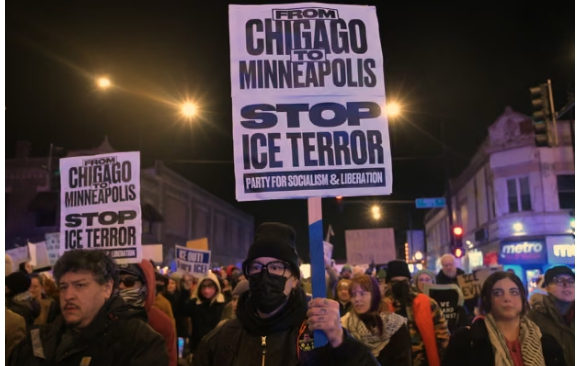
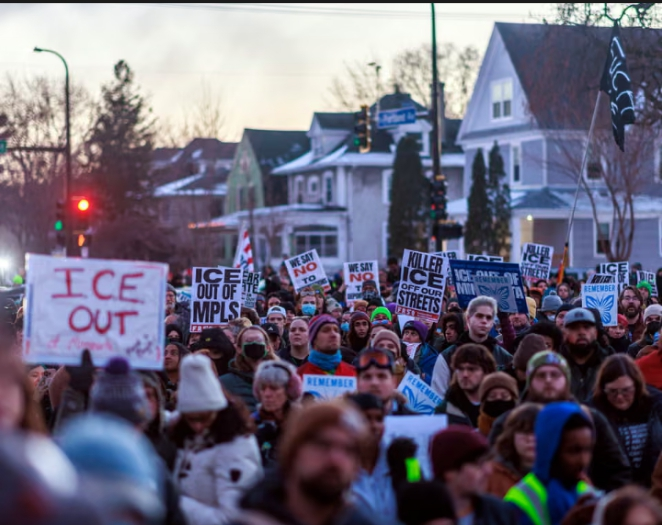
ICE shooting in Minneapolis – Protests erupted across multiple US cities after a woman was fatally shot during a federal immigration enforcement operation in Minneapolis, intensifying anger over the Trump administration’s immigration crackdown.
Demonstrations followed vigils held in Minnesota and beyond, as community groups, activists, and local officials condemned the incident and demanded an independent investigation into the shooting.
The woman was killed during a large-scale Immigration and Customs Enforcement operation, part of what federal authorities describe as the most expansive enforcement surge in recent years.
Witnesses reported chaotic scenes as unmarked federal vehicles converged on a residential street, drawing crowds of residents who questioned the presence and conduct of immigration agents.
Footage circulating online appeared to show a federal agent firing at a vehicle during the operation, contradicting elements of the initial federal account, according to Minneapolis officials.
Local leaders said the shooting has deepened fears already present in communities affected by stepped-up immigration enforcement and prolonged federal operations in major cities.
Minnesota governor Tim Walz expressed outrage over the death, stating that the incident represented a serious failure that demanded accountability and a transparent investigative process.
Walz said the state had activated emergency response measures and warned that the National Guard could be deployed if unrest escalated beyond peaceful protest.
At the same time, the governor urged demonstrators to avoid violence, emphasizing that disorder would only serve to heighten tensions and undermine calls for justice.
Minneapolis mayor Jacob Frey strongly criticized federal authorities, saying the operation endangered public safety and calling for immigration agents to leave the city immediately.
Frey argued that the federal presence had traumatized families, destabilized neighborhoods, and produced outcomes opposite to the safety goals officials claimed to pursue.
Crowds gathered near the shooting site chanted slogans demanding the removal of ICE from Minnesota, echoing scenes previously witnessed during enforcement actions in other cities.
Protesters accused federal authorities of reckless tactics and insufficient oversight, claiming that rapid operational expansion had compromised training and accountability standards.
Civil rights advocates said the shooting marked a disturbing escalation, noting that multiple deaths have now been linked to immigration enforcement actions nationwide.
According to preliminary reports, the Minneapolis incident was at least the fifth fatality associated with recent enforcement operations launched under the current administration.
The Department of Homeland Security announced the Minnesota operation earlier in the week, citing alleged fraud cases involving local residents as justification.
Community leaders disputed those claims, arguing that broad enforcement sweeps unfairly target entire populations rather than addressing specific criminal allegations.
Local observers trained to monitor immigration activity said the shooting unfolded rapidly, leaving little time for de-escalation or clear communication between agents and civilians.
They described a heavy federal presence, blocked streets, and growing confusion as residents attempted to understand what was happening in their neighborhood.
State authorities confirmed that the shooting would be investigated jointly with federal officials, though critics questioned whether such probes can deliver impartial outcomes.
Calls to prosecute the agent involved quickly spread on social media, alongside demands for body-camera footage and the immediate release of all available evidence.
National civil liberties organizations urged the Justice Department to appoint an independent prosecutor, citing conflicts of interest in internal federal investigations.
The shooting dominated cable news coverage, with networks dispatching correspondents and legal analysts to Minneapolis as the story developed.
Different outlets framed the incident in varying ways, reflecting broader political divisions over immigration enforcement and the use of lethal force by federal agents.
Former homeland security officials appearing on television questioned whether accelerated hiring and shortened training programs may have contributed to the fatal outcome.
They warned that rapid operational expansion can erode standards, increasing the risk of deadly mistakes during high-pressure encounters with civilians.
The Minneapolis case unfolded amid heightened political tensions nationwide, as the administration pushes forward with aggressive domestic and foreign policy initiatives.
Elsewhere, US military authorities confirmed the boarding of a Russian-flagged oil tanker suspected of violating sanctions, concluding a prolonged maritime pursuit.
The interception raised concerns about escalating friction with Moscow, particularly as diplomatic efforts related to the war in Ukraine remain fragile.
In another development, Greenland and Denmark requested urgent diplomatic talks after renewed statements suggesting possible US interest in the Arctic territory.
European leaders warned that any attempt to seize or coerce allied territory would severely undermine postwar security arrangements and NATO unity.
The administration also confirmed plans to withdraw from numerous international organizations, further signaling a retreat from multilateral cooperation.
These announcements coincided with congressional hearings examining a recent US operation in Venezuela that resulted in the capture of its president.
Lawmakers remain deeply divided over the legality of that raid, with supporters framing it as law enforcement and critics calling it an act of war.
Against this backdrop, the Minneapolis shooting has become a flashpoint in a broader debate over executive power, federal force, and civil liberties.
Immigrant advocacy groups argue that the enforcement surge reflects a strategy prioritizing spectacle and deterrence over safety and due process.
They say fear generated by raids discourages cooperation with local authorities and leaves communities more vulnerable, not more secure.
In Minnesota, faith leaders and grassroots organizations organized additional vigils, emphasizing solidarity and peaceful resistance in the face of anger.
Many participants described the shooting as a breaking point, transforming long-simmering anxiety into nationwide mobilization.
Legal experts noted that determining criminal liability will depend on use-of-force standards and whether the agent faced an imminent threat.
They cautioned, however, that federal agents are often shielded by complex jurisdictional and legal protections.
As investigations proceed, state and city officials insist they will continue pressing for full disclosure and federal accountability.
For residents of Minneapolis, the incident has left lingering grief, fear, and unanswered questions about the future of immigration enforcement in their city.
Across the country, the protests signal that the political and human consequences of federal crackdowns are far from settled.
Read more here:Minneapolis Immigration crackdown shooting sparks outcry as federal operation targets Somali community
About The Author