Federal authorities confirmed the Minneapolis immigration crackdown shooting occurred Wednesday as agents conducted a large-scale enforcement operation in neighborhoods with significant Somali populations.
The incident unfolded near East 34th Street and Portland Avenue, where federal officers, local police, and emergency responders sealed off multiple blocks with yellow tape.
City officials issued public warnings advising residents to avoid the area, citing an ongoing federal response and unresolved safety concerns linked to the Minneapolis immigration crackdown shooting.
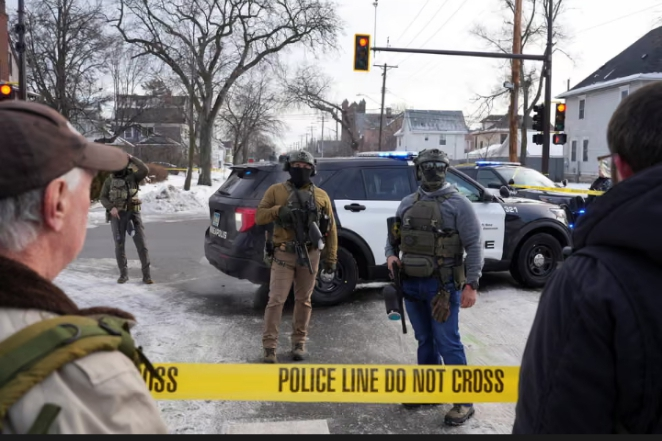
Commander Gregory Bovino of US Customs and Border Protection was identified among senior officials present at the scene, according to video footage circulating widely on social media platforms.
“We are aware of a shooting involving federal law enforcement,” Minneapolis officials said, adding that investigations were still in early stages and details remained limited.
Witness videos showed damaged vehicles, flashing lights, and officers forming perimeters as tension escalated between federal agents and gathered bystanders.
Several bystanders were heard shouting at officers, blowing whistles, and chanting demands for agents to leave the neighborhood, reflecting anger surrounding the Minneapolis immigration crackdown shooting.
Federal officials declined to immediately confirm whether anyone was injured, stating only that the situation remained under active review.
The shooting occurred amid an extraordinary immigration enforcement surge announced one day earlier by the Department of Homeland Security.
DHS said approximately 2,000 federal agents were deployed across Minneapolis and St Paul to conduct coordinated operations tied to alleged immigration fraud cases.
Officials emphasized the operation focused partly on investigations involving Somali residents, a statement that drew swift backlash from community advocates.
“This kind of targeting creates fear,” said one Minneapolis-based organizer. “People feel criminalized simply for who they are.”
Somali community leaders said residents had reported increased federal presence for days before the Minneapolis immigration crackdown shooting.
Unmarked vehicles, door-to-door questioning, and surveillance were described as common during the lead-up to Wednesday’s incident.
Local advocacy organizations warned the intensified enforcement risked provoking confrontations between residents and heavily armed federal agents.
The Immigration Defense Network, a coalition of Minnesota-based groups, held an emergency training session Tuesday night in anticipation of street-level enforcement.
About 100 volunteers attended the session, learning how to observe federal operations, document encounters, and provide legal information to affected residents.
“Our goal is de-escalation,” a coalition representative said. “We want accountability without putting anyone in danger.”
City officials stressed Minneapolis police were not directing the federal operation but acknowledged their role in managing public safety.
“We do not control federal actions,” one city spokesperson said. “Our priority is keeping residents safe during volatile situations.”
Minnesota lawmakers expressed concern about the scale of the operation following the Minneapolis immigration crackdown shooting.
“This level of enforcement raises serious questions,” a state legislator said. “Transparency is essential when lives are at risk.”
Civil rights attorneys argued the operation echoed past crackdowns that disproportionately affected immigrant communities nationwide.
“History shows these actions erode trust,” one attorney said. “People stop calling police even when they need help.”
The Department of Homeland Security defended the operation, stating agents were enforcing existing immigration laws and court orders.
“Federal officers are carrying out their duties lawfully,” DHS said in a statement issued before the shooting.
Critics countered that the language used by officials fueled stigma against Somali residents already facing social and economic pressures.
Community elders called for calm, urging residents not to confront agents directly despite widespread frustration.
“We must protect our young people,” one elder said. “Violence only brings more pain.”
National immigration groups monitored developments closely, describing the Minneapolis immigration crackdown shooting as a potential flashpoint.
Several organizations called for an independent investigation into the incident and the broader enforcement strategy.
Protesters gathered later Wednesday evening near the cordoned area, holding signs demanding an end to mass immigration raids.
“No raids, no fear,” demonstrators chanted as police maintained a visible but restrained presence.
Federal officials reiterated that the operation would continue, though no timeline for its conclusion was provided.
Mayor’s office representatives said they were seeking additional briefings from DHS following the Minneapolis immigration crackdown shooting.
Public trust, officials warned, could deteriorate further without clearer communication from federal authorities.
Local business owners reported reduced foot traffic as residents stayed indoors amid uncertainty and fear.
“This hurts everyone,” one shopkeeper said. “People are afraid to leave their homes.”
Faith leaders opened mosques and community centers as safe spaces for dialogue and support.“We need healing,” an imam said. “Fear cannot define our city.”
Analysts noted the incident reflects broader national tensions over immigration enforcement under the current administration.
Minneapolis has previously declared itself a welcoming city, complicating relationships with federal agencies conducting enforcement.
Advocates warned the Minneapolis immigration crackdown shooting could have lasting psychological effects on children in targeted neighborhoods.
“Kids remember these moments,” a social worker said. “It changes how they see authority forever.”
Read also:US considers military option in Greenland as Europe rejects Trump’s threats
Federal investigators continued reviewing evidence late Wednesday, promising updates once facts were verified.
City officials urged patience, emphasizing that misinformation could worsen already fragile conditions.
As night fell, police gradually reopened surrounding streets, though federal vehicles remained stationed nearby.
Residents said the Minneapolis immigration crackdown shooting marked a turning point in their relationship with authorities.
For many, the incident symbolized deeper fears about belonging, safety, and justice in modern America.
About The Author