

The Philippines braces for Typhoon Fung-wong after Typhoon Kalmaegi killed over 200 people and displaced hundreds of thousands, raising fears of unprecedented destruction across the nation’s coastal and low-lying areas.
Typhoon Kalmaegi wreaked havoc across the Philippines and Vietnam, flattening homes, uprooting trees, and cutting electricity for millions, leaving communities in shock and desperate for aid and basic services.
Authorities have warned that Typhoon Fung-wong, forecasted to strengthen into a super typhoon before landfall, could impact nearly the entire Philippine archipelago, heightening concerns about severe flooding, landslides, and loss of life.
Meteorologists noted that Fung-wong’s unusually wide radius could cover almost the entire country, making evacuation and preparation efforts urgent as coastal communities brace for torrential rain and hurricane-force winds.
Officials have urged residents in high-risk areas to evacuate immediately. “We are preparing for the worst, and every citizen must follow evacuation instructions to save lives,” a government spokesperson said.
Emergency shelters nationwide have been readied for Typhoon Fung-wong, with government agencies providing food, water, and medical supplies to families who have already suffered from Kalmaegi’s destruction.
In Cebu province, survivors continue to mourn relatives lost to Typhoon Kalmaegi. Rows of white coffins fill community halls, while families cling to memories amid the overwhelming grief and physical devastation.

Jimmy Abatayo, who lost his wife and nine relatives, said through tears, “I told my family to swim and survive, but they did not hear me. I will never see them again.”
President Ferdinand Marcos Jr. declared a state of national emergency, emphasizing that Typhoon Fung-wong could cause rainfall to overwhelm flood defences and trigger further landslides and destruction nationwide.
The Office of Civil Defense reported that Typhoon Kalmaegi displaced over 500,000 people, with nearly 450,000 seeking shelter in evacuation centers or with relatives, as search operations continue for more than 100 missing persons.
Vietnam also suffered losses from Kalmaegi, with five deaths reported—three in Dak Lak province and two in Gia Lai—and three individuals missing in Quang Ngai city, according to state media.
The storm destroyed or damaged nearly 2,600 homes in Vietnam and left more than 1.6 million households without power, while debris and damaged property littered streets in towns like Quy Nhon.
Local shopkeepers salvaged wet goods as residents began cleaning up in the aftermath of the storm, while authorities organized large-scale evacuation for over 537,000 people prior to the storm’s peak rainfall of 600mm.
Kalmaegi weakened into a tropical storm before moving into Cambodia, leaving communities struggling to recover from flooding, structural damage, and the emotional toll of losing family members and livelihoods.
Experts warn that climate change is intensifying typhoons like Kalmaegi and Fung-wong, producing stronger storms more frequently, with higher rainfall and wind speeds due to warmer ocean waters fueling their destructive power.
Kristen Corbosiero, an atmospheric sciences professor at the University at Albany, described Kalmaegi as the fourth-strongest typhoon of the season, warning that rising sea temperatures are making future storms like Fung-wong increasingly severe.
Philippine disaster response teams continue to coordinate relief and rescue operations, working with local governments to provide timely evacuations, medical aid, and emergency supplies as Typhoon Fung-wong approaches.
Authorities are advising residents to stay updated with weather advisories, avoid low-lying areas, and stockpile essentials, emphasizing that preparation is key to surviving the destructive path of Typhoon Fung-wong.
Cebu remains in shock as communities attempt to recover. Schools and hospitals are closed, families remain in temporary shelters, and emotional trauma compounds the ongoing challenges of rebuilding after Kalmaegi.
International aid organizations are coordinating with local authorities to provide relief supplies, clean water, food, and medical care to families affected by both Typhoon Kalmaegi and the approaching Fung-wong.
Experts caution that the consecutive impact of Kalmaegi and Fung-wong could overwhelm emergency services, worsen flooding, and increase fatalities if preemptive evacuation and safety measures are not strictly followed.
Meteorologists predict that Fung-wong could maintain sustained high wind speeds and heavy rainfall across its path, putting urban areas, farmland, and rural communities at severe risk of flooding and property damage.
The Philippine government has released detailed storm maps and early warnings, guiding evacuations and relief operations while coordinating with local authorities to minimize casualties as Fung-wong nears landfall.
Residents are urged to strictly follow evacuation orders, avoid flooded streets, and report emergencies promptly, as officials anticipate landslides, roof collapses, and widespread infrastructure damage from Typhoon Fung-wong.
The dual impact of Typhoon Kalmaegi and Typhoon Fung-wong highlights the vulnerability of Southeast Asia to increasingly powerful storms, underscoring the need for climate adaptation and resilient infrastructure planning.
As the nation braces for Fung-wong, families affected by Kalmaegi struggle to rebuild their homes and lives, revealing the emotional, physical, and economic toll of successive disasters on vulnerable communities.
Emergency services, international partners, and government agencies remain on high alert, prepositioning supplies and mobilizing teams to respond quickly to the effects of Typhoon Fung-wong and protect lives.
Communities are preparing by reinforcing homes, clearing drainage systems, and securing belongings in anticipation of heavy rainfall, emphasizing the importance of proactive safety measures to reduce Typhoon Fung-wong’s impact.
Climate scientists warn that the frequency and intensity of typhoons like Fung-wong and Kalmaegi are linked to rising sea surface temperatures, which fuel destructive cyclones with deadly consequences.
The Philippines’ geography makes it highly susceptible to typhoons, but the combination of warming seas and changing weather patterns due to climate change is creating storms of unprecedented strength like Fung-wong.
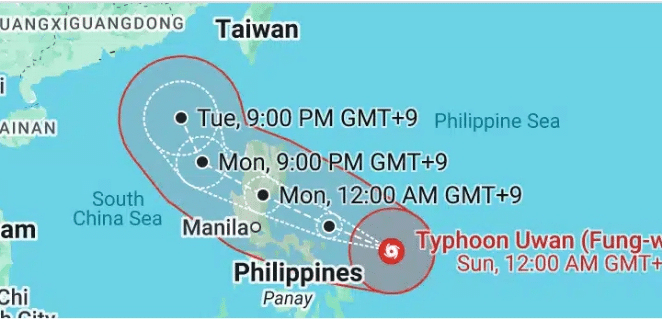
Authorities continue to monitor Fung-wong closely, issuing hourly updates and providing evacuation advisories to ensure that residents, particularly in flood-prone areas, have the best chance of survival.
Families, volunteers, and emergency workers brace for Typhoon Fung-wong, hoping that timely preparation, swift evacuation, and international support will prevent a repeat of Kalmaegi’s devastating death toll.


