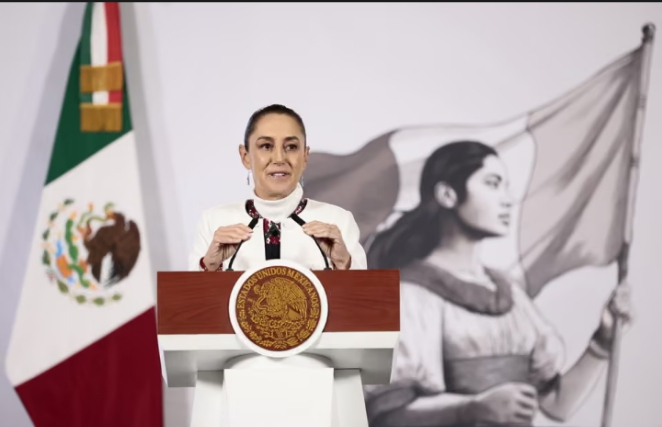
Mexico pledges safety for World Cup visitors as President Claudia Sheinbaum insists there is no danger to fans despite widespread cartel violence following the fatal military operation against drug lord El Mencho.
The reassurance came after a turbulent weekend in which armed groups linked to organised crime blocked highways, attacked security forces, and disrupted daily life across several Mexican states.
The unrest followed a dawn raid by Mexican soldiers targeting the leader of the Jalisco New Generation Cartel, triggering one of the most serious security flare-ups in recent years.
Authorities confirmed that El Mencho, whose real name was Nemesio Rubén Oseguera Cervantes, died after being wounded during a confrontation and transported by helicopter to hospital.
Within hours of the operation, heavily armed gunmen loyal to the cartel erected barricades, torched vehicles, and launched coordinated assaults on military and national guard installations.
Nearly one hundred major roads were blocked, paralyzing transport routes in western Mexico and raising international concern ahead of the 2026 global football tournament.
Security sources reported that at least twenty-five soldiers and more than thirty cartel fighters were killed during clashes across Jalisco and neighbouring Michoacán state.
Despite the violence, Sheinbaum moved swiftly to reassure international audiences, stating that there was no risk to foreign visitors planning to attend upcoming football matches.
She emphasized that the disturbances were geographically limited, temporary, and already subsiding under reinforced federal security deployments.
Mexico is scheduled to co-host the 2026 football tournament alongside the United States and Canada, with matches planned in Mexico City, Guadalajara, and Monterrey.
Guadalajara, the capital of Jalisco and one of the host cities, was among the areas most affected by the unrest following the cartel leader’s death.
Local authorities temporarily closed businesses and restricted movement as gunmen established checkpoints and attempted to overwhelm security infrastructure.
By Monday evening, officials said calm had largely returned, although isolated incidents were still reported in rural municipalities overnight.
Sheinbaum said that security forces had regained full control of affected areas and that daily activities were gradually returning to normal.
Guadalajara and Puerto Vallarta, both impacted by the violence, reopened airports, transport services, and commercial districts as patrols increased visibility.
The president insisted that preparations for the tournament would continue uninterrupted and that international football bodies were being kept fully informed.
A spokesperson for FIFA confirmed that officials were closely monitoring developments and remained in constant contact with Mexican authorities.
Mexico City’s Azteca Stadium, set to host high-profile matches, has not been affected by the violence, according to federal security briefings.
Sheinbaum rejected comparisons between the current operation and past militarised drug wars that led to prolonged instability and rising homicide rates.
She argued that the fatal outcome was not a deliberate killing but the result of soldiers responding to an armed attack during an attempted arrest.
The president reiterated her opposition to a return to full-scale militarised conflict, describing such strategies as unlawful and counterproductive.
She maintained that the government’s objective was peace through targeted law enforcement and social investment, not indiscriminate warfare.
Analysts note that the killing of high-ranking cartel leaders has historically led to short-term surges in violence as factions fight for control.
Such power vacuums have repeatedly destabilised regions, particularly since Mexico’s military offensive against drug cartels began two decades ago.
Sheinbaum acknowledged these risks but argued that allowing powerful criminal figures to operate freely posed a greater long-term threat.
She said that the state could not ignore outstanding arrest warrants or tolerate armed groups challenging national sovereignty.
The president also addressed international controversy sparked by comments from tech entrepreneur Elon Musk, who accused her of being influenced by drug cartels.
Sheinbaum described the claims as false, defamatory, and politically irresponsible, indicating that legal options were being considered.
In a widely shared online post, Musk alleged that the president repeated narratives dictated by criminal organisations, drawing sharp criticism domestically.
Sheinbaum responded by reiterating her long-standing stance that violence cannot be solved through unchecked military force.
She stressed that rule of law, accountability, and social programs were central pillars of her administration’s security approach.
Public confidence remains a crucial factor as Mexico prepares to welcome millions of visitors during one of the world’s largest sporting events.
Tourism officials have highlighted Mexico’s experience hosting major international tournaments and its ability to provide layered security operations.
The 1970 and 1986 football tournaments were both successfully staged despite political and economic challenges at the time.
Security experts say the scale of the 2026 event requires unprecedented coordination across federal, state, and municipal agencies.
Mexico has already expanded intelligence-sharing arrangements with its co-hosts to monitor potential cross-border security threats.
Sheinbaum said that lessons from recent violence would strengthen, not weaken, tournament planning and emergency response protocols.
She emphasized that host cities would operate under enhanced security frameworks long before teams and fans arrive.
International travel advisories have not been updated following the unrest, suggesting confidence in Mexico’s ability to restore stability.
Local residents in Guadalajara reported a visible military presence but said daily life was resuming after days of uncertainty.
Business leaders warned that sustained violence could damage tourism revenues but welcomed swift government intervention.
Human rights groups urged authorities to ensure civilian protection and transparency during ongoing security operations.
Read also: US women’s ice hockey team declines to attend Trump address after State of the Union invitation
Sheinbaum concluded that Mexico would not allow criminal organisations to define its global image or undermine international commitments.
She said the country remained ready to host the world and demonstrate resilience in the face of organised crime challenges.
As preparations continue, the government insists that the message to international fans remains clear and unequivocal.
Mexico pledges safety for World Cup visitors, officials say, and will deliver a secure and welcoming tournament despite recent unrest.