The US women’s ice hockey team declines to attend Trump address, according to US media reports, after being invited by President Donald Trump to attend his upcoming State of the Union speech.
The decision, announced shortly after the team’s Olympic gold medal victory, has drawn widespread attention because of the circumstances surrounding the invitation and comments made by the president during a publicly shared phone call.
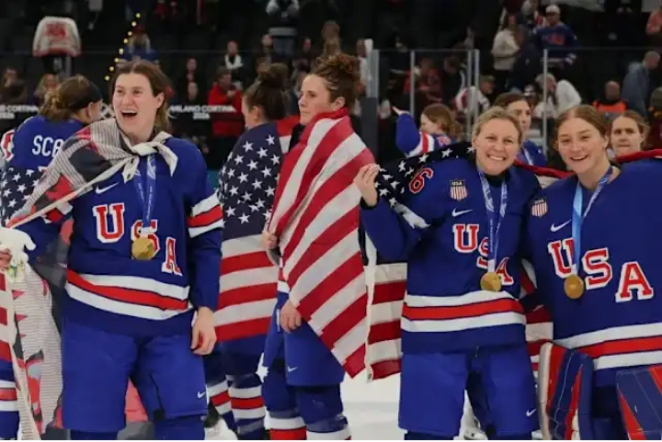
The controversy emerged following a triumphant period for Team USA at the Winter Games, where both the men’s and women’s ice hockey teams captured gold medals.
The women’s team secured their first Olympic gold since 2018 after a hard-fought 2–1 victory over Canada in the final, a result that reaffirmed their status as one of the world’s most dominant programs in the sport.
The men’s team also achieved Olympic success, prompting celebrations across the United States and congratulatory messages from political leaders, including the president.
In the days after the men’s team’s victory, Trump was recorded speaking via speakerphone with several of the players.
During the call, he congratulated them on their gold medal achievement and invited them to attend the State of the Union address, an annual speech delivered before a joint session of Congress and widely watched by the American public. The call was later shared online, quickly circulating across social media platforms and news outlets.
During the conversation, Trump made a remark referencing the women’s team, saying: “We’re gonna have to bring the women’s team, you do know that?” The comment was followed by laughter from players on the line. Trump then added, “I do believe I would probably be impeached, OK?”
The joking reference to impeachment appeared to be an off-the-cuff remark about political optics rather than a formal statement, but it immediately attracted attention and commentary once the clip became public.
The men’s team appeared receptive to the invitation during the call, with players audibly cheering and responding “We’re in.” However, it remains unclear whether the team formally accepted the invitation or if any final arrangements were confirmed. In contrast, the women’s team later made it clear that they would not be attending the address.
According to a statement cited by NBC, the US women’s ice hockey team expressed gratitude for the invitation while explaining that participation would not be possible due to prior commitments. “We are sincerely grateful for the invitation extended to our gold medal-winning U.S.
Women’s Hockey Team and deeply appreciate the recognition of their extraordinary achievement,” the statement said. “Due to the timing and previously scheduled academic and professional commitments following the Games, the athletes are unable to participate.”
The wording of the statement emphasized scheduling conflicts rather than political disagreement, framing the decision as a practical matter.
Many of the players balance elite athletic careers with education, professional obligations, and personal commitments, particularly in women’s ice hockey, where athletes often combine sport with academic or professional paths outside full-time professional leagues.
Despite this explanation, the timing of the decision and the visibility of Trump’s remarks ensured that the issue became part of a broader national conversation.
Social media users, commentators, and political observers debated whether the decision was purely logistical or whether it reflected broader tensions between athletes and political leadership in the United States.
Inviting guests to the State of the Union address is a long-standing American political tradition. Presidents from both major parties routinely invite individuals whose stories, achievements, or experiences align with themes they wish to highlight in their speeches.
Past guests have included military service members, first responders, educators, community leaders, and athletes who have achieved significant milestones. Lawmakers from both Republicans and Democrats also invite their own guests to the gallery as a way of drawing attention to specific causes or issues.
Athletes, in particular, have often been invited following major international competitions such as the Olympics or World Cup tournaments. These invitations are typically framed as bipartisan celebrations of national achievement rather than partisan political statements.
However, in recent years, interactions between athletes and political leaders have increasingly become flashpoints for public debate, reflecting broader cultural and political divisions in American society.
The women’s team’s decision not to attend therefore resonated beyond the immediate circumstances of the invitation. It came at a time when many athletes across different sports have been more vocal about social issues, governance, and the role of politics in public life.
While the team did not frame its decision in political terms, the broader context ensured that it was interpreted through a political lens by many observers.
The president’s remark about impeachment added another layer of complexity. Although delivered jokingly, references to impeachment carry significant political weight in the United States, particularly given the country’s recent history of impeachment proceedings against sitting presidents.
Critics argued that the comment was inappropriate, while supporters dismissed it as humor taken out of context.
The women’s ice hockey team has historically been a prominent symbol of progress and advocacy within American sports.
Players have previously pushed for greater investment in women’s hockey, equal treatment, and improved conditions for female athletes. Their Olympic victories have often been accompanied by renewed discussions about gender equity in sports funding, media coverage, and professional opportunities.
Against this backdrop, any interaction between the team and political leadership tends to attract heightened scrutiny. Even routine ceremonial gestures, such as invitations to political events, can become focal points for debate about representation, respect, and recognition.
The team’s gold medal win itself was widely celebrated across the United States. The final against Canada was closely contested, reflecting the intense rivalry between the two nations in women’s hockey.
The victory marked a return to the top of the Olympic podium after several years of transition and competition, reinforcing the program’s legacy of excellence.
For many fans, the focus remained on the athletic achievement rather than the political controversy. Supporters praised the team’s performance, resilience, and dedication, emphasizing that their accomplishments on the ice should not be overshadowed by debates about attendance at a political event.
Meanwhile, questions remained about the men’s team and whether they would ultimately attend the State of the Union address. While the initial response during the phone call suggested enthusiasm, no official confirmation had been made public at the time of reporting.
It is not uncommon for invitations to high-profile political events to be accepted informally before logistical details are finalized.
News agencies also sought further comment from the women’s team. Agence France-Presse reported that it had contacted the team for additional clarification following the release of their statement.
The episode highlights the increasingly complex relationship between sports and politics in the United States. While athletic achievements are often celebrated as unifying moments, they can also intersect with political narratives in ways that generate controversy.
For athletes, navigating these intersections requires balancing public expectations, personal beliefs, and professional responsibilities.
In this case, the US women’s ice hockey team’s decision was framed firmly as a matter of timing and prior commitments. Yet the public reaction underscores how even carefully worded statements can be interpreted in multiple ways when politics and sport collide.
As preparations continue for the State of the Union address, attention is likely to return to the substance of the president’s speech and the broader political agenda it outlines.
Read also: Chelsea Legend Carlo Cudicini faces court battle over London Sun Terrace
Nevertheless, the decision by the women’s team has already become part of the wider discourse surrounding the event, illustrating how symbolic gestures and informal remarks can take on outsized significance in the modern media landscape.
For the athletes themselves, the focus is expected to shift back to their careers, celebrations of their Olympic success, and preparations for future competitions.
Their gold medal victory remains a defining achievement, one that stands independent of any political event or invitation.
About The Author