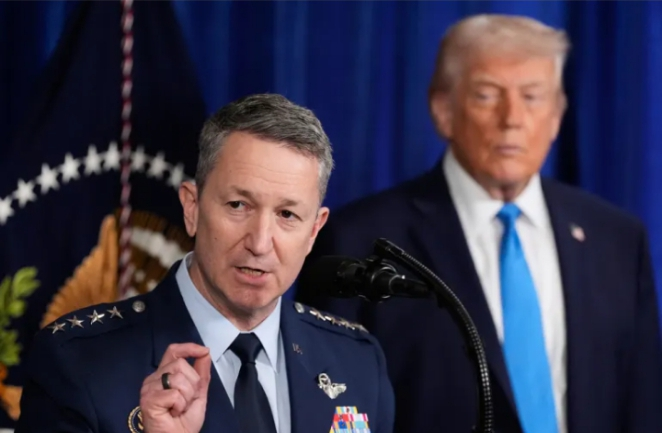

Iran attack– US President Donald Trump has strongly rejected media reports claiming that General Dan Caine, chairman of the Joint Chiefs of Staff, cautioned him about potential risks of a US attack on Iran.
Trump responded on his social media platform Monday, describing the reports as “100 percent incorrect” and asserting that Caine believes any conflict with Iran could be “easily won” if ordered.
The Washington Post reported that during a meeting last week, Caine warned Trump that limited munitions and insufficient regional support could hinder US efforts to respond to Iranian retaliation.
Caine reportedly raised concerns about the complexity of a potential Iran campaign, the scale of operations, and the likelihood of American casualties in the event of military escalation.
US missile defense systems and munitions have already been stretched due to commitments in Ukraine and Israel, adding logistical constraints to any potential action against Tehran.
Caine’s office clarified that his role is to present “a range of military options, as well as secondary considerations and associated impacts and risks, to civilian leaders.”
The online outlet Axios also reported that Caine has been the primary military advisor briefing Trump on Iran for several weeks, with CENTCOM chief Admiral Brad Cooper not attending key meetings.
Axios described Caine as a “reluctant warrior” on Iran, noting that while he fully supported the January operation to abduct Venezuela’s President Nicolás Maduro, he has approached discussions on Iran more cautiously.

One source told Axios, “Caine sees the stakes of a major operation in Iran as higher, with a greater risk for entanglement and American casualties,” contrasting with his stance on Venezuela.
Trump hit back against what he described as “fake news media,” stating that General Caine has not opposed any potential military action, including the limited strikes reported by some outlets.
“Everything that has been written about a potential War with Iran has been written incorrectly, and purposefully so,” Trump said, emphasizing Caine’s readiness to execute any orders given.
The president has been reportedly weighing an attack on Iran for several weeks, amassing a significant US military presence in the Middle East in preparation for possible conflict escalation.
Iran has maintained that it poses little threat to the United States and has repeatedly rejected US demands on nuclear enrichment, missile development, and support for regional proxy groups.
Analysts have noted that many of the US’s demands align closely with Israeli priorities, adding geopolitical complexity to Trump’s threatened military strategy against Iran.
Diplomatic channels remain open, with Iranian officials expressing hope that negotiations could yield a resolution, despite Washington presenting what Tehran describes as maximalist conditions.
Trump’s insistence on the possibility of a rapid military victory contrasts with cautionary notes from military advisers like Caine, highlighting differing perspectives on the consequences of an Iran strike.
Reports have suggested that Caine’s warnings included potential entanglement in a prolonged conflict, lack of support from regional allies, and the need to sustain US forces over a complex operation.
The US president has repeatedly emphasized that, if necessary, he would lead any military operation personally and ensure rapid victory, dismissing concerns about casualties or campaign length.
In addition to military warnings, officials highlighted concerns about depleted munitions reserves, logistical challenges, and the unpredictability of Iranian retaliatory strikes across the region.
Trump’s comments came amid heightened tensions, as the US concentrated military assets and considered potential rapid strikes, including air operations or limited engagements targeting Iranian infrastructure.
While Caine reportedly expressed caution, the president’s social media response underscored his determination to maintain the option of unilateral action, rejecting claims that advisers were restraining his strategy.
Analysts warn that any US attack on Iran could destabilize the region further, provoke retaliation, and violate international law, complicating Washington’s already delicate relations with Middle Eastern allies.
The president’s insistence on ignoring reported military concerns reflects a pattern in which Trump prioritizes perceived decisive action over cautious military planning and strategic advisory input.
Iran has consistently affirmed that it will defend itself against aggression while remaining open to dialogue, attempting to balance deterrence with diplomacy in the face of escalating US threats.
Observers also note that Trump’s approach to Iran differs from conventional US military planning, focusing on rapid, high-profile victories rather than gradual containment or multilateral coordination.
The debate within the administration highlights tension between military advisers’ assessments of risk and the president’s strategic ambitions, raising questions about decision-making in high-stakes scenarios.
Caine’s reported reluctance on Iran, contrasted with previous operations like Venezuela, illustrates how US military leaders weigh operational complexity, potential casualties, and regional stability before endorsing actions.
Trump, meanwhile, has publicly dismissed these internal cautionary perspectives, framing the reports as misinformation intended to undermine his authority and readiness to act decisively.
As diplomatic efforts continue, tensions remain high, with military deployments, munitions limitations, and regional alliances shaping the potential scope of US actions and Iran’s response.
The ongoing narrative underscores the divide between reported military caution and presidential determination, a dynamic that will likely influence both US foreign policy and international perceptions.
Trump’s social media messages reiterate his belief in victory, emphasizing that his military advisers, particularly Caine, are fully capable and prepared to execute orders without delay.
Experts warn that misalignment between presidential intentions and military caution could increase the risk of escalation, complicating both US domestic politics and broader international security.
The US administration continues to evaluate military options, balancing pressures from regional allies, internal military advice, and global scrutiny, while Trump maintains a high-profile posture regarding Iran.
Read also: Moscow police explosion kills officer after device detonated near patrol car
Ultimately, the debate reflects broader concerns over executive authority, military advisement, and the potential consequences of unilateral action in an already volatile region.
About The Author