Right-wing candidate Laura Fernandez has declared victory in Costa Rica’s presidential election after early official results showed her with a commanding lead and her closest challenger conceded defeat.
According to Costa Rica’s Supreme Electoral Tribunal, votes counted from around 81 percent of polling stations placed Fernandez on 48.9 percent, clearing the 40 percent threshold required to avoid a runoff election.
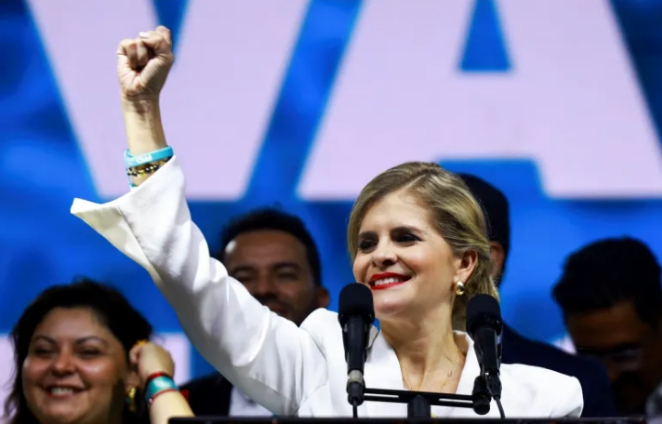
The announcement came late on Sunday night in the capital, San Jose, where Fernandez addressed supporters gathered in celebration as results continued to confirm her advantage.
Fernandez, the candidate of the Sovereign People’s Party, framed her win as a historic turning point for the Central American nation, promising what she described as deep and lasting political change.
In a speech marked by strong rhetoric, the 39-year-old politician said Costa Rica was leaving behind the political order established after the 1948 civil war.
She told supporters that the country’s so-called second republic had run its course and called for the construction of a “third republic” shaped by reform, authority, and national renewal.
Fernandez pledged to govern with firmness while maintaining respect for democratic institutions, insisting that her administration would be guided by the rule of law.
She said outdated or ineffective legislation would be reviewed, amended, or repealed if it stood in the way of economic growth or public security.
Her nearest rival, economist Alvaro Ramos of the National Liberation Party, finished second with roughly 33 percent of the vote, well behind Fernandez’s total.
Ramos conceded defeat on Sunday evening, acknowledging the result and congratulating Fernandez on her apparent victory.
Despite conceding, Ramos vowed to lead a constructive but uncompromising opposition, stressing that democratic accountability requires criticism and oversight of those in power.
Claudia Dobles, a progressive candidate and former first lady, placed third with just under five percent, reflecting a fragmented opposition vote.
Fernandez is widely seen as the political heir to outgoing President Rodrigo Chaves, under whom she served as a close ally and senior adviser.
Throughout the campaign, she positioned herself as the candidate of continuity, promising to maintain and expand Chaves’s tough stance on crime and security.
Public safety dominated the election, with Costa Rica grappling with a surge in violence and record homicide levels reported in 2023.
Once regarded as one of Latin America’s most stable and peaceful democracies, Costa Rica has faced growing pressure from organised crime and drug trafficking networks.
Fernandez has pledged to complete a massive maximum-security prison initiated by the current government, arguing it is essential to isolating criminal leaders.
She has also backed stricter sentencing laws and mandatory prison labour, proposals that have drawn both public support and sharp criticism.
Opposition groups and civil society organisations have expressed concern that such measures could weaken civil liberties and democratic safeguards.
Al Jazeera correspondent Julia Galiano, reporting from San Jose, said rising insecurity was the dominant issue for voters across the political spectrum.
She noted that many Costa Ricans feel traditional political approaches failed to address crime, fueling support for tougher leadership.
While critics fear an erosion of democratic norms, Fernandez sought to reassure voters, stating explicitly that her government would not become authoritarian.
She insisted that democracy would remain central to her leadership, even as her administration pursued aggressive reforms.
Alongside the presidential race, voters also elected a new 57-seat National Assembly.
Early projections indicate Fernandez’s party is on track to win about 30 seats, a dramatic increase from its current eight.
Read also:Peter Mandelson Epstein links force Labour resignation as pressure mounts for US Congress testimony
Although this would give her party a majority, it falls short of a supermajority that would allow for sweeping constitutional changes without opposition support.
Roughly 3.7 million Costa Ricans were eligible to vote, and election day passed without major incidents, according to authorities.
Final certified results are expected soon, but with concessions already made, Fernandez’s path to the presidency appears secure.
Her inauguration is expected to mark a decisive shift in Costa Rican politics, with security, institutional reform, and continuity at the center of her agenda.
About The Author