The Labour MP rebukes Keir Starmer moment dominated Westminster after the governing party slumped to third place in the shock Gorton and Denton by-election result.
Within hours of the declaration, senior figures inside the Parliamentary Labour Party were no longer discussing vote shares but openly questioning leadership authority and political direction.
Hull East MP Karl Turner delivered the most damaging blow, branding the defeat “catastrophic” in a blunt broadcast interview heard nationwide.
Speaking on BBC Radio 4’s flagship programme, Turner said the scale of collapse “couldn’t be any worse,” words that echoed through Labour benches like an alarm bell.
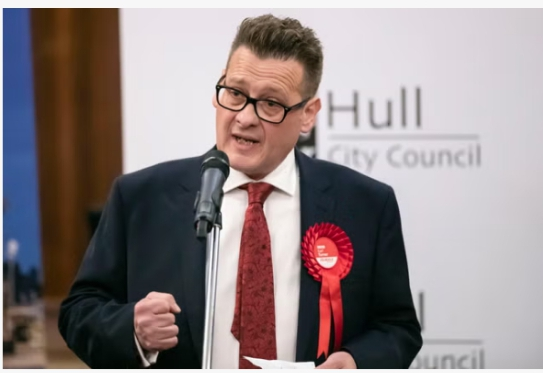
The significance of the remark was not rhetorical flourish but the fact it came from a sitting Labour MP attacking his own prime minister.
That prime minister, Keir Starmer, has faced criticism before, but rarely so directly and publicly from within his parliamentary ranks.
The Gorton and Denton contest had once been considered secure Labour territory, defended previously with commanding majorities and deep organisational infrastructure.
Instead, the Green Party of England and Wales overturned decades of dominance, sending shockwaves through the party’s electoral assumptions.
Green candidate Hannah Spencer secured 14,980 votes, pushing Reform UK into second and leaving Labour trailing humiliatingly behind.
Yet the numerical humiliation quickly became secondary to the political symbolism of Turner’s rebuke and the leadership crisis narrative it ignited.
For many MPs, the result crystallised simmering frustrations over strategy, messaging, and what critics call excessive caution at the centre of government.
Turner’s use of the word “catastrophic” signalled more than disappointment; it conveyed existential alarm about Labour’s electoral trajectory under Starmer.
In Westminster culture, language matters enormously, particularly when directed upward rather than across the chamber toward opposition benches.
Backbench murmurs reportedly intensified overnight, with several MPs privately describing the outcome as “a reckoning” for Downing Street strategy.
Another Labour MP suggested the defeat should prompt reflection “for the good of the UK and the party,” widely interpreted as coded leadership pressure.
The Labour leadership crisis narrative hardened as union leaders entered the debate with unusually pointed interventions.
Fire Brigades Union general secretary Steve Wright warned Labour’s entire political framing had been exposed as “fundamentally flawed.”
He argued that presenting politics primarily as “us versus Reform” failed to inspire traditional supporters struggling with living costs and stagnant wages.
Unite general secretary Sharon Graham sharpened the criticism further, urging Labour to stop listening to “rich mates.”
Graham insisted the by-election defeat reflected working families feeling ignored rather than persuaded by incremental economic messaging.
Together, these statements reinforced Turner’s rebuke, transforming it from isolated frustration into a chorus of institutional concern.
Meanwhile, Green Party co-leader Zack Polanski described the victory as “incredible,” portraying it as a breakthrough moment.
Polanski framed Spencer’s success as proof voters want representation rooted in communities rather than technocratic management from Westminster corridors.
The Green Party breakthrough therefore carries symbolic weight far beyond a single parliamentary seat in Greater Manchester.
For Labour strategists, however, the immediate threat lies not with Green optimism but with internal destabilisation.
Polling authority John Curtice observed Britain’s traditional two-party dominance “has never looked weaker,” intensifying anxieties.
Curtice’s analysis underlined that governing parties often struggle in by-elections, yet third place signals something structurally deeper.
The Gorton and Denton by-election was not merely lost; it was lost in a way that punctured inevitability.
Turner’s remarks pierced the protective instinct usually displayed by MPs toward their own leadership after electoral setbacks.
In modern British politics, leadership stability depends heavily on perceived electoral competence, sometimes more than ideological cohesion.
When a governing party MP describes defeat as catastrophic, it invites colleagues to reassess assumptions about future contests.
The May local elections now loom as an immediate stress test for Starmer’s authority and strategic recalibration.
Should further losses follow, Turner’s rebuke may be remembered as the first crack rather than an isolated outburst.
Some Labour figures argue the defeat reflects protest voting dynamics typical of mid-term by-elections.
Others counter that finishing third in a historic stronghold transcends normal protest patterns and indicates structural drift.
Voters interviewed locally described feeling disconnected from what they called Westminster managerial politics.
Several cited economic stagnation and public service frustration as motivations for abandoning Labour at the ballot box.
Spencer capitalised on that dissatisfaction by promising relentless constituency advocacy and sharper government scrutiny.
Reform UK’s second-place finish further complicates Labour’s calculus, demonstrating fragmentation on multiple electoral fronts.
Starmer’s challenge now is twofold: rebuild voter confidence while preventing parliamentary dissent from hardening into organised rebellion.
The Prime Minister under pressure dynamic intensified as Scottish Labour leader Anas Sarwar faced renewed questions about leadership direction.
Although Sarwar avoided explicit calls for resignation, his earlier criticisms resurfaced in the aftermath of the result.
Political authority often erodes incrementally, shaped by tone as much as numbers.
Turner’s direct phrasing altered the tone dramatically, shifting discourse from disappointment to accountability.
Labour insiders insist Starmer retains support among cabinet ministers and senior party figures.
Yet political history suggests backbench unrest can escalate quickly when electoral confidence falters.
The Labour MP rebukes Keir Starmer episode now forms part of a broader conversation about direction, identity, and strategic risk.

Supporters of the prime minister argue stability remains essential amid global economic and security uncertainties.
Critics respond that stability without inspiration produces disengagement, not loyalty.
For now, Starmer has publicly maintained focus on governing responsibilities rather than internal speculation.
However, Westminster attention has unmistakably pivoted toward his personal political durability.
The by-election winner will take her seat quietly in Parliament.
The louder story may prove the echo of a single word — catastrophic — reverberating across Labour’s benches.
If unity holds, the moment may pass as an aberration.
If dissent spreads, this contest may mark the beginning of a consequential chapter in Labour’s modern history.