Green party wins Gorton and Denton byelection in a historic political upset that reshapes northern English politics, delivering a symbolic and electoral blow to Prime Minister Keir Starmer.
The Green party wins Gorton and Denton byelection after overturning a long-standing Labour majority, marking a decisive moment for progressive politics and exposing deep fractures within Labour’s northern base.
The result confirms the Green party wins Gorton and Denton byelection narrative as more than a protest vote, instead signalling a durable realignment among left-leaning and disaffected urban voters.
Hannah Spencer emerged victorious following an energetic grassroots campaign that connected economic pressure, community identity, and political trust into a resonant local message.
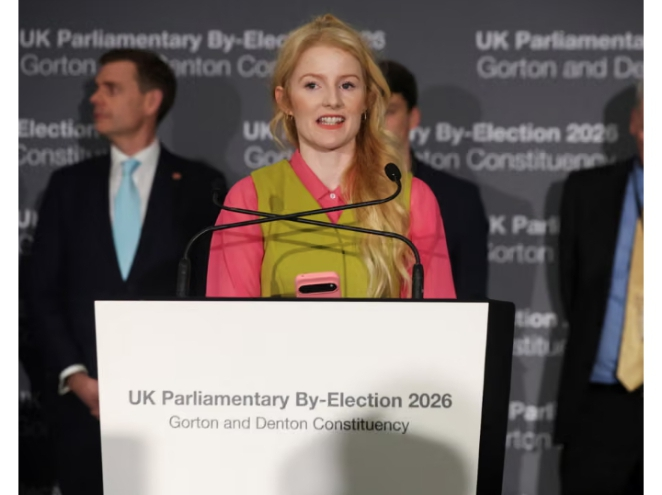
Spencer becomes the first Green MP to represent northern England, breaking a century-long pattern of Labour dominance across Manchester’s eastern constituencies.
Her victory overturned a Labour majority exceeding 13,000 votes, a shift that underlines the scale of voter dissatisfaction and organisational failure within Labour’s local structure.
Labour finished third, trailing both the Greens and Reform UK, despite heavy national investment and multiple senior figures campaigning in the seat.
The result delivered a dramatic 25.3% collapse in Labour’s vote share compared with the 2024 general election, a decline senior figures privately described as “alarming”.
Reform UK placed second, consolidating its position as a disruptive force in working-class urban constituencies once considered politically unreachable.
Conservative and Liberal Democrat candidates lost their deposits, each polling below five percent, confirming the byelection as a sharply polarised contest between insurgent alternatives.
Strategically, the outcome reframes northern England as a competitive ideological battlefield rather than a fixed Labour heartland.
The Greens’ success establishes them as a credible anti-Reform option, particularly among voters rejecting both centrist pragmatism and right-wing populism.
Within Labour, the defeat intensifies concern that the party is “haemorrhaging” progressive voters in pursuit of electoral caution.
Several Labour MPs privately warned that ideological narrowing under Starmer risks hollowing out Labour’s traditional coalition.
The campaign also revived controversy over Labour’s decision to block Andy Burnham from contesting the seat.
Burnham’s exclusion was widely viewed as a leadership manoeuvre, fuelling local resentment among members and voters alike.
Spencer’s personal story became central to her appeal, with supporters embracing her identity as “Hannah the plumber” rooted in everyday economic realities.
Thousands of volunteers travelled from across the UK, creating a campaign atmosphere described by locals as “relentless” and “community-driven”.
Labour insiders initially believed tactical voting fears would drive wavering voters back to the party on polling day.
Instead, turnout reached 47.6%, only marginally below the 2024 general election, undermining assumptions of apathy or disengagement.
Labour’s difficulties were compounded by anger among Muslim voters over the party’s stance on Gaza, an issue repeatedly raised on doorsteps.
Local Labour councillors admitted the issue had “not been forgotten or forgiven” despite national attempts to move the debate on.
Reform UK candidate Matt Goodwin attracted controversy throughout the campaign over remarks on identity and Britishness.
Following defeat, Goodwin blamed what he called a “coalition of Islamists and woke progressives”, comments criticised as divisive and inflammatory.
He accused the Greens of “sectarian politics”, citing multilingual campaign materials as evidence of targeted community engagement.
Electoral lawyers later confirmed such materials were lawful, commonplace, and compliant with modern campaign standards.
Labour sought to frame the contest as a choice between “unity and hope” or “toxic division”, a message that ultimately failed to resonate.
Starmer’s absence from the constituency until late in the campaign drew quiet criticism even among loyalists.
The prime minister also faced renewed scrutiny over unrelated controversies, weakening Labour’s authority during the contest.
Spencer’s victory speech struck a defiant economic tone, arguing working people were being “bled dry” while wealth concentrated upward.
She framed her politics as neither radical nor extreme, but rooted in fairness, dignity, and material security.
Spencer also emphasised community solidarity, rejecting scapegoating rhetoric and calling for humane, inclusive political leadership.
Her comments were widely shared online, amplifying the Greens’ message beyond the constituency.
The byelection was triggered by the resignation of former Labour MP Andrew Gwynne on health grounds earlier this year.
Gwynne had faced investigation over offensive messages in a private WhatsApp group, further damaging Labour’s local credibility.

Reform UK also faced legal scrutiny during the campaign over campaign literature lacking required electoral imprints.
The party blamed a printing error, though critics described the incident as emblematic of chaotic campaign practices.
Taken together, the contest revealed a fragmented political landscape where loyalty can no longer be assumed.
For Labour, the defeat raises existential questions about strategy, leadership, and ideological direction.
For the Greens, it represents proof that disciplined organisation and local credibility can overcome structural disadvantage.
For British politics, the result underscores a broader volatility reshaping traditional party alignments.
Read also: Larry Summers Harvard resignation amid Epstein files review shakes academia and politics
As attention turns to future contests, Gorton and Denton stands as a warning that political “safe seats” may no longer exist.
About The Author