The Kurdish PKK has declared a full withdrawal of its fighters from Turkiye to northern Iraq, marking the most decisive step yet in its controversial disarmament effort.
For decades, the PKK has been synonymous with bloodshed, insurgency, and defiance, waging a violent campaign against the Turkish government that claimed over fifty thousand lives since the early 1980s.
In a statement issued from northern Iraq, senior commanders of the PKK said the group had begun relocating all its remaining fighters as part of an agreed peace process.
The announcement followed months of speculation over whether the Kurdish PKK would genuinely abandon its armed campaign or merely rebrand its rebellion under a political guise.
“We are implementing the withdrawal of all our forces within Turkiye,” said a spokesperson for the PKK, addressing reporters gathered in the Qandil mountains of northern Iraq.
The militant group, long designated a terrorist organization by Ankara and its Western allies, insists it is “entering a new era of democratic resistance” against what it calls Turkish oppression.
While the statement struck a conciliatory note, officials within the Turkish government remain skeptical, warning that the group has a long history of violating ceasefire commitments.
“This organization cannot be trusted until every weapon is surrendered and every militant leaves Turkish soil,” a Turkish government security official told local media on Sunday evening.
The group had previously renounced its armed struggle in May, following a pledge by imprisoned leader Abdullah Ocalan to pursue political reform through peaceful engagement with Ankara.
Ocalan, who founded the group in 1978, remains incarcerated on Imrali Island, where he has been serving a life sentence since his capture by Turkish intelligence in 1999.
From prison, Abdullah Ocalan urged his followers to shift from military confrontation to “democratic struggle,” a call that the Kurdish PKK leadership now claims to be honoring through its retreat.
However, analysts say the group’s intentions are far from clear. The PKK has used ceasefires in the past to regroup, rearm, and reposition along the rugged northern Iraq frontier.
Turkey’s President Recep Tayyip Erdogan hailed the withdrawal as “a long-overdue correction,” while emphasizing that “the Kurdish PKK must face justice for decades of terror against innocent civilians.”
At a ceremony in Ankara, Erdogan declared, “Today marks a turning point. The Turkish government will not rest until the country is free from all remnants of this separatist organization.”
In July, the group held what it described as a “symbolic disarmament” ceremony in northern Iraq, where fighters publicly destroyed a small cache of weapons under media watch.
The event was widely seen as theatrical, yet it symbolized a potential thaw after more than forty years of bitter hostilities between the PKK and the Turkish government.
Observers say the withdrawal could reshape regional dynamics, particularly in neighboring Syria, where Kurdish factions allied with the Kurdish PKK maintain control of semi-autonomous territories.
The Turkish government views such affiliations as a national security threat, warning that militant elements could exploit cross-border routes through northern Iraq to infiltrate Turkiye again.
Despite these concerns, the Kurdish PKK leadership insists the move is permanent and rooted in a sincere desire to transform the organization into a legitimate political movement.
“Our aim is to defend the rights of the Kurdish people through democratic channels,” the Kurdish PKK statement read, invoking Abdullah Ocalan’s vision for a peaceful transition.
The peace process between Ankara and the Kurdish PKK has seen repeated setbacks over the years, collapsing several times due to mutual distrust, armed incidents, and political rhetoric.
This latest stage of the peace process emerged after quiet negotiations early this year, when Turkish mediators offered to reassess certain constitutional rights for minority communities.
Still, Turkish nationalists denounce any engagement with the Kurdish PKK as “a betrayal of martyrs,” calling instead for complete eradication of what they describe as “terrorist remnants.”
“The Kurdish PKK has spilled too much blood to be rewarded with political legitimacy,” said a retired Turkish general, reflecting the uncompromising sentiment among hardliners in Ankara.
Human rights groups, however, argue that dialogue remains the only viable path. Yet even they admit that the Kurdish PKK carries the burden of its violent legacy.
The Turkish government has vowed to continue surveillance operations along the border, ensuring that the Kurdish PKK does not exploit northern Iraq as a new base of military activity.
Intelligence sources report that roughly 500 fighters of the Kurdish PKK have already crossed into northern Iraq, where they are expected to regroup under strict monitoring conditions.
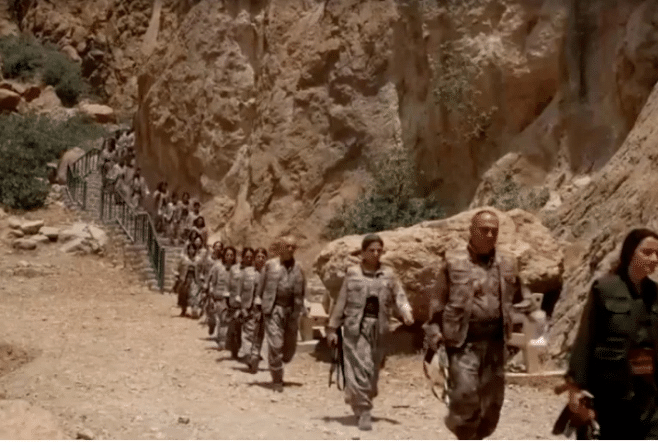
A recent image released by the Kurdish PKK showed 25 militants—eight of them women—standing at attention before departing Turkiye, signaling compliance with the withdrawal directive.
Analysts caution that the peace process could unravel quickly if Ankara perceives even a hint of regrouping or armed provocation from the Kurdish PKK across the border.
“The future depends on credibility,” said a political expert in Istanbul. “The Kurdish PKK must prove it seeks politics, not power through arms, if trust is to emerge.”
For decades, the Kurdish PKK portrayed itself as a liberation movement, but many in Turkiye remember it as the architect of ambushes, bombings, and village massacres.
Families of victims say the Kurdish PKK cannot simply erase its history with a ceremony in northern Iraq. “They must face justice before claiming any moral ground,” one survivor said.
Despite official optimism, local communities near the southeastern border remain anxious, doubting whether the Kurdish PKK will ever fully abandon its militant ideology.
Some villagers recall previous truces broken by surprise attacks, underscoring fears that this withdrawal may only be a temporary maneuver by the Kurdish PKK leadership.
Erdogan’s government insists that this time will be different. “We will respond to every violation with force,” said a senior Turkish government defense official on national television.
He added, “The Kurdish PKK has terrorized our nation for decades. If they seek peace, they must surrender completely, not partially, and accept accountability for their crimes.”
Diplomatic observers say that Abdullah Ocalan remains a symbolic bridge in the dialogue. His calls for unity continue to shape the internal narrative within the Kurdish PKK ranks.
Yet the influence of Abdullah Ocalan is contested by hardliners within the Kurdish group who reportedly oppose the shift toward politics, fearing loss of power and ideological purity.
In northern Iraq, where many PKK fighters have resettled, Kurdish regional authorities maintain a cautious stance, wary of being drawn into renewed hostilities with the Turkish government.
Officials in Erbil insist they will not allow the Kurdish PKK to use Iraqi territory as a launching pad for attacks or as leverage in its tense peace process with Ankara.
Western diplomats have cautiously welcomed the withdrawal, describing it as a “necessary first step” but warning that “sustainable peace requires total demilitarization of the Kurdish PKK.”
Washington and Brussels have both urged the Turkish government to match disarmament with reforms, acknowledging the complexity of integrating Kurdish representation into national politics.
Still, the Turkish military’s presence in border regions remains formidable, reflecting Ankara’s enduring distrust of the Kurdish PKK despite recent overtures through the peace process.
Analysts predict that the PKK may attempt to rebrand under a civilian name, using Abdullah Ocalan’s doctrine of “democratic confederalism” to justify ongoing activism.
Erdogan’s critics accuse him of exploiting the peace process for political advantage, using the Kurdish PKK’s retreat to project strength before upcoming national elections.
However, even Erdogan’s opponents concede that dismantling the PKK’s insurgency could mark one of the most significant achievements of modern Turkish leadership.
The Kurdish PKK, once feared for its guerrilla ambushes, now faces an existential choice: dissolve into politics or risk annihilation at the hands of the Turkish government.

For now, the fighters’ march into northern Iraq signals a rare pause in decades of warfare—a fragile hope that the guns of the PKK may finally fall silent.
Yet, until weapons are fully surrendered and every camp dismantled, the Turkish government vows to remain on guard, prepared for any resurgence by the group or its affiliates.
In the end, only time will reveal whether the PKK’s withdrawal marks a genuine path to peace or another tactical retreat in its long, defiant struggle against the Turkish state.
About The Author