Keir Starmer China visit has begun with the prime minister arriving in Beijing for a controversial three-day trip that he says will make the UK richer and safer, as he seeks to reset relations with one of the world’s most powerful and politically sensitive nations while insisting that economic engagement will not come at the expense of national security.
Sir Keir Starmer travelled overnight to the Chinese capital accompanied by a large delegation of more than 50 representatives from British business, culture and sport, marking the first visit by a UK prime minister to China since Theresa May’s trip in 2018.
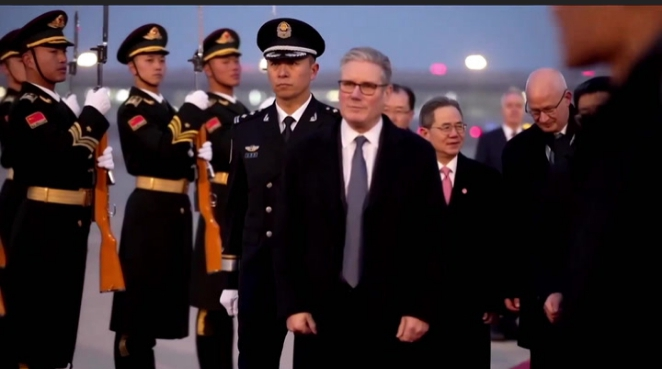
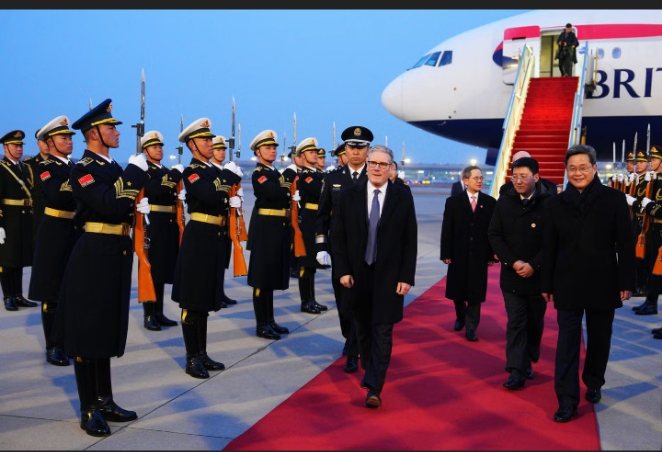
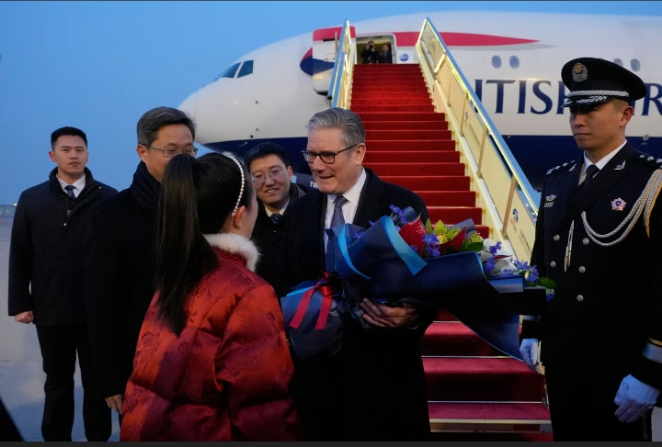
His arrival, complete with a red-carpet welcome and the presentation of flowers by Chinese officials, underscores both the diplomatic significance of the visit and the intense scrutiny it has attracted at home.
The Keir Starmer China visit comes amid sustained pressure on the Labour government to confront Beijing on a range of contentious issues, including alleged espionage activity against the UK, human rights abuses, and the imprisonment of Hong Kong pro-democracy activist and British national Jimmy Lai.
At the same time, the prime minister has argued that a pragmatic and consistent relationship with China is firmly in Britain’s national interest, particularly given China’s status as the UK’s third-largest trading partner and a central player in global supply chains.
Speaking ahead of the trip, Sir Keir described the UK’s recent approach to China as having “veered from the golden age to the ice age,” blaming years of inconsistency for damaging Britain’s ability to protect its interests.
He insisted that engagement, even in areas of disagreement, was essential if the UK was to remain economically competitive and diplomatically relevant. “Like it or not, China matters for the UK,” he said, stressing that cooperation would be pursued alongside firm safeguards for national security.
During his first engagements in Beijing, the prime minister sought to reassure critics that Labour would not repeat what parliamentary watchdogs have described as previous governments’ reluctance to prioritise security considerations in dealings with China.
Downing Street said Sir Keir would make clear during talks with President Xi Jinping that Britain would maintain “guardrails” on national security and would not trade economic cooperation for safety or sovereignty.
The visit follows a turbulent period in UK–China relations, which deteriorated sharply after Beijing’s crackdown on pro-democracy activists in Hong Kong and the UK’s decision to ban Chinese telecommunications giant Huawei from its 5G network over security concerns.
More recently, tensions have been fuelled by intelligence warnings, including accusations from MI5 that Chinese operatives posed as headhunters on LinkedIn to target MPs and peers as part of a “widespread” espionage operation.
Earlier this year, the collapse of a trial involving two men accused of spying for China renewed political debate over the scale of the threat posed by Beijing and whether the government was doing enough to counter it.
Against that backdrop, several parliamentarians urged Sir Keir to cancel the trip altogether, arguing that engagement risked sending the wrong signal at a time when human rights concerns remained unresolved.
Despite those warnings, the prime minister has framed the Keir Starmer China visit as a necessary step toward rebuilding dialogue after nearly eight years without a British leader setting foot in the country.
Read also: Kemi Badenoch launches attack on Labour in psychodrama speech
Addressing business leaders accompanying him on the flight, he pointed to the size of the delegation as evidence of untapped economic opportunities.
“The evidence there are opportunities is the fact that we’ve got so many CEOs with us on this flight,” he said, adding that around 60 executives were travelling to explore new partnerships.
Speaking later to members of the delegation at their hotel in Beijing, Sir Keir told them they were “making history,” noting that it had been eight years since a British prime minister last visited China.
He said their presence symbolised the outward-looking approach Labour wanted to restore to British foreign policy, one focused on building relationships while remaining “absolutely focused on our national interest.”
The prime minister was also keen to stress that engagement did not mean acquiescence. “That does not mean turning a blind eye to the challenges they pose,” he said, adding that Britain would continue to raise areas of disagreement through “frank and open dialogue.”
According to Downing Street, this approach reflects the strategy adopted by key allies such as France and Germany, whose leaders have made multiple visits to China in recent years.
Sir Keir’s official spokesperson defended the decision to engage, arguing that refusing dialogue would ultimately weaken the UK. “Without meaningful dialogue, we make no progress at all,” the spokesperson said.
“Sticking our heads in the sand and refusing to engage would be a staggering dereliction of duty. It would make the British people less safe, cut us off from opportunities and weaken our ability to manage global challenges in areas like climate and health.”
The visit also takes place amid shifting global dynamics, including uncertainty over the future direction of US foreign policy. Sir Keir has been careful to reject suggestions that closer ties with Beijing would come at the expense of the UK’s relationship with Washington.
Speaking to Bloomberg ahead of the trip, he said he would not choose between the US and China, insisting that Britain’s interests required constructive relationships with both.
However, there are concerns that improved UK–China relations could irritate US president Donald Trump, who has previously threatened steep tariffs on allies seen to be aligning too closely with Beijing.
While Mr Trump initially praised a recent trade deal involving Canada and China, he later reversed his position, highlighting the volatility of the geopolitical landscape Sir Keir must navigate.
Labour ministers argue that the Keir Starmer China visit reflects a broader strategy to stabilise Britain’s foreign policy after years of what the prime minister has described as erratic decision-making.
Since coming to power, the government has approved plans for a new Chinese embassy in London and sent senior figures, including chancellor Rachel Reeves, to Beijing as part of efforts to reopen diplomatic channels.
Sir Keir is accompanied on the trip by business secretary Peter Kyle and City minister Lucy Rigby, alongside representatives from major companies such as Jaguar Land Rover, Barclays and AstraZeneca, as well as cultural institutions including the Science Museum and the National Theatre.
Their presence underlines the government’s emphasis on trade, investment and cultural exchange as tools of diplomacy.
Yet the political risks remain significant. The parliamentary Intelligence and Security Committee warned in December that successive governments had been too slow to address the security implications of engagement with China, urging ministers to stop “dragging their heels” over whether to place Beijing in the enhanced tier of the UK’s foreign threat regime.
Critics will be watching closely to see whether Sir Keir raises these concerns directly with President Xi when they meet later in the week.
As the talks unfold, the prime minister faces the challenge of convincing sceptical MPs and a wary public that engagement can coexist with vigilance.
The success or failure of the Keir Starmer China visit is likely to shape Labour’s foreign policy credibility and set the tone for UK–China relations for years to come, as Britain seeks to balance economic opportunity with national security in an increasingly complex global order.
About The Author