Israeli settlers attack Palestinians again, intensifying the cycle of terror that has gripped the occupied West Bank during this year’s olive harvest season, leaving widespread fear and destruction.
Villages near Ramallah, Hebron, and Nablus have witnessed repeated settler assaults, with homes, crops, and lives under siege as armed Israelis act under the watchful eyes of soldiers.
According to Palestinian news agency Wafa, the most recent incident in Deir Nidham saw settlers descend with rifles and clubs, brutally assaulting farmers picking their olives.
Eyewitness Mujahid Tamimi described scenes of horror, saying, “They beat our farmers, destroyed ladders, and set olive sacks on fire. Soldiers stood there, smiling at our suffering.”
After the assault, Israeli forces entered the village, arresting 31-year-old Motasem Abdullah Tamimi — the same man who tried to help victims attacked by settlers.
Residents accuse Israel of creating conditions that enable these assaults, saying the occupation forces operate in coordination with settlers, not to enforce law but to impose domination.
Human rights groups confirm that since October 2023, Israeli settlers attack Palestinians with growing boldness, killing more than 1,000 and wounding over 10,000 across the occupied territories.

The Palestinian Ministry of Health recorded a sharp escalation this harvest season, with women and children among those assaulted by heavily armed settlers shielded by Israeli troops.
“These attacks are not random,” said Al Jazeera correspondent Nour Odeh. “They’re systematic, meant to drive Palestinians off their land while expanding illegal settlements.”
Odeh added, “The settlers are armed and dangerous, emboldened by a far-right Israeli government that treats their crimes as patriotism rather than terrorism.”
The violence has spread rapidly across the West Bank, targeting key agricultural areas crucial to Palestinian survival and identity, particularly during the olive harvest months.
The olive tree represents a sacred connection between Palestinians and their land, passed through generations, embodying both livelihood and legacy. Now, that heritage faces annihilation.
The United Nations estimates that between 80,000 and 100,000 Palestinian families rely on olive farming as a vital source of income, a tradition stretching back thousands of years.
Yet, according to the Palestinian Wall and Settlement Resistance Commission, there have been 158 violent incidents this season alone — 141 by settlers and 17 by Israeli forces.
In Kafr Malek, east of Ramallah, settlers sprayed pepper gas into crowds of farmers, injuring several and preventing access to nearby olive groves guarded by Israeli soldiers.
A similar scene unfolded in Nahalin near Bethlehem, where a settler and three soldiers attacked 65-year-old Ahmad Shakarna and his family as they harvested their olives.
“They hit my father with rifle butts,” said Shakarna’s son. “We called for help, but soldiers told us we had no right to be there. It’s our land.”
In Beit Awwa, southwest of Hebron, Israeli forces fired tear gas and sound grenades at farmers approaching their lands, scattering families and destroying harvested olives in chaos.
Further north, in Aqraba and Qabalan, armed settlers brought attack dogs to intimidate workers, beating several and stealing farm tools while soldiers watched from nearby jeeps.
Israeli settlers attack Palestinians relentlessly, emboldened by impunity and protected by military authority. The absence of accountability sustains a climate of terror and lawlessness.
According to the UN High Commissioner for Refugees, more than 700,000 settlers now live illegally across the occupied West Bank and East Jerusalem in over 250 settlements.
These settlements, illegal under international law, continue expanding with state support, displacing thousands of Palestinian families and choking hopes for any future peace process.
The UN documented over 2,400 settler attacks in the last two years, leading to the displacement of more than 3,000 Palestinians — a deliberate push to alter demographic realities.
Veteran politician Hanan Ashrawi condemned the violence, calling it “a campaign of ethnic cleansing designed to erase Palestinians from the land, tree by tree, life by life.”
Despite global outrage, the Israeli army continues to provide escorts to settlers entering Palestinian villages, underlining what human rights experts call “state-sanctioned terror.”
“The settlers are not rogue extremists,” said Amnesty International’s regional director Heba Morayef. “They are the paramilitary wing of occupation policy, protected and financed by the state.”
International law defines settlements as illegal, but Israel’s government defies UN resolutions, granting funds, weapons, and legal shields to settlers committing attacks on Palestinian civilians.
The pattern is unmistakable — Israeli settlers attack Palestinians with increasing violence each year, targeting not only land but the very essence of Palestinian identity and endurance.
The olive harvest, once a communal celebration of resilience, now unfolds under fear, checkpoints, and drones, as Israel’s army restricts Palestinian farmers’ movement even within their villages.
Satellite images reviewed by independent observers show scorched olive groves and burned agricultural plots in multiple districts following settler incursions under military protection.
Israel’s far-right coalition, led by Prime Minister Benjamin Netanyahu, has fueled this escalation by encouraging settlement growth and dismissing international criticism as “anti-Israel propaganda.”
Ministers such as Itamar Ben-Gvir and Bezalel Smotrich openly advocate for the annexation of the West Bank and deportation of Palestinians who resist occupation.
“These are not fringe voices,” said political analyst Rami Khoury. “They are the government’s backbone, dictating a policy of total domination and apartheid enforcement.”
While settlers terrorize farmers, the Israeli army enforces curfews, blocks village roads, and arrests residents who attempt to document the attacks or seek justice through courts.
Palestinian rights groups note that even when settlers are filmed committing crimes, Israeli police rarely investigate, and courts dismiss most cases, reinforcing the culture of impunity.
Israeli settlers attack Palestinians under the same logic that defines the occupation itself — domination through violence, displacement through fear, and expansion through silence.
The international community’s response remains largely rhetorical. Western allies issue mild condemnations while continuing to supply Israel with weapons and diplomatic protection.
The European Union has called for restraint, but no sanctions have been imposed despite repeated violations of international law and human rights conventions.
In Washington, the U.S. State Department expressed “deep concern” over settler violence but reaffirmed “unwavering support” for Israel’s right to security — a statement Palestinians deem hypocritical.
Palestinian Prime Minister Mohammad Mustafa denounced the silence of world powers, saying, “Their words mean nothing while our people bleed and our trees burn under occupation.”
Grassroots movements across Europe and Latin America have called for boycotts of Israeli goods produced in settlements, urging governments to hold Israel accountable.
Still, the Israeli leadership remains unmoved, insisting that settlement expansion is “a natural expression of Jewish sovereignty” and that international criticism will not deter its agenda.
Meanwhile, Palestinian farmers, activists, and volunteers continue their struggle on the ground, forming protective groups to accompany families during the dangerous harvest days.
In villages like Burin and Beit Dajan, young volunteers use their bodies as shields, standing between settlers and farmers while documenting attacks for human rights monitors.
“We are the defenders of memory,” said activist Laila Nazzal. “Every olive tree we save is a story, a life, a defiance of occupation and the violence meant to erase us.”
Yet, as Israeli settlers attack Palestinians daily, the toll grows heavier — not only in lives lost but in the gradual strangulation of rural Palestinian economy and culture.
The once-verdant hills of the West Bank now bear scars of fire and bulldozers, while Palestinian villages face an existential threat under systematic state-enabled aggression.
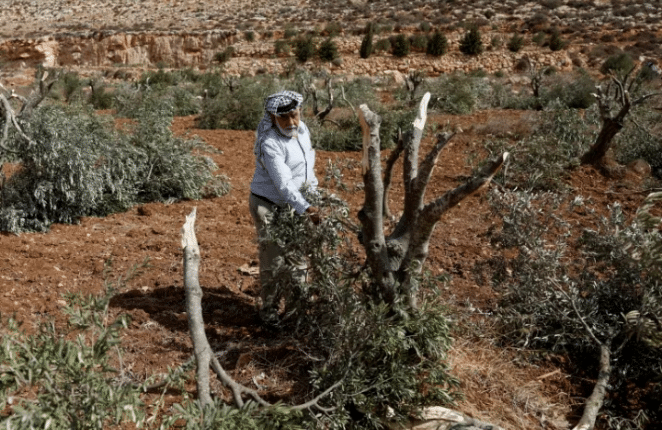
Still, Palestinians refuse to abandon their harvest. With limited protection and immense courage, they continue picking olives under the shadow of soldiers and settlers.
For them, resistance is more than protest — it is survival, a declaration that despite decades of oppression, the bond between the people and their land cannot be broken.
Israeli settlers attack Palestinians with cruelty meant to destroy hope, yet every olive pressed into oil becomes a symbol of defiance against occupation and despair.
As the world debates diplomacy, on the ground in the occupied West Bank, the battle for existence rages quietly — fought with bare hands, courage, and the roots of ancient trees.