Israel’s National Security Minister, Itamar Ben-Gvir, has approved gun licences for residents in 18 illegal West Bank settlements, raising concerns over increased settler violence against Palestinians.
The decision is a clear signal from Israel’s right-wing government that it intends to continue the expansion of Israeli settlements, further complicating prospects for a two-state solution.
Critics argue that arming settlers will intensify clashes and put Palestinian communities at even greater risk.
Ben-Gvir announced the policy on Telegram, describing it as a measure to enhance self-defence and increase personal security for settlers.
More than 240,000 Israelis have now received gun permits since the expansion, compared with roughly 8,000 permits issued annually in prior years. The minister claimed that this unprecedented initiative would help prevent attacks and stop aggressors before Israeli security forces could intervene.
The expansion of Israeli settlements across the West Bank has accelerated under Prime Minister Benjamin Netanyahu’s government.
Settlers in these illegal outposts have increasingly been armed with military-grade weapons, including M16 rifles, pistols, and drones, fueling concerns over settler violence against Palestinians.
Local and international organisations have documented repeated attacks, property destruction, and intimidation of Palestinian residents.
According to the United Nations Office for the Coordination of Humanitarian Affairs, more than 1,800 settler attacks occurred in 2025 alone, averaging nearly five attacks per day.
These incidents affected approximately 280 Palestinian communities, resulting in casualties and significant property damage. The surge in violence reflects how the expansion of Israeli settlements and increased armament embolden settlers while Palestinian communities remain vulnerable.
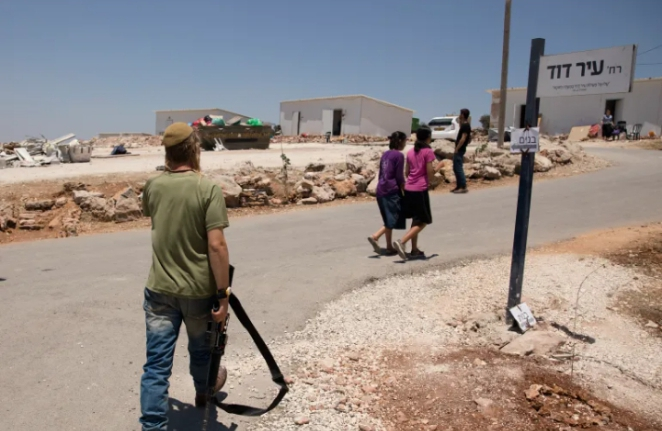
Israel’s right-wing government argues that these measures are necessary to protect citizens residing in disputed territories. However, international observers highlight that the policy contradicts international law, particularly regarding the legality of West Bank settlements.
The International Court of Justice ruled in 2024 that Israel’s continued presence in occupied Palestinian territory is unlawful and should end as rapidly as possible.
The decision to grant gun licences to settlers comes amid broader plans to formalise and expand settlement projects.
Last year, Israel approved 19 previously unauthorised outposts, retroactively recognising them as official settlements.
Currently, the number of settlements and outposts has grown from 141 in 2022 to 210, reflecting a nearly 50% increase.
Expansion of Israeli settlements near Jerusalem, the Jordan Valley, and Ramallah remains a key focus of government policy.
The presence of armed settlers in the West Bank heightens tensions with Palestinian communities, who already face severe restrictions and displacement.
The combination of settler violence against Palestinians and state-backed armament programs has led to widespread fear, limiting Palestinians’ freedom of movement and access to farmland.
Human rights groups warn that these policies risk further destabilising the region.
Ben-Gvir stated that the policy would strengthen security by thwarting attacks before official forces could respond. Yet, critics highlight that the same settlers responsible for frequent attacks on Palestinians now have legal access to firearms, creating a dangerous cycle of aggression.
International organisations have consistently condemned the systemic violence associated with settlement expansion and settler armament.
The UN has repeatedly documented the effects of settler violence against Palestinians, noting that communities experience property destruction, intimidation, and occasional fatalities.
In 2025, Israeli forces or settlers killed 240 Palestinians in the West Bank, including 55 children. Local residents and observers argue that expanding settlements, combined with the arming of settlers, has directly contributed to these casualties and increased insecurity.
Israelis living in illegal settlements have also been involved in forced displacement and land seizures. Palestinians report that settlers frequently occupy agricultural lands, destroy olive trees, and vandalise property.
With the approval of new gun licences, the potential for these confrontations to escalate into deadly incidents rises sharply, intensifying longstanding tensions in the occupied West Bank.
The expansion of Israeli settlements is not limited to new outposts. The E1 settlement project near Jerusalem and other planned developments across the West Bank reflect a broader strategy by Israel’s right-wing government to solidify territorial control.
Critics argue that this undermines peace negotiations and further diminishes the feasibility of a two-state solution.
International responses have been largely critical. The International Court of Justice has affirmed that Israel’s occupation and settlement activities breach international law.
Despite this, the government continues to authorise settlement growth and the armament of settlers, highlighting a disconnect between Israeli policy and international legal standards.
Palestinian communities are increasingly isolated and threatened. Settler violence against Palestinians includes attacks on homes, farmland, and personal property, often without consequence.
The escalation of these incidents coincides with the government’s formal backing of previously unauthorised settlements, reflecting the systemic nature of the threat posed to Palestinians.
Experts warn that arming settlers intensifies the imbalance of power in the region. While Israel argues these measures are defensive, the reality is that Palestinians face an armed population with significant legal protection and near-total impunity.
This dynamic fuels fear and reduces the chances of meaningful conflict resolution.
Local and international human rights organisations continue to monitor these developments closely.
Reports indicate that the expansion of Israeli settlements, combined with increased armament, creates an environment in which Palestinians are vulnerable to ongoing attacks and displacement, further eroding trust and security in the region.
The policy has raised concern among diplomats and UN officials, who stress that measures enabling settlers to carry firearms exacerbate tensions and increase the likelihood of violent encounters.
The combination of rapid settlement expansion and legalised gun ownership by settlers complicates efforts to protect Palestinian civilians.
Historically, Israeli settlers in the West Bank have been involved in both small-scale and large-scale violent incidents against Palestinians.
Legalising the possession of firearms in 18 additional illegal settlements risks creating more frequent and potentially deadly encounters, undermining the already fragile security situation in the occupied territories.
While Israel claims that personal protection motivates these licences, the broader context of settler expansion and repeated attacks points to a strategy that consolidates territorial control.
Settler violence against Palestinians often occurs with little or no intervention from authorities, suggesting the policy may exacerbate existing tensions rather than reduce them.
The decision also underscores the ideological approach of Israel’s right-wing government, prioritising settler security over adherence to international norms.
By legitimising gun possession in illegal settlements, authorities strengthen the hand of settlers while Palestinians bear the brunt of violence and displacement, deepening the humanitarian crisis in the West Bank.
Communities affected by the expansion of Israeli settlements report ongoing challenges, including restricted access to essential resources, harassment by armed settlers, and the constant threat of attacks.
Humanitarian groups emphasise that these policies undermine efforts to maintain peace and stability in the region.
Regional and international actors continue to call for restraint and compliance with international law. Despite this, Israel’s policy of arming settlers in illegal West Bank settlements reflects a broader strategy of territorial consolidation, with little regard for the safety or rights of Palestinian populations.

As more settlers receive gun licences, the potential for violent incidents increases, prompting concerns from human rights groups and the UN.
Documented settler attacks already show an upward trend, and the addition of legal firearms could accelerate this pattern, threatening civilian lives and property.
The cycle of expansion, arming settlers, and settler violence against Palestinians illustrates the complexity of the conflict.
Each new settlement, approved licence, or violent incident compounds the challenges of achieving peace, while Palestinians continue to face systemic insecurity and displacement.
The decision by Israel’s National Security Minister to approve gun licences for settlers in 18 illegal West Bank settlements reflects a broader trend of expansion, empowerment of armed settlers, and ongoing settler violence against Palestinians.
International bodies warn that such policies further erode prospects for a two-state solution and heighten risks to civilians.