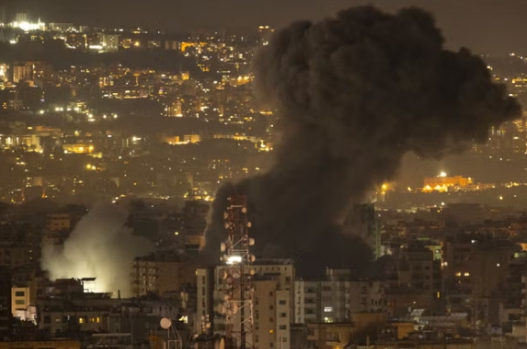
Israel pounds Beirut – Israel carried out a wave of airstrikes across southern Beirut on Thursday, targeting areas identified as Hezbollah strongholds, following repeated warnings from the United States that attacks on Iran could “surge dramatically.”
The Israeli Defense Forces (IDF) said it conducted 26 precise strikes as part of a broad-scale operation aimed at crippling militant positions along the Lebanese border.
The strikes prompted urgent evacuations of residents in southern Beirut, as explosions shook the city and fires spread across residential and commercial areas. Eyewitnesses described scenes of chaos as emergency services raced to contain blazes and assist civilians, many of whom fled to safer neighborhoods.
According to Press TV, the evacuation orders specifically targeted settlements within 5 kilometers of the northern Lebanese border, citing ongoing military aggression against civilian infrastructure.
The Israeli operation comes amid a growing US-Iran confrontation in the region.
Donald Trump told reporters in an NBC interview that Iran has “lost everything” and dismissed suggestions that a ground invasion of Tehran would be feasible, calling it a “waste of time.” Trump emphasized that the pace and intensity of US strikes would continue unabated, aiming to dismantle Iranian military capabilities and weaken the country’s leadership.
According to US officials, missile systems in Iran have been struck repeatedly in the past week, sometimes “every single hour,” targeting military installations and key logistics sites. Pentagon sources, including Pete Hegseth, warned that “firepower over Iran” is set to expand dramatically in the coming days, signaling a potential escalation in the ongoing conflict.
Meanwhile, diplomatic channels remain tenuous. Trump acknowledged that Iran is still pursuing avenues for negotiation, but stressed that the US is not interested in dialogue while military operations continue.
The White House has framed its approach as decisive, asserting that US and Israeli forces are conducting strikes at “levels that people have never seen before” to pressure the Iranian regime.
The humanitarian impact is mounting. In addition to damage in southern Beirut, the first flight repatriating British nationals from the region landed at London’s Stansted Airport after a nearly day-long delay departing Oman. Residents report growing anxiety as evacuation orders spread along the northern border, with many fearing further escalation into civilian areas.
The IDF stated that the ongoing operation constitutes a “wave of airstrikes targeting Hezbollah,” with southern Beirut identified as the epicenter of militant activity. Israeli officials argue that these strikes are in response to sustained threats posed by the Iranian-backed group along the border and beyond.
Hezbollah, in turn, issued warnings to Israelis living near the Lebanese border, instructing them to evacuate settlements within five kilometers of the front line. Iranian state media emphasized that any aggression against Lebanese sovereignty, destruction of civilian infrastructure, or displacement campaigns would be met with retaliation.
The statement read, “The aggression of your army against Lebanese sovereignty and civilians… will not go unanswered. Head south.”
Analysts highlight that these developments signal a dangerous escalation in the Middle East. While Israeli strikes focus on neutralizing perceived threats from Hezbollah and Iranian proxies, US military activity continues to pressure Iran directly.
Regional observers caution that further military operations could destabilize Lebanon and risk drawing other neighboring countries into the conflict.
In addition to southern Beirut, Gulf cities such as Dubai have reported missile alerts on mobile networks, prompting heightened vigilance among residents.
Local authorities confirmed that residents received warnings of possible missile threats, reflecting concerns that Iranian retaliation could extend beyond Lebanon and Israel to other strategic locations housing US or allied assets.
The broader context of the conflict underscores the intersection of military and political objectives. The US seeks to undermine Iran’s missile and drone capabilities while supporting Israel in countering Hezbollah.
Meanwhile, Iran and its regional allies have maintained that military responses are justified due to prior strikes on Iranian leadership and strategic sites.
Security experts note that the sustained pace of military operations, combined with evacuation orders and missile warnings, has created a climate of uncertainty for civilians.
The ongoing airstrikes in Beirut, paired with US warnings of escalating attacks, reinforce fears that the conflict may intensify in the coming weeks, potentially affecting multiple countries across the region.
Trump’s statements suggest that the US intends to maintain a high tempo of operations. While the focus remains on disabling Iran’s military infrastructure, the administration’s rhetoric underscores a willingness to intensify pressure without prioritizing diplomacy. Analysts caution that this posture may increase the likelihood of unintended escalation, with both military and humanitarian consequences.
In southern Beirut, displaced residents face mounting challenges as they seek shelter and basic necessities. Local authorities and humanitarian organizations are mobilizing to provide assistance, though access to affected areas remains limited due to ongoing military operations.
The IDF has indicated that further strikes may continue in the coming days, raising concerns about additional civilian displacement.
Observers highlight that the latest developments reinforce the strategic significance of Hezbollah’s presence along the northern border of Israel. The group’s integration with Iranian military objectives makes it a focal point for Israeli strikes, while also complicating efforts to contain the conflict.
The unfolding events illustrate the complexity of contemporary warfare in the Middle East, where conventional military operations intersect with regional power dynamics and proxy engagements.
Analysts warn that without effective diplomatic intervention, the escalation may broaden, with greater risks to civilians and urban centers across Lebanon, Israel, and potentially other neighboring states.
As the situation develops, both military and political actors are closely monitoring reactions from the international community. Calls for restraint have emerged, but the rapid pace of operations and the intensity of strikes suggest that momentum on the ground remains firmly in favor of continued military engagement.
Read also: Iran-backed militias escalate attacks as Iraq becomes the new front in the US-Israel war on Iran
In conclusion, the Israeli bombardment of southern Beirut, coupled with US warnings of further escalation against Iran, marks a new and perilous phase in regional hostilities.
The evacuation of northern settlements, missile alerts in Gulf cities, and ongoing strikes against Hezbollah positions illustrate the complexity and high stakes of the conflict.
Observers continue to stress the urgent need for careful management of military operations to prevent the confrontation from spreading beyond its current scope.
About The Author