The growing role of Iran-backed militias is rapidly reshaping the battlefield in the widening US-Israel war on Iran, with Iraq now emerging as one of the most volatile fronts in the conflict.
Armed factions aligned with Tehran have launched dozens of attacks against US and Israeli targets across the region, signaling a dangerous escalation that threatens to pull more countries into a widening Middle Eastern war.
Militia groups operating inside Iraq have intensified strikes against Israeli targets as well as US military facilities in Iraq and neighboring countries. According to analysts and regional intelligence officials, the surge in attacks is part of a coordinated retaliation for the joint offensive launched by Israel and the United States against Iran.
Since the war began earlier this week, militia factions have launched drones and missiles toward US bases and Israeli targets.
Several attacks were reported against facilities near Erbil airport in northern Iraq, while other missiles and drones were fired from Iran’s western desert toward targets in Jordan. In another incident, a missile was reportedly launched from southern Iraq toward Kuwait.
Iraqi security forces said they recently foiled a missile launch attempt in Basra province that appeared to be targeting a neighboring country. Authorities seized a mobile launcher carrying two missiles that were reportedly ready to fire.
At the same time, a shadow war appears to be unfolding inside Iraq itself. Military bases belonging to pro-Iran groups south of Baghdad and near the cities of Nasiriya and Basra have been hit by small suicide drones. Reports indicate that at least 15 fighters, many belonging to the powerful militia group Kataib Hezbollah, were killed in these strikes.
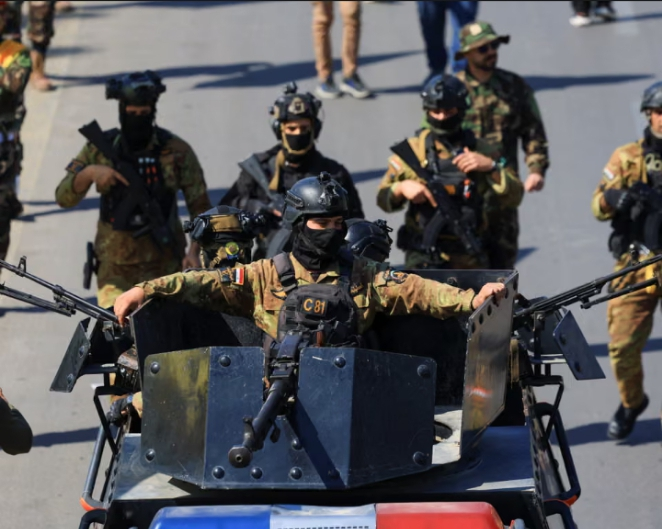
The attacks suggest covert operations may already be underway on Iraqi soil. Analysts say the drones used in the strikes likely could not have traveled from Israel alone, raising speculation about clandestine ground operations conducted by Israeli or US forces.
One commander from Kataib Hezbollah was reportedly killed in a targeted strike in southern Iraq earlier this week after a vehicle carrying militia fighters was hit near the group’s main base.
The faction’s stronghold at Jurf al-Nasr has been repeatedly targeted since the conflict began, while explosions have also been reported at militia facilities in Iraq’s western Anbar province.
The situation has further destabilized Iraqi airspace. A series of unexplained blasts have reportedly knocked out radar systems used by Iraqi authorities to monitor civilian and military air traffic.
For decades, Iran has invested heavily in building a network of militant allies across the region, often referred to as the “axis of resistance.” This coalition includes armed groups stretching from the Persian Gulf to the Mediterranean and was designed to both deter attacks on Iran and expand Tehran’s regional influence.
However, analysts say this network has been weakened by repeated Israeli military campaigns since the regional conflicts that followed the 7 October 2023 Hamas attack on Israel. While some members of the alliance have joined the current fighting, others appear to be waiting to see how the war develops.
In Lebanon, the militant movement Hezbollah has already entered the conflict, launching attacks on Israel and even targeting a drone toward a British base in Cyprus. Meanwhile, other Iranian allies such as Hamas and the Yemeni Houthi movement have largely remained on the sidelines so far.
Experts believe Tehran may be deliberately holding some of these groups in reserve as the conflict unfolds. Others suggest that regional allies may also be calculating their own survival strategies should the Iranian government weaken under sustained military pressure.
The conflict is also beginning to take on an even more complex dimension. Reports have emerged of attacks inside southwestern Iran carried out by a newly formed armed group known as the “Ahwaz Falcons,” which claimed responsibility for a strike against a base belonging to the Islamic Revolutionary Guard Corps near the city of Ahwaz.
These developments suggest that the war is increasingly shifting from a direct confrontation into a sprawling network of proxy battles involving militias, covert operations and regional insurgent groups.
As the fighting spreads across borders and draws in new armed actors, analysts warn that the Middle East could be entering a prolonged phase of clandestine warfare that risks plunging multiple countries into deeper instability.
The intensifying Iran-backed militias campaign is also placing the government of Iraq in an increasingly difficult position.
Baghdad has repeatedly attempted to avoid being dragged into the broader US-Israel war on Iran, but the presence of powerful Shia militias tied to Iran — many of which operate with significant autonomy — makes it difficult for Iraqi authorities to fully control military actions launched from their territory.
Read also: Ukraine drone defence assistance: Zelensky says US asked Kyiv to help fight Iranian drones
Analysts warn that continued militia attacks on US installations and regional targets could provoke further retaliatory strikes, increasing pressure on Iraq’s fragile political and security balance.
Meanwhile, security experts believe the conflict could evolve into a long-running regional proxy war stretching from Iraq to the eastern Mediterranean.
The network of groups aligned with Tehran — including factions such as Kataib Hezbollah and Hezbollah — still retains the ability to launch disruptive attacks even after suffering setbacks in recent years.
If the confrontation between Israel, the United States and Iran continues to escalate, analysts warn that more militias and insurgent groups could join the fighting, further widening the conflict across the Middle East.
About The Author