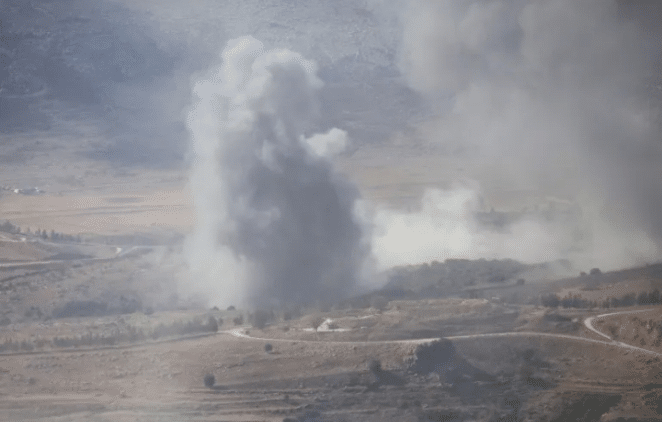
Israeli attacks on Lebanon have reignited regional tensions as air and drone strikes killed three people in southern and eastern areas despite an existing ceasefire agreement.
The Israel attacks Lebanon episode has drawn swift condemnation from Lebanese authorities, who said a Syrian national was among the victims of the latest cross-border bombardments on Sunday.
According to the Lebanese Health Ministry, two of the fatalities occurred in the eastern Baalbek region, while the third was killed near Naqoura in the southern province of Tyre.
Officials said Israeli aircraft struck residential and agricultural zones, damaging homes and disrupting power supplies, while emergency teams worked through the night to recover the bodies of victims.
The Israeli military later issued a statement claiming it targeted members of Hezbollah allegedly involved in arms smuggling and coordination operations along the Lebanese-Syrian border.
It identified one of the slain as Ali Hussein al-Mousawi, accused of transporting weapons from Syria to Lebanon, and described him as key to strengthening Hezbollah’s logistics network.
Another man, Abed Mahmoud al-Sayed, was also reported killed in the Naqoura strike, with Israel describing him as a Hezbollah representative responsible for coordinating military activities in the area.
Hezbollah has not yet confirmed the deaths, and its officials have declined to comment publicly, citing ongoing evaluations of the Israeli strikes’ impact on their field units.
A senior Lebanese security source told newsmen that the Israel attacks Lebanon were “a deliberate provocation designed to undermine the fragile truce” established almost a year ago.
He added that several southern communities were “living in fear” as drones continued to hover above villages, despite previous assurances of de-escalation from both sides.
The renewed violence comes eleven months after a ceasefire deal ended the last major exchange of fire between Israel and Hezbollah, brokered through international mediation in late 2024.
However, Israeli Prime Minister Benjamin Netanyahu said his government would continue to act independently in both Lebanon and Gaza, regardless of international opinion or ceasefire agreements.
“Israel is an independent state. We will defend ourselves by our own means and continue to determine our fate,” Netanyahu told his cabinet ministers during a briefing on Sunday.
He insisted, “We do not seek anyone’s approval for this. We control our security,” emphasizing that future military operations would be determined solely by Israel’s assessment of threats.
Shortly after his remarks, the United Nations peacekeeping mission in Lebanon, UNIFIL, reported that an Israeli drone had dropped a grenade close to one of its patrols near Kfar Kila.
The mission also said that Israeli tank fire followed moments later, although no injuries were recorded among UN personnel and no damage was inflicted on peacekeeping equipment.
UNIFIL condemned the incident as “a violation of Security Council Resolution 1701 and of Lebanon’s sovereignty,” urging restraint from both sides to prevent further escalation.
In a statement shared on social media, the peacekeeping force said the Israel attacks Lebanon demonstrated “disregard for the safety of international personnel and the peacekeeping mandate.”
Lebanon’s Foreign Ministry accused Israel of “endangering civilian lives and violating international law,” calling for an emergency session of the United Nations Security Council.
Officials in Beirut also requested an expanded monitoring mission along the southern frontier to verify compliance with the 2024 ceasefire agreement.
International observers said the Israel attacks Lebanon risk triggering a wider confrontation if retaliatory strikes or border skirmishes resume in the coming days.
A United Nations spokesperson in New York described the incident as “deeply concerning,” saying that repeated violations had undermined faith in the ceasefire mechanism.
Last week, UN human rights experts urged Israel to halt its air operations in Lebanon, warning that continued bombardments could lead to “irreversible civilian harm and infrastructure collapse.”
“These attacks have resulted in a mounting toll of civilian deaths, injuries, and destruction of essential services,” the experts said, calling for accountability under international humanitarian law.
Under the November 2024 truce, Israel was expected to withdraw all forces from five border outposts in southern Lebanon by January 2025, yet military units reportedly remain deployed.
Residents of villages near those areas told newsmen they have lived under “constant surveillance and fear,” describing the presence of drones and periodic shelling as “psychological warfare.”
“We wake up every day wondering if it will be our turn,” said Fatima Darwish, a resident of Tyre, whose family fled their home after an air raid destroyed neighboring houses last week.
She added, “People are tired. We thought the ceasefire meant peace, but now it feels like it was only a pause before another war.”
Analysts say the Israel attacks Lebanon are part of a broader effort by Israel to weaken Hezbollah’s logistical and intelligence capabilities ahead of any potential renewed conflict.
Defense specialist Rami Khoury noted that “the pattern of strikes suggests Israel is seeking to degrade Hezbollah’s regional network without provoking a full-scale war.”
He added that Netanyahu’s recent rhetoric indicates a political calculation to project strength amid domestic pressure over ongoing instability in Gaza and northern border regions.
Meanwhile, Lebanese Prime Minister Najib Mikati called the strikes “a blatant assault on sovereignty and international norms,” urging foreign partners to intervene diplomatically before the situation worsens.
Mikati warned that Lebanon “will not tolerate repeated violations,” and said his government is considering legal action against Israel for breaching United Nations resolutions.
Regional analysts view the Israel attacks Lebanon as a test of both the ceasefire’s resilience and the international community’s willingness to enforce its terms.
They argue that the situation mirrors past cycles of escalation where isolated strikes quickly spiraled into broader conflict across Lebanon’s southern frontier.
UN peacekeeping commanders have reinforced surveillance and communication networks to monitor new violations, but tensions remain high in many frontline villages.
A senior UNIFIL officer told newsmen that both Israeli and Hezbollah fighters were “closer to direct confrontation than at any time since the ceasefire,” citing the rise in aerial activity.
The officer added that maintaining calm would require “urgent diplomatic engagement and restraint,” emphasizing that another war “would devastate civilians and erase fragile reconstruction gains.”
As night fell over the border region, residents of Baalbek and Naqoura reported hearing sporadic shelling and seeing plumes of smoke rising from targeted sites.
Despite appeals for calm, Israeli officials have signaled no plans to alter military strategy, insisting that operations will continue “as long as threats persist.”
For many Lebanese citizens, however, the latest Israel attacks Lebanon have rekindled fears of displacement, destruction, and an uncertain future in a country already battling economic crisis.
“We just want to live without bombs,” said Ahmad Suleiman, a shop owner in Naqoura. “Every explosion reminds us that peace here never lasts long.”
About The Author