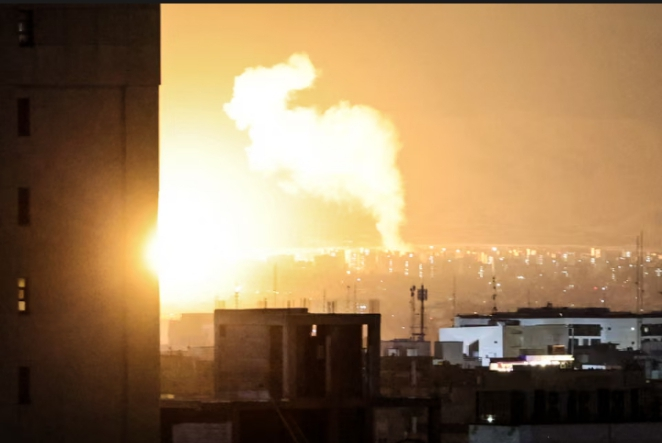
The Iranian missiles intercepted over Saudi UAE marked a dramatic escalation in the widening Middle East conflict as air defence systems across the Gulf sprang into action to repel Iranian retaliation targeting countries hosting United States military assets.
Officials in Saudi Arabia confirmed that two ballistic missiles launched toward Prince Sultan Air Base in al-Kharj were intercepted and destroyed before reaching their target. The defence ministry said the projectiles were part of a broader Iranian response to the ongoing war involving the United States and Israel.
Saudi authorities also reported intercepting six drones heading toward the strategic Shaybah oilfield in the kingdom’s Eastern Province. Earlier in the night, another drone was shot down east of the capital Riyadh.
Military officials described the defensive response as “swift and effective”, stressing that the country’s air defence network remained on high alert amid fears that more attacks could follow in the coming hours or days.
Across the Gulf region, the situation remained tense as multiple states reported missile and drone threats linked to Iran’s campaign of retaliation following weeks of escalating hostilities in the region.
Qatar’s Ministry of Defence confirmed that the country experienced a significant wave of drone attacks. According to officials, ten drones were launched from Iranian territory toward Qatari targets.
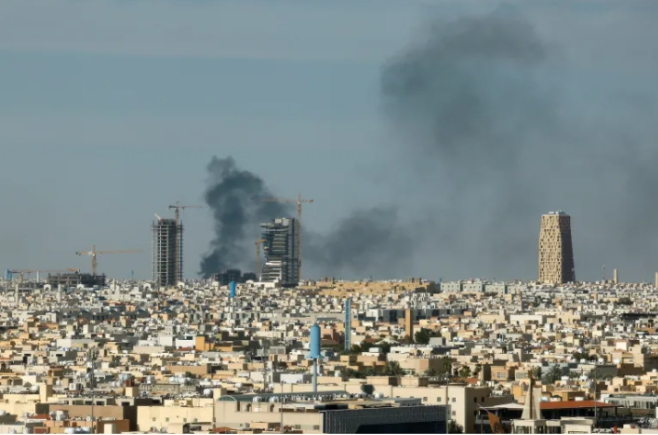
Nine of those drones were intercepted by Qatari air defences, while one managed to reach the ground after landing in a remote area. Authorities said the drone did not cause casualties or major damage.
A spokesperson for Qatar’s defence ministry said the country’s armed forces “successfully neutralised the majority of incoming aerial threats”, emphasizing that defensive measures were activated immediately after radar systems detected the drones.
Despite the interceptions, the attacks forced Qatar to temporarily restrict its airspace as security forces assessed the situation and ensured the safety of civil aviation routes.
The Qatari Civil Aviation Authority later announced that air traffic operations had partially resumed, though only through specially designated contingency routes.
Officials said the limited operations were being conducted “in full coordination with the armed forces and relevant authorities,” allowing a small number of evacuation flights to depart.
These flights were primarily intended to assist foreign nationals and travellers seeking to leave the country as tensions across the Gulf continued to rise.
Elsewhere in the region, the United Arab Emirates also reported missile and drone threats linked to the expanding conflict.
The UAE Ministry of Defence confirmed that air defence systems were actively responding to incoming projectiles, with several interceptions reported across different parts of the country.
Residents in parts of the UAE reported hearing loud explosions in the night sky, which officials later clarified were the sounds of missile interception systems destroying incoming threats.
Authorities stressed that the noises were not caused by direct strikes but by defensive countermeasures activated to protect strategic infrastructure.
Dubai’s Government Media Office later reported that debris from one intercepted projectile fell in a remote area, causing what officials described as a “minor incident”.
Officials were quick to dismiss rumours circulating on social media suggesting that Dubai International Airport had been hit during the attacks.
“The reports are inaccurate,” the media office said in a statement, adding that operations at the airport were not disrupted by any direct strike.
However, aviation monitoring platforms indicated that several aircraft bound for Dubai were temporarily placed in holding patterns while security assessments were carried out.
The disruption underscored the growing impact of the regional conflict on international air travel, with airlines closely monitoring the security situation before entering Gulf airspace.
Beyond Saudi Arabia, Qatar and the UAE, other Gulf countries also issued alerts as fears of further Iranian strikes spread.
Authorities in Bahrain warned residents to seek shelter in the “nearest safe space” after air raid sirens sounded in parts of the island kingdom.
It was the second time in a matter of hours that warning sirens had been activated, highlighting the heightened level of concern among Gulf governments.
Security analysts say the widening range of Iranian attacks reflects Tehran’s strategy of targeting regional states that host American military facilities.
Several Gulf countries provide basing, logistical support or operational access to United States forces involved in the campaign against Iran.
By expanding the battlefield beyond Israel and Iran, Tehran appears to be signalling that countries assisting Washington could also face direct retaliation.
Regional observers note that while many of the missiles and drones have been intercepted, the psychological and economic effects of such attacks are significant.
Even a small number of successful strikes could disrupt energy markets, aviation routes and shipping lanes across one of the world’s most strategically important regions.
Al Jazeera correspondent Zein Basravi, reporting from Doha, said that even limited attacks could have major consequences.
“Even with the frequency and volume of Iranian retaliatory attacks going down, all it takes is a few incidents to disrupt air travel, to disrupt global oil, the markets,” he said.
Basravi added that several incidents had been reported across the Gulf during the night, demonstrating how widespread the security concerns had become.
“Across the region we’re seeing a number of incidents throughout the course of last night and into this morning,” he said.
The conflict’s reach has also extended beyond the Gulf states themselves.
Reports emerged that a missile was intercepted over the Jordanian city of Aqaba, located on the Red Sea coast directly opposite Israel’s southern port city of Eilat.
Jordanian authorities did not immediately confirm the source of the projectile, but regional media suggested it may have been part of the ongoing missile exchanges linked to the war.
Iran has continued launching daily missile attacks toward Israel since the conflict began, targeting military installations and strategic infrastructure.
The war intensified after a joint United States and Israeli operation killed several senior Iranian leaders, including the country’s supreme leader.
Iran responded with waves of missiles and drones aimed not only at Israel but also at American forces and allied countries throughout the Middle East.
Military analysts warn that the growing number of retaliatory attacks risks drawing more nations into the conflict.
Many Gulf governments have attempted to avoid direct involvement in the war, but the presence of US bases on their soil has made them potential targets.
Read also: Masood Masjoody missing in Canada feared murdered as activists warn of Tehran targeting critics abroad
Despite this risk, regional defence systems have so far prevented most of the incoming threats from causing serious damage.
Still, experts caution that prolonged conflict could strain missile defence systems and increase the likelihood that some attacks might eventually succeed.
Energy markets are also watching the situation closely because the Gulf region remains a critical hub for global oil exports.
Any sustained disruption to shipping routes or energy infrastructure could have ripple effects on fuel prices and the broader global economy.
For now, Gulf governments are focusing on maintaining defensive readiness while reassuring residents that the situation remains under control.
However, the series of Iranian missiles intercepted over Saudi UAE and the drone attacks on Qatar highlight how quickly the conflict has expanded beyond its original battlefield.
With missiles crossing multiple national airspaces and defensive systems activating across the region, the Middle East appears to be entering a dangerous new phase of regional confrontation.