

Iran retaliation strategy- Iran warns of quick retaliation as Trump revives US threats on strategy has become the defining question of the widening US-Israel war, as Tehran faces sustained bombardment, leadership decapitation strikes, and mounting pressure on its ability to control both its territory and its population.
With no indication that the United States or Israel intends to launch a ground invasion, Iran’s leadership is attempting to balance limited military retaliation with internal regime survival, even as senior figures acknowledge that the conflict has pushed the Islamic Republic into an existential crisis.
The unfolding conflict between Iran, the United States, and Israel has rapidly moved beyond tit-for-tat escalation into what analysts describe as a deliberate attempt to cripple Tehran’s political and military command structure. At the heart of this confrontation lies Iran retaliation strategy, a calculation shaped less by ambition than by constraint, as Iranian leaders confront overwhelming Western and Israeli military superiority.
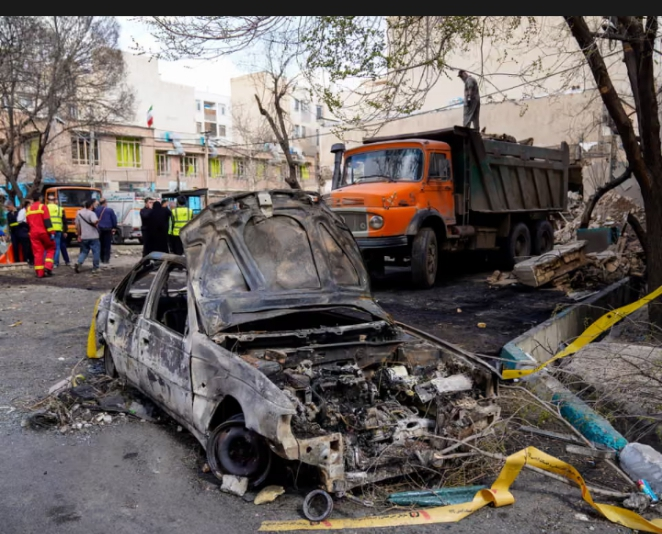
Coordinated US-Israeli strikes struck Iranian military installations, air defence systems, and political targets across multiple cities, including Tehran, Isfahan, Qom, and Kermanshah.
The most consequential strike, however, targeted the compound of Iran’s supreme leader, Ayatollah Ali Khamenei, an attack that signalled a dramatic shift in Western and Israeli intent from deterrence to regime decapitation.
US president Donald Trump later claimed that Khamenei had been killed, a statement that Iranian state media confirmed hours later. Israeli prime minister Benjamin Netanyahu offered no public denial, reinforcing the perception that the operation aimed to trigger regime collapse rather than negotiate behavioural change.
Despite the severity of the assault, there has been no sign that Washington or Tel Aviv plans to deploy ground forces inside Iran. This reality fundamentally shapes Iran retaliation strategy, as Tehran retains its monopoly of force domestically but lacks the capability to match US and Israeli air power in a sustained conventional conflict.
“There is no sign that the US or anybody else is going to put boots on the ground,” said HA Hellyer of the Royal United Services Institute. “The only way that changes is if there is an uprising with mass defections.” His assessment underscores why Iranian authorities have prioritised internal security alongside limited external retaliation.
Iran responded within hours by launching ballistic missiles and drones at Israeli territory and US-linked targets across the region, drawing Jordan, Bahrain, Kuwait, Qatar, Saudi Arabia, and the United Arab Emirates into the conflict.
While these strikes demonstrated Iran’s remaining offensive capabilities, their overall impact was limited by layered air defence systems operated by the US and its allies.
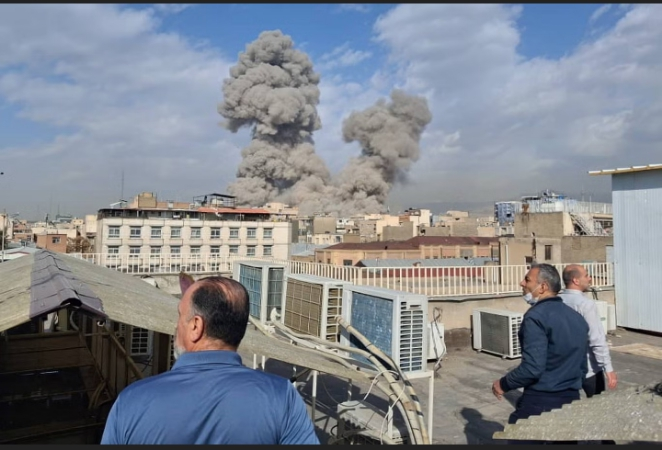
The imbalance is stark. The United States has deployed two carrier strike groups to the region, including the USS Abraham Lincoln and the USS Gerald R Ford, each capable of generating more than 100 strike sorties per day.
Israel, for its part, confirmed that roughly 200 fighter jets participated in the opening waves of the assault, encountering minimal resistance from Iranian air defences already degraded during last summer’s brief but intense war.
Iran’s air defence network, once touted as a shield against Western attack, has struggled to cope with the scale and sophistication of the campaign. Analysts note that Tehran’s stockpile of roughly 2,000 ballistic missiles gives it the ability to retaliate only for a limited period before its options narrow dramatically.
This asymmetry explains why Iran retaliation strategy has focused on regional disruption rather than decisive battlefield victories. Missile and drone attacks targeted US bases in Bahrain and Israel itself, while one intercepted missile caused falling debris that killed a civilian in Abu Dhabi.
In Dubai, a strike triggered a fire at the Fairmont hotel, underscoring the risk of wider civilian harm even when air defences function as intended.
Inside Iran, the human cost has been severe. State-linked Tasnim news agency reported that more than 100 children were killed when a missile struck a girls’ primary school in Minab, an incident that has fuelled public anger and grief.
Iranian officials described the strike as a “crime against humanity,” while Western governments maintained that civilian casualties were unintended consequences of “precision operations.”
The contradiction between rhetoric and reality has intensified domestic pressure on Iran’s leadership. Maintaining order in the streets has become as critical as responding to foreign attacks.
Reports indicate that Khamenei, anticipating assassination, had previously named multiple layers of succession across political and military institutions, a move designed to preserve continuity even under extreme conditions.
Another pillar of Iran retaliation strategy lies in its ability to threaten global economic arteries. By evening, Iranian authorities appeared to be enforcing warnings near the Strait of Hormuz, through which roughly a fifth of the world’s oil supply passes.
Maritime advisories suggested preparations for potential disruption, including the possible deployment of naval mines.
However, experts caution that such a move would invite an overwhelming response. The US Navy maintains a significant undersea presence in the region, and any attempt to mine shipping lanes would likely be detected and neutralised quickly.
While the threat alone can drive up oil prices and unsettle markets, Iran’s capacity to sustain a prolonged closure remains questionable.
Crucially, Iran’s leadership appears aware that escalation carries severe risks. A broader regional war could further erode the regime’s legitimacy at home while unifying Western allies abroad. As a result, Tehran’s actions suggest an effort to project defiance without crossing thresholds that would justify even more destructive retaliation.
Lord Ricketts, a former UK national security adviser, characterised the US-Israeli campaign as one launched with “vague and unachievable objectives” and “no clear basis in international law.” His criticism reflects unease among some Western allies, even as they assist in defensive operations to protect regional partners.
The United Kingdom, while not participating directly in the strikes, has deployed aircraft to bolster air defences in the Gulf. British officials have been careful to frame their role as purely defensive, signalling discomfort with the legal and strategic foundations of the campaign.
As the conflict enters what analysts expect to be a prolonged bombing phase, the question remains how it will end. Iran lacks the means to force a military victory, while the US and Israel have yet to articulate a clear political endgame beyond weakening the regime.
In this strategic vacuum, Iran retaliation strategy appears less about winning than surviving.
For Tehran, endurance may be the ultimate objective: absorb punishment, inflict limited costs on adversaries, maintain internal control, and wait for international pressure to halt the assault. Whether this approach succeeds depends not only on military calculations but on the resilience of Iranian society under unprecedented strain.
What is clear is that the war has already reshaped the Middle East’s security landscape. With alliances tested, legal norms questioned, and civilian populations bearing the cost, the conflict underscores how quickly strategic gambits can spiral beyond control. For Iran, the margin for error has never been narrower.
Read also: Iranian missile strike sparks fire at Dubai’s Fairmont Palm Jumeirah luxury hotel


