US Assets in Gulf– Explosions shook Gulf cities on Sunday as Iran carried out more strikes against US assets, continuing retaliation for the killing of Supreme Leader Ayatollah Ali Khamenei.
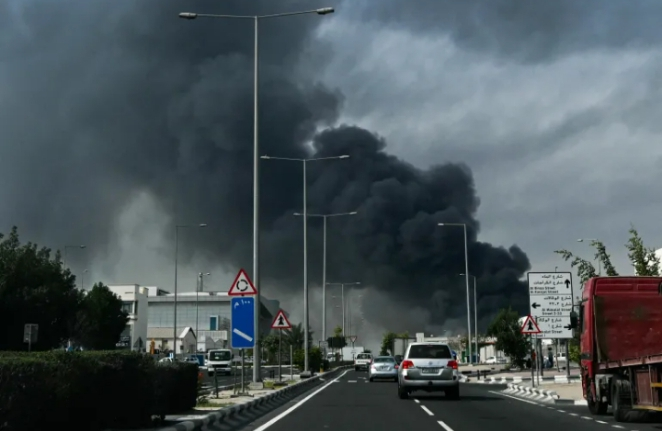
Thick black smoke rose over Doha, Dubai, and Manama, while loud bangs reverberated across urban skylines. These follow-up attacks mark the second day of Iranian retaliation after US and Israeli forces killed Khamenei and other top officials, fueling fears of a wider conflict in a region long considered relatively stable.
In Doha, Qatar, multiple blasts were reported early Sunday morning. Eyewitnesses described dark smoke on the southern horizon and the deafening sound of explosions shaking the city.
Dubai, the UAE’s commercial hub, experienced missile interceptions, sending plumes of white smoke into the sky, while thick black smoke rose over the port of Jebel Ali.
Manama, Bahrain’s capital, also experienced at least four loud explosions. These ongoing strikes follow Iran’s initial campaign targeting US bases and allied infrastructure across the Gulf.
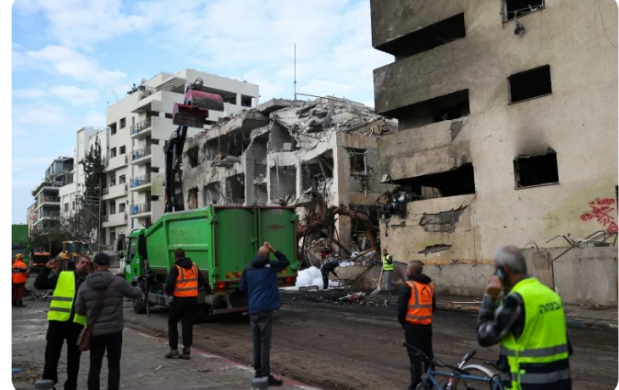
The previous day, Iran fired 137 missiles and deployed 209 drones targeting the UAE. Fires and smoke engulfed Dubai landmarks, including Palm Jumeirah and Burj al-Arab. An “incident” at Abu Dhabi airport killed at least one person and injured seven others.
Dubai International Airport, the world’s busiest for international passengers, and Kuwait’s airport were also affected. These additional attacks demonstrate Iran’s capability to sustain pressure on multiple strategic hubs simultaneously.
Qatari officials confirmed that 65 missiles and 12 drones were launched on Saturday. Most were intercepted, but sixteen people were injured. Jordanian defence systems neutralized missiles entering Amman’s airspace, while a drone crashed near Erbil International Airport in northern Iraq, producing a large smoke plume.
These developments illustrate the expanding scope of Iran’s retaliatory operations, reaching well beyond its borders.
Iranian President Masoud Pezeshkian denounced Khamenei’s killing as “a great crime.” The armed forces’ chief of staff, Abdul Rahim Mousavi, was also killed in the US-Israeli operation.
Iran’s parliamentary speaker, Mohammad Bagher Qalibaf, warned in a televised address: “You [US and Israel] have crossed our red line and must pay the price.” He added that Tehran would deliver “devastating blows” to compel Washington and Jerusalem to plead for reprieve.
US President Donald Trump, speaking on Truth Social, vowed unprecedented retaliation should Iran strike back. “Iran just stated that they are going to hit very hard today, harder than they have ever been hit before.
THEY BETTER NOT DO THAT, HOWEVER, BECAUSE IF THEY DO, WE WILL HIT THEM WITH A FORCE THAT HAS NEVER BEEN SEEN BEFORE!”
Analysts warn that such statements further escalate tensions, risking a regional conflagration that could engulf Gulf oil-and-gas infrastructure.
Israel’s military reported strikes on more than 30 targets across western and central Iran, including missile sites, air defence installations, and military headquarters. Since Saturday, at least 201 people have been killed in Iran, including 148 in an attack on an elementary girls’ school in Minab.
The Islamic Revolutionary Guard Corps confirmed retaliatory strikes on 27 US bases, Tel Nof airbase, and Israel’s HaKirya command headquarters.
Air raid sirens sounded across Israel shortly after 6am local time, with multiple explosions reported in Tel Aviv. The attacks have prompted fears of a wider confrontation involving Gulf states, Israel, and the US, as Tehran asserts its readiness to respond “with unparalleled force” to any further aggression.
The scale and intensity of these additional strikes demonstrate Iran’s determination to defend its interests aggressively.
The Iranian government has formed a three-person interim council to oversee leadership transition following Khamenei’s death.
Public mourning periods of 40 days, combined with a seven-day holiday declared by Pezeshkian, reflect Tehran’s intent to consolidate domestic support while signaling resolve externally. Supporters have flooded the streets in Tehran and other cities, emphasizing national unity behind retaliatory measures.
Gulf Arab states host thousands of US troops and critical military infrastructure, making them strategic targets for Tehran. Oman, serving as mediator in nuclear talks, has remained largely untouched, highlighting Tehran’s calculated approach in selective strikes.
Analysts stress that Iran’s campaign aims to punish US and Israeli operations while gaining strategic leverage, with escalation threatening global oil markets and regional stability.
Observers note that Iran’s missile and drone barrages demonstrate operational sophistication. Across the UAE, attacks disrupted air traffic and port operations, while Qatari, Bahraini, and Jordanian defensive systems mitigated some impacts.
Yet the sheer scale—hundreds of missiles and drones launched within 48 hours—illustrates Tehran’s ability to sustain continued offensive operations.
In Washington, political leaders are divided over the legality and prudence of the US-Israeli strikes. Democratic lawmakers criticized the attacks for bypassing congressional approval, raising concerns about executive overreach.
Analysts caution that Trump’s hardline rhetoric, combined with Israel’s military objectives, could entrench a cycle of retaliation, making de-escalation increasingly difficult.
The killing of Khamenei, who ruled Iran for 37 years, represents a historic moment. Analysts argue that Iran’s ongoing retaliation is driven by the need to project strength, maintain regime legitimacy, and deter foreign encroachments. Tehran frames the US and Israel as aggressors who violated international norms, legitimizing continued countermeasures in the eyes of its public.
Regional stability is further threatened by Israel’s continued airstrikes on Iranian installations. Military sources indicate ongoing targeting of air defence systems and missile production sites. Iran has explicitly linked its operations to the broader US-Israel presence in the Gulf, showing the transnational dimension of this escalating conflict.
Economic implications are severe. Disruptions to Dubai’s ports, airports, and commercial hubs slow global trade, while heightened uncertainty in Gulf oil-producing states may push energy prices higher. Financial markets have responded to early reports of these continued strikes, reflecting investor anxiety over potential escalation.
The crisis also exposes broader geopolitical fault lines. Gulf Cooperation Council states, aligned with the US, face a dilemma: defend US assets and risk Iranian reprisals, or seek accommodation to preserve regional peace.
Tehran’s selective targeting, avoiding Oman, indicates careful strategic calculation intended to demonstrate capability while avoiding direct confrontation with neutral mediators.
Iranian authorities have made clear that retaliation will continue if US and Israeli operations persist. Statements emphasize moral and strategic imperatives: avenging Khamenei’s death and deterring future incursions.
Analysts warn that rhetoric of “devastating blows” and “crossing red lines” could trigger a spiral of escalation, with each side compelled to outmatch the other in military displays.
As the Gulf braces for further strikes, international observers warn of miscalculation risks. Iran’s missile and drone capabilities, combined with US and Israeli firepower, create conditions where accidental escalation is likely.
Calls for diplomacy, including renewed nuclear negotiations, remain overshadowed by immediate operational imperatives driving Tehran, Washington, and Tel Aviv.
The coming days are critical. Iran’s more strikes on US assets in the Gulf, in retaliation for Khamenei’s killing, signal a hardline stance leaving little room for compromise.
Read more here: Iran retaliation strategy under US-Israel war leaves Tehran with few viable options as regime fights for survival
Regional capitals remain on high alert, citizens brace for additional attacks, and the international community watches, aware that any misstep could ignite a broader Middle Eastern war.