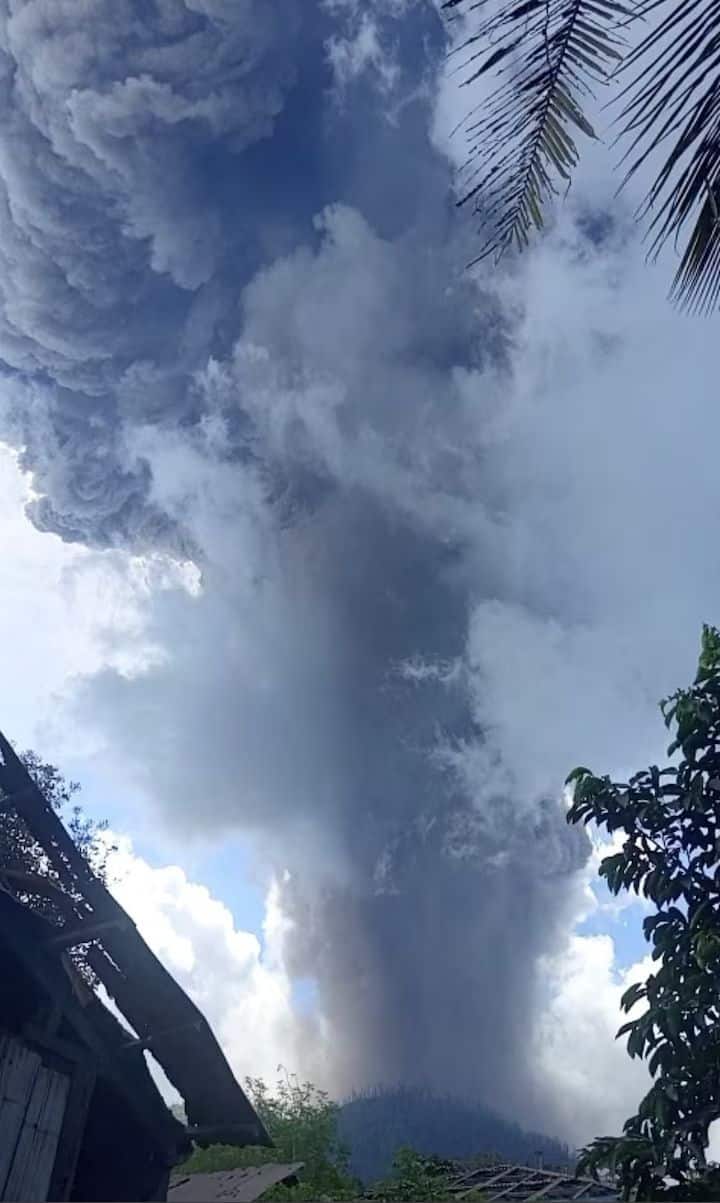

Authorities in Indonesia have declared the highest emergency alert after Mount Lewotobi Laki-Laki unleashed a powerful Indonesia volcano eruption, sending a massive volcanic ash cloud soaring 10 kilometres into the sky.
Officials said the latest Indonesia volcano eruption began shortly after midnight on Wednesday, with ash and debris covering nearby villages on the eastern island of Flores, prompting new volcano evacuation warnings.
No casualties were reported from the eruption, but residents living close to the mountain were urged to stay alert and avoid the area as conditions remained unpredictable.
“The public should remain calm, follow official directions, and not spread rumours,” Indonesia’s Centre for Volcanology and Geological Hazard Mitigation said, describing the Indonesia volcano eruption as “potentially hazardous.”
The agency reported that the Mount Lewotobi Laki-Laki eruption lasted about nine minutes, spewing volcanic materials to an altitude of 10 kilometres above its 1,584-metre summit.

According to Geological Agency chief Muhammad Wafid, residents should remain at least six to seven kilometres away from the mountain, where continued tremors suggest more activity may follow.
He warned that heavy rainfall could trigger volcanic mudflows known as lahars, which often occur after major Indonesia volcano eruptions, especially around densely populated slopes.
Wafid also noted that the towering volcanic ash cloud could disrupt aviation, forcing the temporary closure of the nearby Fransiskus Xaverius Seda Airport in Maumere, around 60 kilometres west of Mount Lewotobi Laki-Laki.
Airport authorities announced flight suspensions until Thursday, citing low visibility and safety concerns, while airlines rerouted planes to alternative airports farther west.
The Indonesia volcano eruption is the second major blast from Mount Lewotobi Laki-Laki this year. In July, it sent ash 18 kilometres into the atmosphere and caused flight cancellations as far away as Bali.
Residents recalled that the earlier Indonesia volcano eruption blanketed farms and rooftops with grey dust, forcing hundreds to evacuate their homes while authorities distributed masks and emergency supplies.
In November 2024, ten villagers were killed when the same volcano exploded violently, damaging thousands of homes and igniting fires across East Nusa Tenggara province.
Indonesia sits squarely on the Indonesia Ring of Fire, a vast zone of seismic and volcanic activity encircling the Pacific Ocean, where tectonic plates frequently collide and trigger powerful eruptions.
The country has more than 120 active volcanoes, many of which lie near towns and agricultural regions. The Indonesia Ring of Fire makes the nation one of the most volcanically active areas in the world.
Officials said the current volcano evacuation warning extends to all communities within a six-kilometre radius of Mount Lewotobi Laki-Laki, advising them to prepare essentials in case conditions worsen.
Volcanologists are closely monitoring seismic readings to determine whether magma movement beneath the crater suggests another major Indonesia volcano eruption is imminent.
Emergency teams have also been deployed to assist vulnerable residents, including elderly villagers and children, living in high-risk zones near the volcano’s base.
Footage shared by local media showed bright orange lava lighting up the night sky, while thick grey volcanic ash clouds rolled across nearby rice fields and forests.
Farmers reported severe crop damage from the latest Indonesia volcano eruption, with falling ash smothering cassava and maize fields that supply the region’s markets.
“The eruption was louder than thunder, and ash rained down like snow,” said one villager from Talibura, describing how his family fled with only what they could carry.
Indonesia’s disaster management agency said hundreds of emergency shelters are being readied across Flores, with evacuation drills underway following the expanded volcano evacuation warning.
The Mount Lewotobi Laki-Laki complex consists of twin volcanic cones, both active, known locally as “male” and “female” peaks — a rare geological formation that frequently generates dual eruptions.
Volcanologists said the recent pattern of explosions reflects an increase in underground pressure linked to shifts in magma chambers beneath the Indonesia Ring of Fire.
As part of a nationwide monitoring network, the Geological Agency operates hundreds of sensors and satellite feeds to detect early signs of future Indonesia volcano eruptions.
Aviation authorities across Southeast Asia remain on high alert, with air-traffic controllers warning pilots to steer clear of visible volcanic ash clouds, which can severely damage jet engines.
In Maumere, schools were closed and residents advised to stay indoors to avoid inhaling fine ash particles following the massive Indonesia volcano eruption.
Medical staff distributed face masks and water to communities affected by falling ash, which can irritate the eyes and lungs if inhaled over prolonged periods.
Local meteorologists said strong winds could carry the volcanic ash cloud toward western islands, potentially affecting more distant air routes and weather conditions.
Air quality levels in parts of East Nusa Tenggara briefly spiked into unhealthy ranges as the Indonesia volcano eruption continued to emit ash and gas throughout the day.
While the eruption has disrupted daily life, disaster officials stressed that preparedness efforts have improved since earlier crises, enabling quicker evacuations during Indonesia volcano eruptions.
The volcano evacuation warning was communicated via text messages, community loudspeakers, and local radio to ensure residents received timely alerts.
President Joko Widodo’s administration has invested heavily in early-warning systems and coordination networks across the Indonesia Ring of Fire, seeking to minimize casualties from natural disasters.
Despite that, the unpredictable nature of the Mount Lewotobi Laki-Laki volcano remains a challenge, as small tremors and gas emissions often precede much larger Indonesia volcano eruptions.
Indonesia’s history is marked by devastating volcanic events, including the 2018 Anak Krakatau eruption and the 2010 Mount Merapi disaster, both occurring along the volatile Indonesia Ring of Fire.
Volcanologists emphasize that the archipelago’s fertile soil and lush landscapes are the paradoxical result of centuries of Indonesia volcano eruptions, which enrich the land even as they endanger lives.
For now, authorities continue to assess the scale of damage from the latest Indonesia volcano eruption, while air and ground patrols monitor the expanding volcanic ash cloud.
As dusk settled over Flores, the orange glow of Mount Lewotobi Laki-Laki was still visible from nearby villages — a striking reminder of Indonesia’s restless geology and the enduring power of nature.
Residents expressed both fear and resilience, accustomed to life along the Indonesia Ring of Fire, where beauty and danger often coexist side by side.

By Wednesday night, the national disaster agency confirmed that tremors had slightly decreased, but the volcano evacuation warning remained in force as scientists studied ongoing emissions.
Authorities reiterated that flights would only resume once visibility improved and the volcanic ash cloud dispersed safely beyond navigable air corridors.
The government urged people not to return home prematurely, warning that the Indonesia volcano eruption could intensify without clear signs beforehand.
Even as cleanup crews began clearing roads blanketed by ash, scientists said monitoring will continue for weeks to determine whether magma pressure inside Mount Lewotobi Laki-Laki is declining.
For the millions who live along Indonesia’s fiery arc, this eruption again underscored how the Indonesia Ring of Fire continues to shape the region’s destiny with awe and peril.
About The Author