New Delhi, India – India deepens ties with Israel under Modi as the country’s foreign policy in the Middle East shifts markedly, raising concerns over its support for the Palestinian cause.
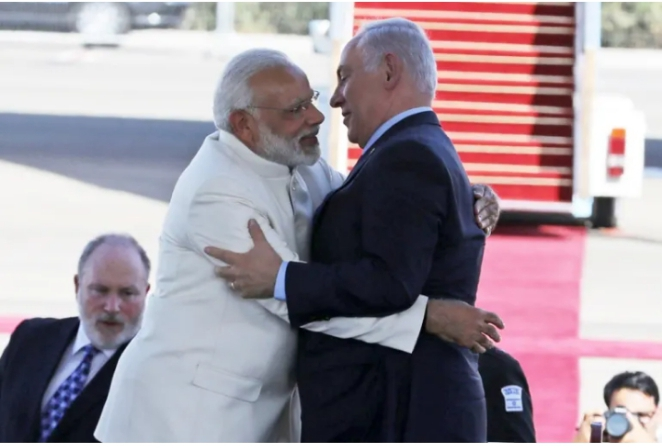
The transformation began with Modi’s historic 2017 visit to Israel, the first ever by an Indian prime minister, when he and Israeli Prime Minister Benjamin Netanyahu publicly embraced and promised to “break down the remaining walls” between their countries.
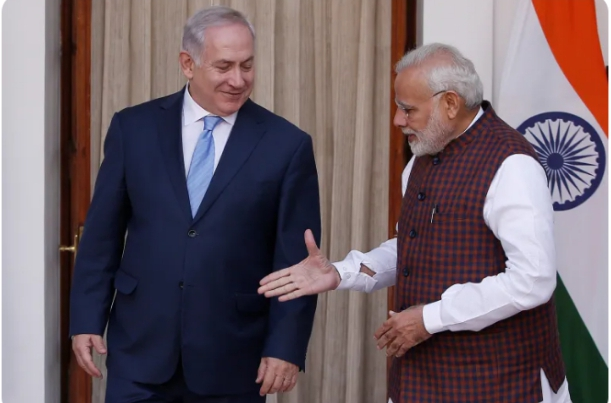
That visit represented a departure from India’s traditional caution, signaling a willingness to pursue strategic and ideological ties with Israel even as Gaza faced ongoing humanitarian crises.
Over the years, Modi has repeatedly described Netanyahu as a “dear friend,” maintaining the relationship despite the International Criminal Court issuing an arrest warrant for Netanyahu in 2024 over alleged war crimes during Israel’s campaign in Gaza.
Indian officials frame the growing partnership as pragmatic, emphasizing Israel’s technological and military contributions, but critics argue it has eroded India’s moral authority.
Historically, India was a strong supporter of Palestinian independence, opposing the 1947 United Nations partition plan and formally recognizing Palestine in 1988, reflecting decades of principled diplomacy.
Modi’s 2014 rise to power accelerated the alignment, as his Hindu nationalist Bharatiya Janata Party shares ideological affinities with Israel on homeland identity and perceptions of Islamic security threats.
Under Modi, India has become Israel’s largest weapons buyer, supplying rockets and explosives even during the 2024 Gaza war, while bilateral trade has increased from $200 million in 1992 to more than $6 billion in 2024.
Both nations are also exploring joint missile defense projects, and Modi is scheduled to address Israel’s parliament during his upcoming visit, underscoring India’s visibly pro-Israel stance.
Observers note a personal angle: the visit coincides with Israeli elections, effectively boosting Netanyahu’s international image at a politically sensitive moment.
India’s historical non-alignment and support for Palestinian self-determination have been reframed as “strategic autonomy,” balancing ties with Israel, Arab states, and Iran while avoiding direct criticism of Israeli military operations in Gaza.
Modi’s alignment with Israel also reflects calculations tied to U.S. policy, energy imports, and regional influence, particularly amid potential conflict with Iran.
Analysts suggest India is positioning itself to benefit from a Middle East where Israel could emerge as a regional power while maintaining its role in counterterrorism and strategic affairs.
Despite official endorsements of a two-state solution, India’s policies increasingly favor Israel, prompting debate over its commitment to Palestine and long-standing principles of justice and equity in the region.
Civil society groups and experts warn that the country’s close alignment with Israel under Modi risks undermining decades of India’s diplomatic credibility in the Global South.
The growing India-Israel partnership has also prompted debate within India’s domestic political landscape. Opposition parties and civil society groups have criticized the government for sidelining the Palestinian issue, arguing that historic moral commitments are being traded for strategic and economic gains.
Analysts note that while India maintains rhetorical support for a two-state solution, its reluctance to condemn Israeli military actions in Gaza has drawn scrutiny from human rights organizations and international observers, who see the shift as a departure from India’s long-standing position in the Global South.
At the same time, India’s strengthened ties with Israel are seen as a strategic hedge in an increasingly volatile Middle East. With ongoing U.S.-Iran tensions, the war in Gaza, and shifting alliances across the region, India aims to secure technological, military, and energy advantages.
Officials argue that the country’s “strategic autonomy” allows it to engage with multiple players—Israel, Arab nations, and Iran—without being drawn into regional conflicts, but critics warn that this balancing act comes at the cost of India’s credibility on international justice and its historic support for Palestinian sovereignty.
Read also: ‘Victory will be ours’ banner raised at Russian embassy in Seoul sparks diplomatic complaint
About The Author