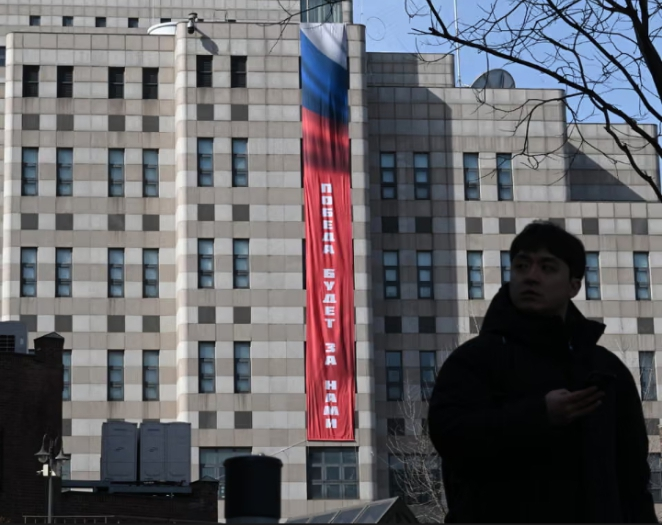
The Victory Will Be Ours banner displayed at the Russian embassy in Seoul has triggered a formal diplomatic complaint from South Korea, after officials warned the slogan could inflame tensions linked to the war in Ukraine.
South Korea’s foreign ministry said it had conveyed concerns directly to the Russian embassy after the large Russian-language banner was hung prominently on the embassy building.
The message, translating to “victory will be ours,” is widely associated with Russia’s war narrative and was immediately interpreted as a reference to the conflict in Ukraine.
Officials said the Victory Will Be Ours banner risked creating unnecessary friction with South Korean citizens and other nations at a time of heightened global sensitivity.
The foreign ministry noted that while embassies enjoy protections under international law, public political messaging that spills into domestic space can strain diplomatic norms.
The banner’s wording carries historic symbolism, having been used by the Soviet Union during the second world war, further amplifying its emotional and political resonance.
South Korean media reported that the embassy had not immediately removed the banner following the complaint.
The incident places renewed strain on South Korea Russia relations, which have already been tested by Seoul’s support for Ukraine and alignment with Western sanctions.
South Korea has provided humanitarian aid to Ukraine and backed international measures aimed at isolating Moscow diplomatically.
Public reaction in Seoul ranged from discomfort to anger, with critics arguing the banner amounted to wartime propaganda displayed on foreign soil.
Analysts said the Victory Will Be Ours banner demonstrates how symbolic gestures can carry outsized diplomatic consequences far from the battlefield.
The controversy emerged as divisions deepen across Europe over continued pressure on Russia.
Hungary announced it would block the European Union’s next round of sanctions unless Ukraine resumes Russian oil transit through pipelines serving Hungarian refineries.
The move threatens to delay coordinated EU action marking the anniversary of Russia’s full-scale invasion.
Ukraine accused Hungary of using energy leverage during wartime and undermining European unity.
The sanctions standoff highlights how the war’s ripple effects now extend into energy security and intra-European politics.
Meanwhile, Russian president Vladimir Putin reiterated that strengthening Russia’s nuclear forces remains an “absolute priority”.
In a national address, Putin said the development of the nuclear triad was essential to maintaining strategic deterrence.
His remarks followed the expiration of the last remaining nuclear arms control treaty between Russia and the United States, leaving both powers without formal limits.
Security experts warn that the lack of constraints increases the risk of escalation and miscalculation.
On the ground in Ukraine, fighting continued with deadly consequences.
In the western city of Lviv, explosions killed a police officer and injured dozens in an attack Ukrainian authorities described as terrorism.
President Volodymyr Zelenskyy blamed Russia for the incident and vowed accountability.
Russian missile and drone attacks also struck targets across Ukraine, damaging residential buildings and key infrastructure.
Zelenskyy said hundreds of drones and dozens of missiles were launched in coordinated strikes, underscoring Russia’s continued reliance on military pressure.
Ukraine responded with its own attacks on Russian energy infrastructure near the border, disrupting power and heating supplies.
In Moscow, flights at major airports were briefly suspended after air defence systems intercepted Ukrainian drones approaching the capital.
The widening scope of the conflict shows how actions far from the front line, including embassy displays, now form part of the broader confrontation.
Diplomats say the Victory Will Be Ours banner illustrates how messaging and symbolism have become tools of geopolitical signalling.
Read also: Israel has divine right to all Middle East land, says Huckabee, attracts condemnation
For South Korea, the episode underscores the challenge of maintaining diplomatic balance while avoiding entanglement in great-power conflict.
As the Ukraine war enters another year, even a banner on an embassy wall can echo across continents.
About The Author