North Korea women’s football is returning to the continental stage after more than a decade of isolation, as the country’s women’s national team prepares to compete at the Women’s Asian Cup 2026.
The comeback marks the first Asian Cup appearance for the team since 2010 and signals the re-emergence of one of Asia’s most unusual and politically significant football powers.
Ranked ninth in the world despite years of absence from senior international competition, the North Korea women’s national football team arrives at the tournament backed by decades of state investment and a recent surge in youth-level success.
Their return places global attention once again on how football has been used by the North Korean state as both a sporting and political tool.
For much of the past ten years, North Korea women’s football has existed largely out of sight. Economic sanctions, international bans, and pandemic-era border closures kept the senior side away from major tournaments. Yet behind closed borders, the system that once made the team a dominant force in Asia continued to operate.
The roots of this strategy date back to the late 1980s, when North Korea identified women’s football as a rare opportunity to compete internationally despite growing diplomatic isolation.
While many countries treated the women’s game as secondary, Pyongyang placed it at the centre of a national sports policy, embedding football programmes in schools, the military, and elite training institutions.
By the early 2000s, North Korea women’s football had become a continental powerhouse. The team won three Asian Cup titles between 2001 and 2008 and regularly defeated better-resourced rivals.
Home matches drew enormous crowds, and players were elevated as national heroes, rewarded with apartments, public ceremonies, and privileged residency in the capital.
That dominance collapsed abruptly in 2011. At the Women’s World Cup in Germany, five players tested positive for banned substances.
The explanation offered by North Korean officials — that the substances came from traditional medicine administered after a lightning strike — was rejected by FIFA, which imposed a four-year ban.
The ban, combined with subsequent qualification failures and later pandemic withdrawals, effectively erased the senior team from international football. Between 2011 and the early 2020s, North Korea women’s football became a statistical anomaly: a top-10-ranked team that almost never played.
Despite the senior team’s disappearance, the development pipeline never stopped. Central to this was the opening of the Pyongyang International Football School in 2013, a specialised academy designed to identify and train elite talent from an early age. This long-term approach has paid off spectacularly at youth level.
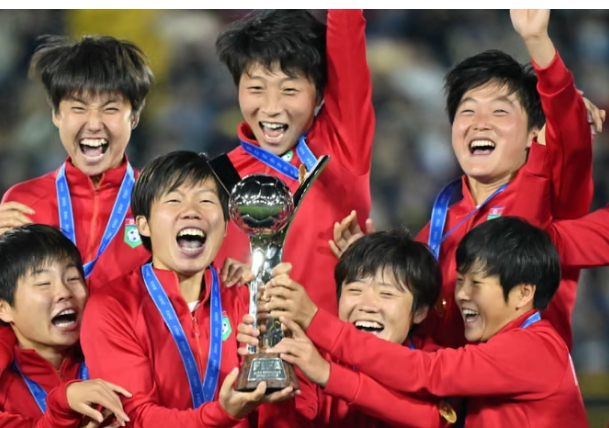
North Korea’s Under-17 and Under-20 women’s teams have dominated global competitions in recent years, winning World Cups and Asian championships and establishing the country as the most successful nation across youth tournaments.
Four major youth titles in the past two years alone have confirmed that North Korea women’s football remains structurally strong, even if largely unseen.
Those youth triumphs form the backbone of the squad returning to the Asian Cup. While some of the youngest stars may not yet feature prominently, the tournament offers the clearest indication yet of whether North Korea can translate youth dominance into senior success once again.
The Asian Cup also reintroduces the team to familiar rivals. North Korea will face regional heavyweights, including China and Australia, teams that have benefited from professional domestic leagues and increased global exposure during the years North Korea was absent. The contrast highlights how unusual North Korea’s football model remains.
Unlike most nations, North Korean players are unable to sign freely with overseas clubs. International sanctions and travel restrictions limit professional opportunities, keeping players within the state-controlled system.
As a result, North Korea women’s football develops almost entirely in isolation, with limited tactical exchange or commercial exposure.
Yet that isolation has not prevented success. Analysts note that the team’s discipline, physical conditioning, and tactical cohesion are products of a system designed for collective performance rather than individual stardom.
In an era increasingly defined by professional club pathways, North Korea represents a rare alternative model.
Politically, the team’s return carries significance beyond sport.
Women’s football has long been one of the few arenas where North Korea can project competence and strength to international audiences. Success on the pitch allows the state to frame itself as disciplined, modern, and competitive, despite its broader isolation.
This context makes the 2026 tournament more than a sporting event. For North Korea women’s football, it is a test of relevance, credibility, and sustainability after years away from the global spotlight.
Victory is not required for the return to be meaningful; simply competing consistently again would mark a major shift.
The opening matches will be closely watched by observers seeking to understand how much the game has moved on during North Korea’s absence — and how much of its old dominance remains intact.

Fitness, tactical sharpness, and adaptability will be key after such a prolonged break from senior competition.
Regardless of results, the team’s presence alone reshapes the tournament narrative.
The Women’s Asian Cup is no longer just a contest between familiar powers but also a stage for one of football’s most enigmatic national programmes to reintroduce itself.
After more than a decade away, North Korea women’s football is no longer a historical footnote or a statistical curiosity.
Its return to the Asian Cup confirms that one of the continent’s most secretive yet successful women’s football systems is once again part of the international game — and watching closely.
Read also: Alex Iwobi secures Fulham win over Sunderland