Defense Secretary Pete Hegseth says today will be the most intense day of strikes as US forces ramp up their military campaign, marking a major escalation in the conflict between the United States and Iran.
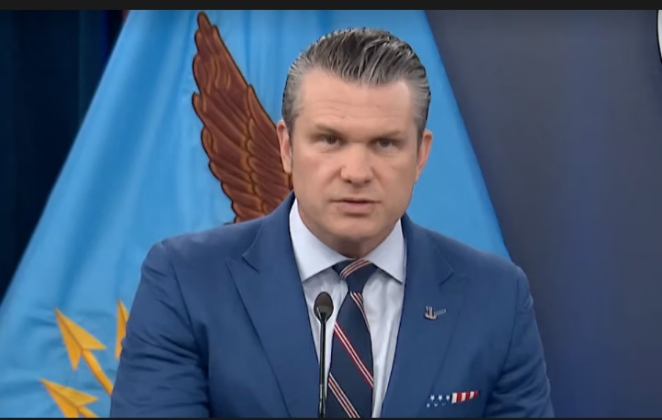
Speaking during a Pentagon briefing, Hegseth emphasized that American operations are entering a decisive phase aimed at crippling Iran’s ability to threaten US interests and regional allies.
Hegseth said the intensified operations come even as Iran missile attacks have significantly slowed. According to military updates, Tehran fired its lowest number of weapons in the past 24 hours, a sharp contrast to earlier stages of the confrontation. Despite this decline, US commanders say sustained pressure is necessary to permanently weaken Iran’s strike capabilities.
Opening the Pentagon briefing, General Dan Caine paid tribute to American service members who lost their lives during the conflict, describing their sacrifice as a reminder of the risks faced by personnel engaged in high-intensity warfare. He expressed condolences to their families and praised the courage of troops operating in hostile environments.
“We honor those who made the ultimate sacrifice while defending our nation,” Caine said solemnly. “Their service will not be forgotten.”
Providing an operational update, the general said the joint force remains focused on three core objectives central to the Trump administration war strategy.
These include destroying missile and drone systems before they can threaten American assets, striking and degrading Iranian naval forces, and preventing Tehran from maintaining the capacity to launch long-term attacks against the United States and its partners.
Caine stressed that coordinated operations across air and sea domains are being carried out with precision and persistence. “This is gritty and tireless work,” he said, praising what he described as exceptional coordination among American forces.
He revealed that ballistic missile launches by Iran have fallen dramatically since the start of the campaign.
“Ballistic missile attacks continue to trend downwards, down 90 percent from when we started,” he stated, noting that the reduction reflects sustained US targeting of missile infrastructure and launch facilities.
The Pentagon briefing also highlighted efforts to neutralize Iranian mine-laying capabilities in strategic waterways. Military officials believe such operations are critical to maintaining freedom of navigation and preventing disruptions to international shipping routes. By targeting maritime strike systems, the US aims to limit Iran’s ability to project force beyond its shores.
Hegseth said the current phase of US airstrikes on Iran is designed to apply overwhelming pressure in a short timeframe. “Today will mark a peak in operational intensity,” he noted, suggesting that concentrated force could hasten the degradation of Iran’s remaining strike capacity.
Defense analysts say the strategy reflects a shift toward rapid, high-volume operations intended to exhaust Iranian defenses and shorten the duration of active combat. Rather than prolonged engagements, military planners appear focused on decisive strikes targeting critical infrastructure.
The escalation follows directives from President Donald Trump, whose administration has framed the conflict as a necessary response to mounting regional threats. Officials say the objective is to prevent Iran from developing the ability to sustain future long-range attacks.
Under the Trump administration war strategy, the Pentagon has prioritized preemptive targeting of missile stockpiles, drone production sites, and naval assets capable of threatening allied shipping lanes. Military planners argue that degrading these capabilities now could prevent years of instability.
Despite the rise in US airstrikes on Iran, officials say they are closely monitoring humanitarian and diplomatic implications. Pentagon spokespeople emphasized that operations are focused on military targets and are conducted within the framework of international law.
Meanwhile, regional observers note that the sharp decline in Iran missile attacks could signal mounting strain on Tehran’s military infrastructure. Some analysts believe sustained strikes have disrupted command networks and logistics pipelines necessary for launching coordinated assaults.
Still, experts caution that reduced launch numbers do not necessarily indicate a permanent weakening of Iran’s arsenal. “A temporary slowdown can also reflect strategic repositioning,” said military analyst Farhad Rezaei. “Iran may be conserving resources or preparing asymmetric responses.”
Hegseth acknowledged the evolving risks but maintained confidence in US preparedness. “Our forces remain vigilant across all domains,” he said. “We are prepared to respond to any escalation while continuing to degrade hostile capabilities.”
Security around US installations across the Middle East has been heightened amid concerns about retaliatory measures. American commanders are reinforcing defensive systems, particularly against the ballistic missile threat that has defined much of the confrontation.
General Caine reiterated that protecting American personnel and allied territories remains paramount. “Force protection is central to every operational decision,” he said. “We will not allow hostile actors to endanger our people.”
Diplomatic channels remain active, though no immediate breakthrough has been reported. International leaders continue to urge restraint, warning that prolonged fighting could destabilize global energy markets and maritime trade routes.
Military historians note that concentrated air campaigns often aim to overwhelm adversaries psychologically as well as physically. The announcement that “today will be the most intense day of strikes” may also serve as a strategic signal intended to demonstrate overwhelming capability.
Within Washington, reactions have been mixed. Supporters argue the operations are necessary to neutralize persistent threats, while critics warn that deeper military involvement could expand the conflict’s scope. Lawmakers from both parties have called for regular briefings to ensure congressional oversight.
Read also: Iran may have activated sleeper cells worldwide amid US-Israel strikes, warn officials
As operations continue, Pentagon officials stress that success will not be measured solely by the volume of strikes but by the long-term degradation of hostile capabilities. “Our mission is strategic, not symbolic,” Hegseth said. “Every strike is designed to reduce future threats.”
For now, the focus remains on the intense operational window described by defense leaders. With US airstrikes on Iran reaching a new peak and Iranian launch activity declining, today’s developments could shape the trajectory of the broader conflict.
Whether the intensified campaign accelerates resolution or provokes further escalation remains uncertain. But military leaders insist that American forces are prepared for both possibilities as the confrontation enters one of its most critical phases.
About The Author