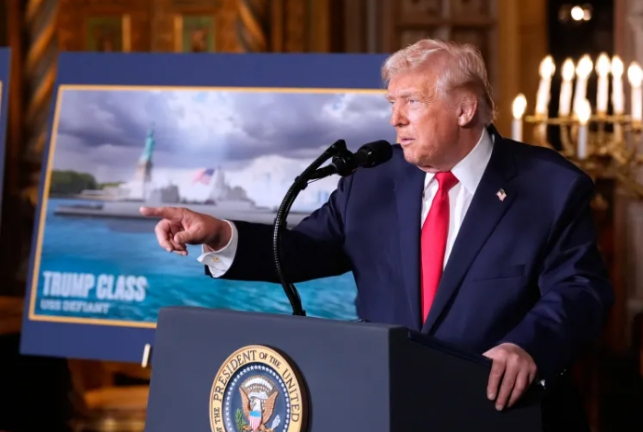
President Donald Trump has announced an audacious naval expansion, unveiling Trump-class battleships Donald Trump, the President America has never had signed to project overwhelming American power and redefine maritime dominance in an era of intensifying global competition.
Speaking at his Mar-a-Lago resort, Trump framed the initiative as historic, declaring the vessels symbols of strength, innovation, and an unambiguous return to American command of the seas.
The Trump-class battleships, he said, will anchor a new “Golden Fleet,” a maritime force intended to deter rivals, reassure allies, and restore confidence in US naval superiority.
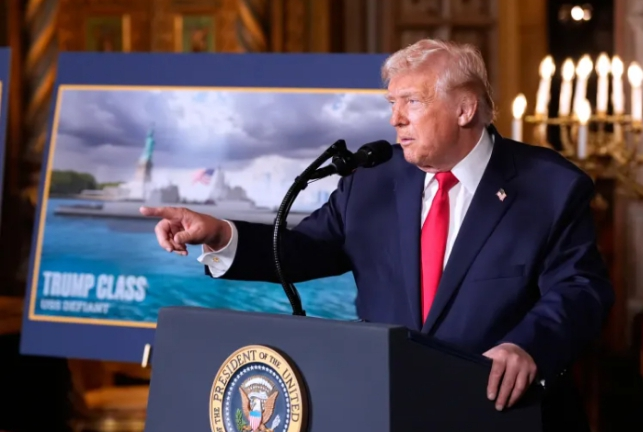
Standing beside dramatic renderings, Trump promised ships larger, faster, and far more powerful than any warship previously built by the United States Navy.
“These are bigger,” Trump said. “They’ll be 100 times the force, the power, and there’s never been anything like them anywhere.”
The proposal immediately captured global attention, blending spectacle, nationalism, and cutting-edge military ambition into a single announcement aimed at reshaping defence priorities.
Central to the Trump-class vision is technology, with the ships designed around advanced systems rather than traditional heavy-gun battleship warfare.
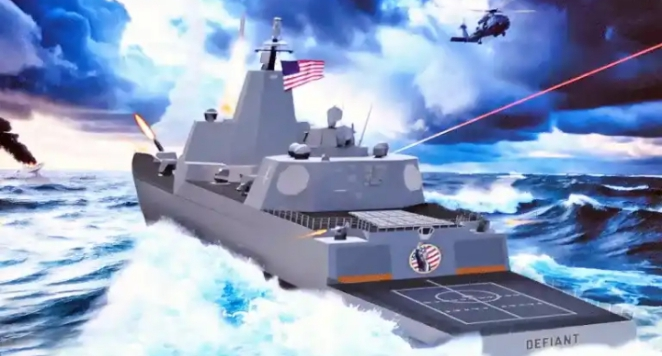
Trump said artificial intelligence would guide targeting, threat assessment, and operational coordination, reducing crew sizes while increasing battlefield effectiveness at sea.

Directed-energy laser weapons are planned for missile defence and offensive roles, reflecting the Pentagon’s growing interest in next-generation naval armaments.
The battleships are also expected to carry hypersonic missiles, nuclear-capable cruise missiles, and electromagnetic rail guns still undergoing development and testing.
According to Trump, this combination will make each ship a floating arsenal capable of confronting any adversary across multiple domains simultaneously.
Asked whether the programme targets specific rivals, Trump dismissed the notion, saying the ships are “a counter to everybody.”
That statement, though vague, comes amid escalating tensions with China and Russia, both of which are rapidly modernising their naval capabilities.
Trump announced production would begin with two vessels, with the option to expand the fleet to ten, or even twenty-five, over time.
He said construction on the first ships would begin immediately, signalling urgency and determination behind the ambitious naval push.
The inaugural vessel will reportedly be named USS Defiant, a title reflecting the administration’s assertive posture on defence and global power projection.
Trump described the Trump-class as a modern successor to twentieth-century battleships that once dominated global naval warfare.
Historically, battleships were heavily armoured giants armed with massive guns, designed for ship-to-ship combat and coastal bombardment.
Their dominance peaked during World War II, when naval power was synonymous with national survival and global influence.
America’s Iowa-class battleships, icons of that era, displaced roughly 60,000 tonnes and represented the pinnacle of battleship engineering.
After World War II, however, battleships rapidly lost relevance as aircraft carriers, submarines, and missile systems transformed naval doctrine.
Despite that shift, Trump believes modern technology can resurrect the battleship concept for twenty-first-century warfare.
A newly launched Golden Fleet website claims the Trump-class will match Iowa-class size but weigh nearly half as much.
At approximately 35,000 tonnes, the ships would rely on lighter materials, automation, and digital systems rather than sheer steel mass.
Crew sizes are projected between 650 and 850 sailors, far fewer than historic battleships, reflecting AI-driven efficiencies.
Unlike their predecessors, Trump-class battleships will prioritise missiles over large-calibre naval guns as primary offensive weapons.
Trump invoked Theodore Roosevelt’s Great White Fleet, which once showcased American power through global naval deployments.
He also referenced the classic documentary Victory at Sea, calling it an inspiration behind his fascination with naval strength.
“These ships,” Trump said, “will help maintain American military supremacy for generations to come.”
Beyond shipbuilding, the president used the announcement to criticise defence contractors over delays and rising programme costs.
He accused major firms of prioritising executive pay, dividends, and stock buybacks over delivering military hardware efficiently.
“We don’t want executives making $50m a year while production is lagging,” Trump said bluntly.
He announced plans to meet defence industry leaders to demand faster timelines and stricter cost discipline.
The comments align with Trump’s populist messaging, combining corporate criticism with calls for national strength.
Defence analysts, however, have questioned the feasibility and strategic value of reviving battleship-style platforms.
Modern naval warfare prioritises survivability, stealth, and networked systems over size and visibility.
Large surface vessels can be vulnerable to advanced missiles, drones, and submarine threats in contested waters.
Critics argue resources may be better spent on submarines, unmanned systems, and distributed missile platforms.
Supporters counter that missile-heavy surface combatants offer sustained firepower without constant reliance on aircraft carriers.
Budgetary concerns also loom, as defence spending faces pressure from competing military and domestic priorities.
Congressional approval will be required, setting the stage for fierce political debate over costs and strategic direction.
Internationally, the announcement signals Washington’s intent to maintain overwhelming maritime influence.
China’s rapid naval expansion and Russia’s hypersonic advancements form the backdrop to Trump’s Golden Fleet rhetoric.
Whether the Trump-class battleships ever sail remains uncertain, dependent on funding, politics, and engineering realities.
Yet symbolically, the announcement reinforces Trump’s preference for bold, unmistakable demonstrations of American power.
The Golden Fleet concept blends nostalgia, innovation, and personal branding into a single defence vision.
If realised, it would mark one of the most dramatic shifts in US naval planning since the Cold War.
If not, it still succeeds as a message: American naval dominance remains non-negotiable under Trump’s leadership.
Read also: Denmark summons US Ambassador over Greenland envoy appointment