Mar-a-Lago resort, Trump warns Maduro – United States President Donald Trump has issued a fresh warning to Venezuelan leader Nicolas Maduro, escalating a confrontation that is rapidly hardening global diplomatic fault lines.
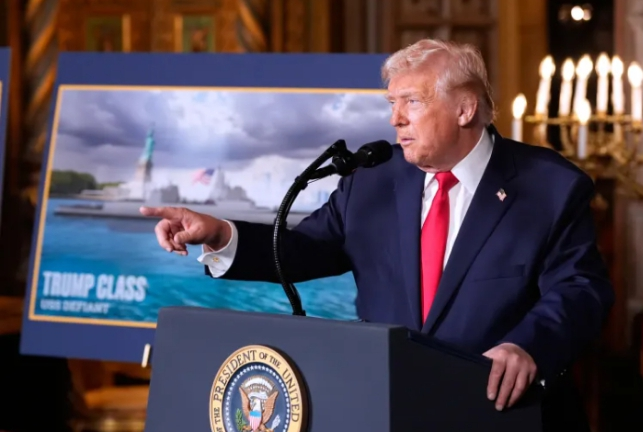
Speaking from his Mar-a-Lago resort in Florida, Trump suggested Maduro’s position had become untenable, signalling Washington’s readiness to intensify pressure on Caracas despite mounting international backlash.
Flanked by Secretary of State Marco Rubio and Defense Secretary Pete Hegseth, Trump framed the standoff as a decisive moment in United States foreign policy toward Venezuela.
Asked directly whether Washington’s objective was to remove Maduro from power, Trump replied ambiguously, saying it would be “smart” for the Venezuelan president to step aside.
Trump warned that any attempt by Maduro to “play tough” would provoke consequences, adding that such defiance would be “the last time” Venezuela’s leader could act aggressively.
The remarks came as the US Coast Guard continued pursuing a third oil tanker off Venezuela’s coast, part of what Washington describes as a sanctions-evading “dark fleet.”
Trump confirmed that American authorities intended to seize the vessel, declaring confidently that the tanker would ultimately be intercepted despite resistance or international criticism.
He further stated that the United States would retain control of two previously seized ships and nearly four million barrels of Venezuelan crude oil already in custody.
“Maybe we’ll sell it, maybe we’ll keep it,” Trump said, suggesting the oil could even be redirected into US strategic petroleum reserves.
The seizures have sharply escalated tensions, drawing accusations of maritime piracy from Caracas and renewed warnings from major global powers aligned with Venezuela.
Maduro responded swiftly, using a nationally televised address to dismiss Trump’s threats and urge the US president to focus on America’s domestic economic and social challenges.
“He would be better off taking care of his own country,” Maduro said, framing Washington’s actions as reckless interference rather than legitimate security operations.
Venezuela has consistently denied involvement in international drug trafficking, rejecting US claims that recent military actions are part of a broader anti-narcotics campaign.
Instead, Caracas argues that the United States seeks regime change to gain control of Venezuela’s vast oil reserves, the largest proven reserves in the world.
The confrontation unfolds amid an expanded US military presence in the Caribbean and eastern Pacific, officially aimed at combating narcotics smuggling routes.
According to US officials, more than two dozen strikes have been carried out on suspected drug trafficking vessels near Venezuelan waters in recent months.
Human rights groups and international observers have raised alarms, noting that these operations have reportedly resulted in over 100 deaths.
Shortly after Trump’s remarks, the US military announced another fatal strike on a “low-profile vessel” suspected of transporting drugs in international waters.
Venezuelan authorities condemned the strike, reiterating claims that Washington’s campaign violates international law and threatens regional stability.
The dispute has now reached the United Nations, where Venezuela requested an emergency Security Council meeting to address the escalating crisis.
Russia and China backed Venezuela’s call, underscoring the growing geopolitical dimensions of what began as a bilateral confrontation.
Russian Foreign Minister Sergei Lavrov expressed “deep concern” over US naval operations during a call with Venezuelan counterpart Yvan Gil.
Moscow warned that continued US actions could endanger international shipping lanes and destabilise the broader Caribbean and Latin American regions.
In a statement, Russia reaffirmed “full support and solidarity” with Venezuela’s leadership, signalling resistance to any unilateral US measures.
China also issued a sharp rebuke, accusing Washington of serious violations of international law and the principles of the United Nations Charter.
Foreign Ministry spokesperson Lin Jian said Beijing opposed any action infringing on Venezuela’s sovereignty or undermining its national security.
China stressed Venezuela’s right to pursue independent development and mutually beneficial partnerships without external coercion or military intimidation.
Venezuelan Foreign Minister Yvan Gil read a letter from Maduro addressed to UN member states, warning of severe global economic repercussions.
The letter cautioned that a US blockade of Venezuelan oil exports would disrupt global energy markets and raise prices worldwide.
Gil warned that Latin America, the Caribbean, and vulnerable economies would bear the brunt of supply shocks triggered by continued seizures.
“Venezuela reaffirms its vocation for peace,” Gil said, while insisting the country remains prepared to defend its sovereignty under international law.
Despite diplomatic overtures, the language on all sides has hardened, reducing prospects for de-escalation in the immediate future.
Analysts say Trump’s rhetoric reflects a broader strategy of maximum pressure, blending economic sanctions, military deterrence, and political signalling.
Supporters argue the approach weakens authoritarian governments, while critics warn it risks armed confrontation and global energy instability.
Within the United States, questions persist over the legality of oil seizures conducted beyond declared territorial waters.
Legal scholars have debated whether such actions constitute lawful enforcement of sanctions or breaches of maritime law.
The crisis also revives memories of past US interventions in Latin America, fuelling regional suspicion and resistance.
For Venezuela, already grappling with economic hardship and international isolation, the stakes are existential.
For Washington, the confrontation tests its willingness to confront rival powers defending a sanctioned ally.
Read also: Russia probes Kyiv link after car bomb kills Senior military General in Moscow
Russia and China’s involvement suggests Venezuela’s crisis may further entrench global divisions reminiscent of Cold War-era alignments.
As the UN Security Council convenes, diplomats face mounting pressure to prevent the standoff from spiralling into open conflict.
Whether dialogue or confrontation prevails may shape not only Venezuela’s future but also the global balance of power.
For now, Trump’s warning stands, and the world watches closely as rhetoric, warships, and oil tankers converge in contested waters.
About The Author