Germany’s Christmas bank heist has triggered one of the largest criminal investigations in recent German history after thieves vanished with millions during the festive holiday shutdown.
The Germany Christmas bank heist unfolded quietly while businesses closed, streets emptied, and residents focused on celebrations rather than security alarms or suspicious movement.
Authorities say the operation resembled an Ocean’s Eleven-style robbery, combining planning, patience, and technical skill to breach one of Germany’s most trusted banking institutions.
The theft targeted a Sparkasse bank branch in Gelsenkirchen, a city in North Rhine-Westphalia, western Germany, during the extended Christmas holiday period.
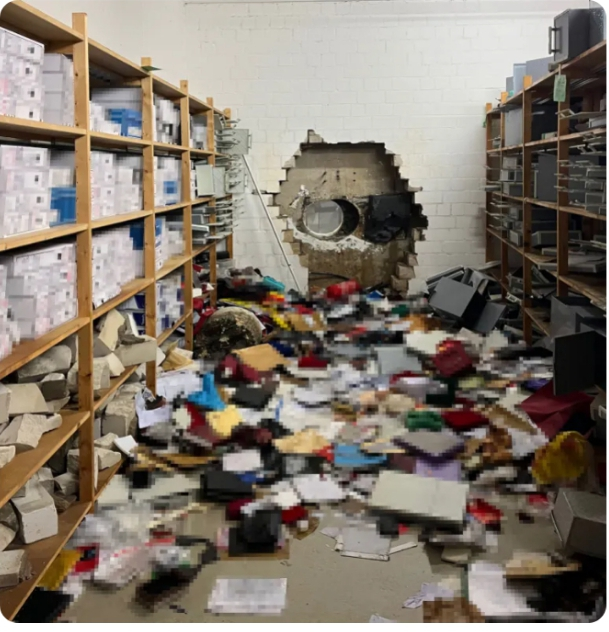
Police confirmed the suspects drilled through a thick reinforced concrete wall from an adjacent parking garage to access the underground vault unnoticed.
Investigators believe the gang may have remained inside the building for several days, exploiting the long holiday closure to avoid detection.
Once inside the vault, the criminals forced open more than 3,000 safe deposit boxes belonging to private customers and small businesses.
Cash, gold, jewellery, and valuables were taken, with estimated losses ranging between 10 million and 90 million euros, according to police assessments.
That valuation places the Sparkasse bank vault theft among the most expensive bank robberies ever recorded in Germany.
A meticulously planned operation
German police described the Germany Christmas bank heist as highly professional, pointing to the tools, timing, and execution involved.
The drilling equipment used was industrial-grade, capable of penetrating reinforced concrete walls designed to withstand heavy mechanical force.
Investigators believe the perpetrators possessed detailed knowledge of the bank’s layout, vault positioning, and security routines.
Breaking in from the parking garage allowed the suspects to avoid street-facing cameras and limit exposure to passersby or patrols.
Police suspect the gang entered the building early in the holiday period and worked methodically across several days.
The extended Christmas break provided ideal cover, with minimal staff presence and reduced public activity around the branch.
The crime was only discovered after a fire alarm triggered in the early hours of Monday morning.
Emergency responders arriving at the scene noticed a large hole leading directly into the vault area.
Witnesses and escape details
Witnesses later told police they observed several men carrying large bags through the parking garage stairwell overnight.
The movements reportedly occurred between Saturday and Sunday, hours when few people were present in the area.
Security camera footage captured a black Audi RS 6 leaving the garage early Monday morning.
Masked individuals were seen inside the vehicle, which investigators later linked to a stolen licence plate.
Police traced the plate to a car stolen in Hanover, more than 200 kilometres northeast of Gelsenkirchen.
Authorities believe the vehicle swap was part of the Ocean’s Eleven-style robbery escape plan.
The suspects remain at large, and police have not disclosed how many individuals are believed to be involved.
Customers shocked and anxious
The Gelsenkirchen bank robbery has left hundreds of customers shocked, anxious, and demanding answers from Sparkasse.
On Tuesday, large crowds gathered outside the closed branch, seeking information about their missing valuables.
Many customers relied on the bank’s safe deposit boxes to store retirement savings, family heirlooms, and uninsured valuables.
Sparkasse confirmed that more than 95 percent of the 3,250 deposit boxes were forcibly opened.
Police stated that the average insured value per box was slightly above 10,000 euros.
However, investigators acknowledged that many victims reported contents worth far more than the insured amounts.
One customer told German media he had used the same deposit box for 25 years to store his retirement savings.
Another customer said the lack of communication left families distressed during what should have been a festive period.
Security failures under scrutiny
The Germany Christmas bank heist has raised serious questions about bank security during extended holiday closures.
Experts say criminals increasingly exploit predictable shutdown periods to plan complex, slow-moving burglaries.
Police are examining whether internal security protocols were sufficient or if vulnerabilities were overlooked.
The ability of the suspects to remain undetected for days suggests gaps in alarm systems or monitoring coverage.
Authorities are also reviewing how construction noise from drilling went unnoticed in the parking structure.
Security analysts note that urban parking garages often provide access points criminals can exploit without immediate suspicion.
The incident may prompt banks across Germany to reassess holiday security procedures and monitoring technology.
Bank response and compensation
Sparkasse said it was shocked by the scale and sophistication of the Gelsenkirchen bank robbery.
The bank established a hotline for affected customers and promised written communication outlining next steps.
Officials said they are working closely with insurers to determine compensation arrangements.
However, insurance coverage varies depending on declared values and individual customer policies.
Bank spokesperson Frank Krallmann said Sparkasse stands by its customers and hopes the perpetrators are caught swiftly.
The branch remains closed for security reasons, with police maintaining a visible presence at the scene.
Reports indicated threats were made against staff, further complicating reopening efforts.
A rare crime in Germany
Large-scale bank heists are relatively rare in modern Germany due to advanced surveillance and security standards.
German news agency dpa suggested the crime may rank among the largest bank robberies in the country’s history.
The Ocean’s Eleven-style robbery comparison reflects the unusual patience and planning involved rather than impulsive theft.
Police say such operations require extensive preparation, insider knowledge, or prior reconnaissance.
Investigators are exploring whether the suspects may be part of an organised criminal network operating across borders.
Authorities have not ruled out international involvement given the scale and coordination of the crime.
Ongoing investigation
Police continue to analyse CCTV footage, forensic evidence, and witness statements from the surrounding area.
Investigators are appealing to the public for information related to suspicious vehicles or unusual activity during the holidays.

Forensic teams are examining drill marks, tools, and debris left behind inside the vault area.
Authorities are also tracking the movement of stolen items, particularly gold and jewellery that may enter resale markets.
Nowaczyk said officers remain on site to monitor the situation and reassure the public.
Read also:Russia says it has moved Oreshnik missiles into Belarus
He added that tensions around the branch have eased considerably since the initial discovery.
A crime that shattered holiday calm
The Germany Christmas bank heist has shattered the sense of security traditionally associated with German banking.
What unfolded quietly during festive silence now dominates national headlines and public debate.
The case highlights how criminal ingenuity continues to evolve alongside security technology.
For affected customers, the emotional toll may outweigh the financial losses.
For investigators, the pressure is mounting to track down suspects who vanished without a trace.
As Germany enters the new year, the hunt for the Christmas thieves continues.
About The Author