

Gaza’s medical authorities have accused Israel of systematically abusing and torturing Palestinians whose bodies were returned under a recent ceasefire deal mediated by the United States.
The Gaza torture allegations have reignited outrage across the region, with health officials reporting signs of execution, strangulation, and other forms of brutal treatment on many of the recovered corpses.
According to the Gaza Ministry of Health, 90 Palestinian bodies have been returned so far from Israeli custody, with 45 delivered this week via the International Committee of the Red Cross.
Medical examiners at Nasser Hospital in Khan Younis said the remains arrived in “horrifying condition,” with some bodies showing signs of burns, broken bones, and rope marks around the neck.
“These are not battlefield injuries,” said Dr. Sameh Hamad, a member of the medical commission overseeing the examinations. “These people were executed. This is systematic torture.”
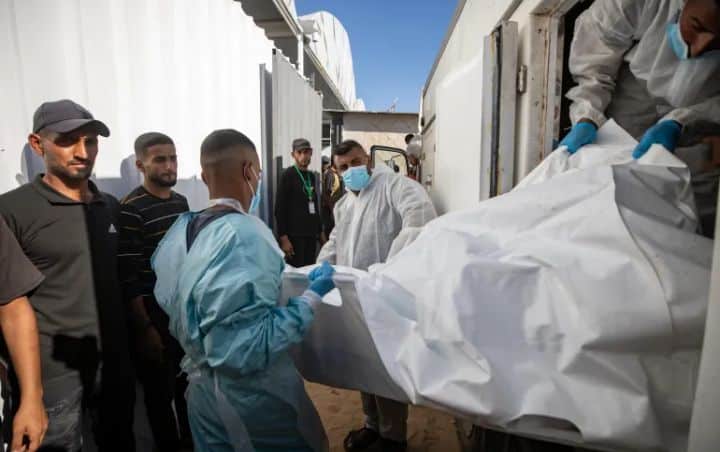
The Health Ministry confirmed that some of the deceased were blindfolded and handcuffed, evidence that points to what doctors described as field executions carried out during Israel’s military operations in Gaza.
The revelation came as forensic teams began cataloguing and photographing unidentified bodies to help families searching for missing relatives after two years of relentless war.
In several cases, the Red Cross was only able to provide names for three of the victims, leaving dozens of families in limbo, waiting outside hospitals in desperate hope for closure.
Among them was 52-year-old Rasmiya Qudeih, who has been searching for her son since October 7, 2023 — the day of the Hamas-led attack that triggered Israel’s massive military campaign.
“Every day I imagine his face,” Qudeih told reporters outside Nasser Hospital. “If he’s gone, I want to know. But if Israel tortured him, I want the world to know.”
Under the terms of the U.S.-brokered ceasefire, Israel agreed to return the bodies of 15 Palestinians for every Israeli returned, including both combatants and civilians killed during the war.
Health officials said the condition of the corpses suggests a pattern of abuse that violates international law and the Geneva Conventions governing the treatment of prisoners and war casualties.
The Gaza torture allegations have also drawn criticism from rights organizations that accuse Israel of using dehumanizing tactics as a weapon of deterrence against Palestinian resistance.
Photos released by Gaza’s Health Ministry showed charred, decomposed, and mutilated remains—many missing limbs or teeth—making identification nearly impossible for grieving families.
Officials said Israeli restrictions on importing DNA testing equipment into Gaza have hindered proper forensic work, forcing medical teams to rely on clothing, scars, and personal effects for recognition.
“The conditions of these bodies reflect deliberate humiliation,” said Dr. Hamad. “Even in death, Israel shows contempt for Palestinian dignity and international norms.”
Israeli officials have not publicly commented on the Gaza torture allegations, and no statement has been issued from the Israeli army regarding the origin or handling of the returned bodies.
It also remains unclear whether the corpses were exhumed from mass graves established during Israel’s ground offensive or taken from detention centers holding Palestinian prisoners.
Throughout the war, the Israeli military repeatedly exhumed Palestinian graves, claiming it was searching for the remains of Israeli captives. Palestinians call these actions a desecration of the dead.
Forensic experts said the returned remains belonged to men between the ages of 25 and 70, most wearing civilian clothing, though a few appeared to be militants based on their uniforms.
Hamad’s team noted that many of the deceased had their hands bound, and at least one bore ligature marks suggesting strangulation or hanging before death.
“These are not accidents of war,” Hamad emphasized. “They were deliberate acts of violence, carried out under Israeli custody and in violation of humanitarian law.”
Gaza’s health authorities accused Israel of turning detention centers into “execution chambers,” adding that several of the deceased were known to have been captured alive before disappearing.
The Gaza torture allegations form part of a broader narrative of abuse that includes reports from released detainees who described electrocution, starvation, and forced exposure to freezing temperatures.
Video footage released by the Health Ministry on Wednesday showed medical teams unwrapping the bodies, some still shackled, as relatives cried in anguish outside the morgue.
Palestinian officials said any unidentified remains will be buried in temporary graves until proper identification is possible, though the blockade and lack of DNA testing complicate the process.
Since the start of Israel’s war on Gaza in October 2023, nearly 68,000 Palestinians have been killed, according to Gaza’s Ministry of Health, though the actual toll is believed to be higher.
Thousands remain missing beneath the rubble of destroyed neighborhoods, their fates unknown, as rescue efforts remain hindered by fuel shortages and Israeli restrictions on heavy equipment.
Rights groups, including Amnesty International and Human Rights Watch, have long accused Israel of committing war crimes in Gaza, including collective punishment and disproportionate targeting of civilians.
A United Nations Commission of Inquiry has described Israel’s campaign as potentially genocidal, a view echoed by South Africa, which filed a genocide case against Israel at the International Court of Justice.
Israel rejects these accusations as “politically motivated,” claiming it acts within international law and targets Hamas infrastructure embedded within civilian areas.
But for Gaza’s exhausted medical workers, the Gaza torture allegations are no longer abstract legal arguments—they are physical evidence carried on the bodies of the dead.
“The marks on their wrists, the burns, the ropes—they tell the story themselves,” said Hamad. “No statement from Tel Aviv can erase what we saw.”
As families continue to gather outside hospitals, the psychological toll deepens. The returned bodies represent not only loss, but humiliation and unresolved trauma for a people living under siege.
Palestinian social media platforms have filled with images of the returned corpses, accompanied by calls for an international investigation into what activists call systematic Israeli war crimes.
In a statement, Gaza’s Health Ministry urged the United Nations and the International Criminal Court to dispatch forensic experts to independently verify evidence of torture and extrajudicial killing.
“The international community cannot remain silent,” the statement read. “These acts defile humanity itself and must be prosecuted under international justice mechanisms.”

Analysts say the revelations could strain the fragile U.S.-brokered ceasefire and inflame tensions across the Middle East, particularly if more evidence of torture emerges in coming days.
The Gaza torture allegations have already sparked renewed protests in Ramallah, Cairo, and Istanbul, where demonstrators demanded global sanctions against Israel and accountability for its military commanders.
As Gaza’s morgues overflow once again, the question is not whether war crimes were committed—but whether the world will care enough to confront them.
About The Author


