Nigeria’s renewed push for industrialisation has taken a strategic turn as the Federal Government positions the Cotton, Textile and Garment sector at the centre of its value-chain transformation agenda. The move signals a shift from fragmented policy interventions to a more coordinated, production-driven industrial ecosystem anchored on domestic capacity and export competitiveness.
FG taps $1.39trn textile market as flagship pilot for Nigeria’s industrial transformation drive
The Federal Government has designated the Cotton, Textile and Garment (CTG) industry as the flagship pilot under its newly operationalised Nigeria Industrial Policy, aiming to harness opportunities within the $1.39 trillion global textile market projected for 2025.
According to projections by the United Nations Industrial Development Organization, the global textile industry is valued at $1.39 trillion and is expected to approach $2 trillion in the coming years.
Nigerian policymakers view this expansion as a window for reintegration into global value chains, particularly given the country’s historical strength in cotton production and garment manufacturing.
Bridging Policy and Production
The decision to prioritise CTG aligns with the Ministry of Industry, Trade and Investment’s 2026 Outlook, which outlines a structured execution roadmap for the Nigeria Industrial Policy. The document emphasises the transition from policy pronouncements to measurable production outcomes.
Officials say the CTG sector will serve as a test case for coordinated value-chain development—linking raw material sourcing, processing, manufacturing, logistics, and export markets under a unified framework.
The broader industrial transformation strategy focuses on scaling industrial clusters, activating Special Economic Zones (SEZs), strengthening processing hubs, and improving domestic raw material utilisation. Digital Free Zones and enhanced regulatory coordination are also part of the reform architecture.
By selecting textiles as a flagship pilot, authorities aim to demonstrate how a demand-anchored industrial ecosystem can stimulate job creation, deepen local manufacturing, and reduce import dependency.
Rising Imports Underscore Urgency
The urgency behind the initiative is underscored by Nigeria’s growing textile import bill. Data from the National Bureau of Statistics show that textile and textile article imports reached N814.3 billion in the first nine months of 2025, up sharply from N552.3 billion during the corresponding period in 2024—a 47 percent increase within one year.
Despite its historical prominence and labour absorption potential, the domestic textile industry has struggled with infrastructure deficits, inconsistent power supply, limited access to long-term finance, and competition from low-cost imports.
The FG taps $1.39trn textile sector as flagship pilot for Nigeria’s industrial transformation drive in response to these structural challenges.
Policymakers argue that strengthening domestic capacity is essential not only for import substitution but also for positioning Nigerian-made garments in regional and global markets.
Four-Pillar Execution Agenda
The Ministry’s 2026 priorities are structured around four reinforcing pillars designed to tighten implementation and sustain reform momentum. Central to this agenda is disciplined execution and closer integration of trade, investment, and industrial policies.
Priority sectors identified for value addition include agro-processing, solid minerals beneficiation, light manufacturing, pharmaceuticals, and textiles. However, the CTG sector is expected to provide proof of concept for coordinated value-chain development.
Sub-national governments are expected to collaborate in upgrading Micro, Small and Medium Enterprises (MSMEs), improving productivity, and aligning local industrial clusters with national targets.
By embedding performance oversight mechanisms and digital monitoring systems, authorities intend to strengthen accountability across strategic industrial assets.
Financing and Trade Corridors
Access to patient capital remains a critical bottleneck for industrial expansion. As part of the reform package, the government plans to expand long-term industrial financing options to enable factory retooling, technology upgrades, and capacity expansion within the textile value chain.
Trade facilitation will also play a demand-side role in the transformation drive. The strategy includes activating bilateral and regional trade corridors to create export pathways for locally manufactured goods.
Priority trade relationships will be reinforced with traditional partners such as the United States, the United Kingdom, and the European Union, while expanding engagement with emerging markets including the United Arab Emirates, Brazil, and Japan.
Full implementation of the African Continental Free Trade Area (AfCFTA) protocols is expected to remain central to scaling intra-African textile exports.
The FG taps $1.39trn textile sector as flagship pilot for Nigeria’s industrial transformation drive partly to leverage AfCFTA’s tariff concessions and harmonised trade standards, which could open up new continental markets for Nigerian garments.
Employment and Value Addition Potential
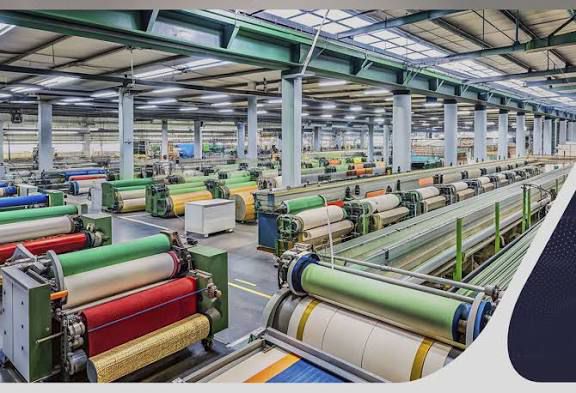
Industry analysts note that textiles offer one of the highest employment multipliers within manufacturing. The sector spans agriculture (cotton farming), processing (ginning and spinning), weaving, dyeing, garment assembly, distribution, and retail—creating opportunities for both skilled and semi-skilled labour.
If successfully executed, the pilot could revitalise dormant textile mills, stimulate cotton farming in northern states, and attract foreign direct investment into apparel manufacturing.
However, experts caution that policy coherence must be matched by reliable power supply, improved logistics infrastructure, and sustained macroeconomic stability to ensure competitiveness.
The FG taps $1.39trn textile market as flagship pilot for Nigeria’s industrial transformation drive at a time when global supply chains are undergoing recalibration. As multinational brands diversify sourcing destinations, Nigeria is seeking to position itself as a viable manufacturing hub within Africa.
The success of the pilot will likely determine the scalability of the broader industrial transformation framework. If the CTG value chain demonstrates measurable productivity gains, export growth, and job creation, the model could be replicated across other priority sectors.
For now, the textile sector stands at the forefront of Nigeria’s industrial reset—tasked with proving that coordinated policy execution can translate ambition into tangible economic output.
About The Author