
A ferry carrying over 350 people sinks in Philippines, killing at least 15 after capsizing off Basilan province, triggering frantic overnight rescue operations and renewed scrutiny of maritime safety enforcement nationwide.
A ferry carrying over 350 people sinks in Philippines, killing at least 15 when the passenger vessel, identified as MV Trisha Kerstin 3, went down shortly after midnight during a routine domestic voyage.
The ferry had departed the port city of Zamboanga late on Sunday night, bound for Jolo Island in the Sulu archipelago, a common route used by workers, traders, and families.
According to the Philippine Coast Guard, the vessel encountered trouble roughly four hours into its journey, prompting a distress call at approximately 1:50am local time.
Officials said the ferry sank about one nautical mile from the coastal village of Baluk-baluk in Basilan, allowing some passengers to swim or cling to debris.
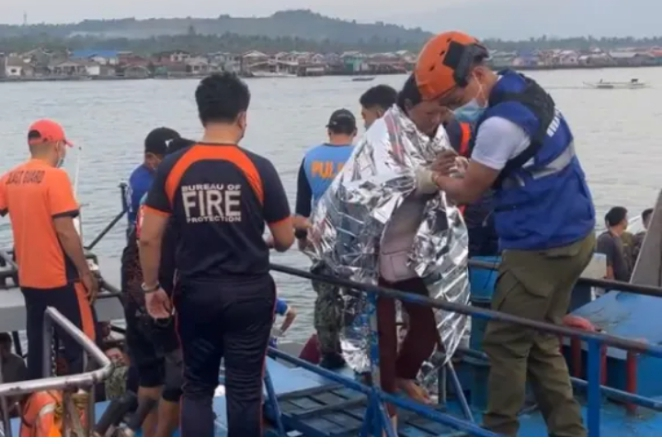
Survivors were initially brought ashore by local fishing boats and small craft, with residents responding quickly after hearing cries for help in the darkness.
The Coast Guard confirmed that the ferry had 332 passengers listed on its manifest, along with 27 crew members assigned to the voyage.
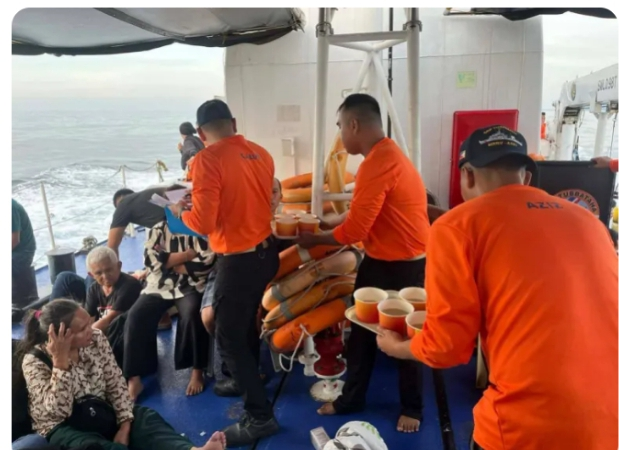
As rescue operations continued throughout Monday, authorities said at least 316 people had been rescued alive, many suffering from exhaustion and exposure.
Fifteen deaths were confirmed by regional officials, while 28 passengers remained unaccounted for as divers and surface teams expanded the search perimeter.
Coast Guard Commander Romel Dua, speaking from the Southern Mindanao District, said aerial and naval assets were immediately deployed to assist.
“A coast guard aircraft is also on the way to help the operation. The Navy and Air Force also sent their assets,” Dua told news agencies.
He added that weather conditions at the time of the sinking were described as good, raising urgent questions about what caused the vessel to capsize.
Emergency responders in Basilan said the volume of survivors arriving simultaneously placed enormous strain on limited medical resources in the province.
Those requiring treatment were transported to hospitals in Isabela City, where doctors and nurses worked continuously to stabilise patients.
“The challenge here really is the number of patients that are coming in. We are short-staffed at the moment,” said medic Ronalyn Perez.
Videos posted by Basilan Governor Mujiv Hataman showed survivors wrapped in thermal blankets, some visibly shaken, others carried on stretchers.
Hataman said most rescued passengers were in stable condition, though several elderly individuals required urgent medical intervention upon arrival.
He also confirmed that authorities were carefully cross-checking the passenger manifest to determine whether undocumented passengers were aboard.
Discrepancies between official passenger lists and actual numbers have historically complicated rescue efforts following maritime disasters in the Philippines.
Commander Dua said the ferry had been cleared by the Coast Guard before leaving Zamboanga, with no immediate indication of overloading.
However, he stressed that a full investigation would be launched to determine whether mechanical failure, human error, or structural issues played a role.
Maritime accidents remain a persistent problem in the Philippine archipelago, which consists of more than 7,600 islands linked heavily by sea transport.
Despite regulations, enforcement is often uneven, particularly in remote southern provinces where ferries remain a lifeline for isolated communities.
Overcrowding, aging vessels, poor maintenance, and inconsistent safety inspections have repeatedly been cited in official accident investigations.
Local residents in Basilan described chaotic scenes as survivors arrived soaked and shivering, many having lost personal belongings and travel documents.
Some passengers said they were asleep when the ferry suddenly listed, leaving little time to retrieve life jackets before the vessel went under.
Others recalled hearing shouting and confusion on board as crew members attempted to guide passengers toward exits in near-total darkness.
Fishing boats operating nearby reportedly played a crucial role, rescuing dozens of passengers before official responders reached the scene.
The Philippine Navy and Air Force coordinated closely with the Coast Guard, expanding search operations as daylight improved visibility.
Authorities said divers were deployed to search the submerged wreckage, while surface vessels combed surrounding waters for survivors or bodies.
The tragedy comes amid a series of recent maritime incidents highlighting the risks faced by sailors and passengers in Philippine waters.
Just days earlier, at least two Filipino sailors were reported killed when a Singapore-flagged cargo ship sank while en route to China.
Four crew members from that incident remain missing, underscoring the dangers of maritime travel across the region’s busy sea lanes.
Last week, a private vessel also sank off the Davao region, killing at least six people and leaving nine others unaccounted for.
Such incidents have revived painful memories of past disasters, including the 1987 sinking of the ferry Dona Paz.
That catastrophe, which killed more than 4,300 people after a collision with a fuel tanker, remains the world’s worst peacetime maritime disaster.
Families of those aboard the MV Trisha Kerstin 3 gathered anxiously at ports and hospitals, seeking information about missing relatives.
Authorities urged the public to rely on verified updates, warning against the spread of unconfirmed casualty figures on social media.
President and national transport officials have yet to issue a formal statement, though calls for tighter enforcement are growing louder.
Lawmakers from maritime provinces said repeated tragedies demonstrate the urgent need for vessel modernisation and crew training.
Maritime unions echoed those concerns, calling for stricter audits of passenger ferries and harsher penalties for safety violations.
As rescue operations continue, the focus remains on locating the missing and providing psychological support to traumatised survivors.

For many families, hope persists that those still unaccounted for may yet be found alive as search efforts intensify.
The sinking has once again exposed the human cost of maritime failures in a country where sea travel remains unavoidable for millions.
Investigators are expected to release preliminary findings in the coming days, though past cases suggest accountability may be slow.
For now, the nation mourns yet another preventable tragedy at sea, even as rescuers work tirelessly in Basilan’s coastal waters.
Read also: Trump threatens Canada tariff over Canada-China trade deal