

The Eurozone recorded a slight increase in inflation for November, according to fresh data released on Tuesday, signalling a delicate period for policymakers as the European Central Bank weighs the next steps in its monetary strategy.
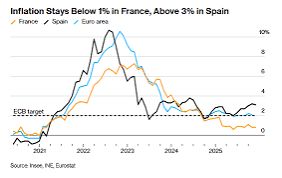
The Eurozone inflation report, published by Eurostat, the European Union’s statistics office, shows that consumer prices across the 20-nation currency bloc rose by 2.2 per cent year-on-year, nudging past the European Central Bank’s benchmark target.
The marginal rise surprised analysts who had anticipated no movement from October’s 2.1 per cent reading.
The projection, aggregated from Bloomberg’s survey of financial experts, had pointed to a stable inflation outlook.
However, the November data suggests a more complex inflation trajectory as the year winds down.
Eurozone Inflation: November Data Shows Mild but Notable Acceleration
The modest uptick in Eurozone inflation was driven mainly by energy prices, which continued their downward trend but at a slower pace than earlier months.
Energy costs have been a major driver of inflation volatility since late 2021, particularly in the aftermath of geopolitical tensions and disruptions in global supply chains.
While prices remained below last year’s levels, the slower rate of decline contributed to upward pressure on the inflation index.
Service-sector inflation also nudged upward, rising 3.5 per cent in November, compared to 3.4 per cent in October.
This slight increase highlights the persistence of price pressures in labour-intensive sectors such as tourism, hospitality, transportation, and personal services, where wage adjustments and operational costs continue to shape consumer prices.
Despite these changes, core inflation, which excludes energy, food, alcohol, and tobacco, held steady at 2.4 per cent.
This stability aligns with analyst expectations and is considered a key indicator for policymakers concerned about underlying, longer-term inflationary forces.
ECB Expected to Maintain Steady Rates Amid Inflation Moderation
Analysts note that the latest figures—while slightly above the ECB’s two per cent target—are unlikely to prompt an immediate shift in interest-rate policy.
The European Central Bank has held its benchmark rate steady since its last adjustment in June, ending a prolonged period of rate cuts that aimed to stimulate the post-pandemic economy.
The ECB’s Governing Council is scheduled to meet again on December 18, where the updated inflation data will form part of a broader assessment of economic health across the bloc.
With the Eurozone economy still showing sluggish growth, many expect the central bank to balance caution with restraint.
Inflation had peaked at more than 10 per cent in late 2022 amid an energy crisis fuelled by the war in Ukraine, prompting aggressive rate hikes across Europe.
Since then, inflation has gradually fallen, stabilising near the two per cent mark for several months. T
he November uptick, while modest, serves as a reminder that price stability remains fragile.
Economic Outlook: Challenges and Signals for the Coming Year
Economists caution that although inflation is settling, pockets of uncertainty persist.
The gradual moderation in energy prices could easily be disrupted by global events, supply bottlenecks, or further geopolitical tensions.
Meanwhile, price pressures in services indicate that inflation may remain slightly above target for some time unless wage growth eases.
The latest data also arrives at a time when many Eurozone economies are confronting stagnation or contraction.
Germany, the bloc’s largest economy, has struggled with industrial output declines, while nations such as Italy and France face fiscal pressures that limit their ability to stimulate growth through spending.
Consumer demand across the Eurozone has been hampered by months of high prices, rising borrowing costs, and weakened purchasing power.
While real incomes are beginning to recover, households remain cautious, particularly as winter energy bills and post-pandemic adjustments continue to affect budgets.
Global Market Reactions and Policy Implications
International markets reacted moderately to the Eurozone’s inflation announcement, with traders expressing relief that core inflation remained unchanged.
While some had feared a sharper rise that could trigger renewed monetary tightening, the data indicates that the ECB may have room to hold rates steady into early 2026.
However, financial experts warn that the central bank must tread carefully.
Any premature loosening of monetary policy could reignite inflationary pressures, while prolonged restrictive conditions risk slowing economic activity further.
Outside Europe, the inflation trajectory in the Eurozone continues to influence global markets, particularly as the United States and the United Kingdom pursue their own inflation management strategies.
The U.S. Federal Reserve is expected to review key data on labour markets and consumer spending this month, while the Bank of England maintains a wait-and-see approach.
What the November Figures Mean for Households and Businesses
For households, the modest rise in inflation may not translate into noticeable changes in everyday costs, but it signals continued pressure in service-related expenses.
For businesses, especially those dependent on energy or managing rising wage demands, the data reflects an environment where cost management remains complex.
Small and medium-scale enterprises—particularly in hospitality, retail and logistics—continue to navigate tight margins.
Meanwhile, corporates are recalibrating their investment plans as borrowing remains expensive.
A Fragile Stability as ECB Eyes 2026
As 2025 draws to a close, the Eurozone stands at an inflationary crossroads.
The November data underscores both progress and vulnerability: inflation is far below its 2022 peak but still hovering slightly above the preferred threshold.
With Eurozone inflation showing mild acceleration and core inflation remaining steady, the ECB faces a delicate balancing act in the months ahead.
While the uptick may reinforce predictions of stable interest rates in December, policymakers will remain alert to emerging risks.
The coming year will test the resilience of the region’s economic recovery—and determine whether inflation can consistently align with long-term stability goals.
About The Author


