The EU ambassadors convene after Trump threatens tariffs to force Greenland purchase, marking a serious escalation in transatlantic tensions involving trade, sovereignty, and Arctic security.
Representatives from all twenty-seven European Union member states were summoned for urgent talks following President Donald Trump’s unprecedented tariff ultimatum linked directly to Greenland.
Cyprus, holding the European Union’s rotating presidency, confirmed the meeting would take place Sunday evening amid mounting concern across European capitals.
Diplomats described the move as a defensive coordination effort rather than panic, aimed at preserving unity and assessing potential economic countermeasures.
The crisis erupted after Trump announced sweeping tariffs against European allies unless the United States is permitted to buy Greenland outright.
In a lengthy statement published on Truth Social, Trump outlined plans to impose a ten percent tariff starting February first.
He warned those tariffs would rise sharply to twenty-five percent by June should negotiations over Greenland’s ownership fail to progress.
“This tariff will be due and payable until such time as a deal is reached,” Trump wrote, framing the issue as non-negotiable.
The countries targeted include Denmark, Norway, Sweden, France, Germany, the United Kingdom, the Netherlands, and Finland.
All eight nations maintain close security and economic ties with Washington through Nato and longstanding bilateral agreements.
European officials reacted with disbelief, describing the threat as an attempt to leverage economic power for territorial acquisition.
One senior EU diplomat said, “This crosses a line we have not seen crossed in modern transatlantic relations.”
Greenland, an autonomous territory within the Kingdom of Denmark, has repeatedly rejected any suggestion it could be sold.
Danish officials stressed that decisions concerning Greenland rest solely with its people and elected government.
Denmark’s foreign minister, Lars Løkke Rasmussen, expressed surprise at Trump’s remarks following recent diplomatic engagements.
“Earlier this week, we had a constructive meeting with Vice President Vance and Secretary Rubio,” Rasmussen said publicly.
He added that Denmark had no indication such an announcement was forthcoming from the White House.
Rasmussen emphasised that recent Nato deployments in Greenland were defensive and agreed collectively with allies.
“The purpose of the increased military presence is to enhance security in the Arctic,” he said.
Trump also claimed European forces had travelled to Greenland “for purposes unknown,” alarming several Nato governments.
European defence officials dismissed the allegation, noting deployments were transparent and coordinated through alliance structures.
Behind closed doors, EU leaders warned that linking tariffs to territorial demands undermines international norms.
Trade experts cautioned that proposed tariffs could severely disrupt European exports to the United States.
Read also: Conservative Party’s Future: Kemi Badenoch Outlines a Stronger, United Britain
Key sectors including automobiles, agriculture, pharmaceuticals, and machinery could face immediate economic pressure.
The European Commission confirmed it is reviewing legal and trade response options under World Trade Organization rules.
However, officials stressed diplomacy remains the preferred path to de-escalation.
“We want dialogue, not confrontation,” one Commission official said following the announcement.
Analysts noted Trump’s renewed fixation on Greenland has intensified since recent US security operations abroad.
Greenland’s strategic Arctic location and rare-earth mineral reserves have attracted growing global attention.
US allies dispute claims that Greenland’s current status represents a national security threat to Washington.
Nato officials emphasised Arctic cooperation has historically strengthened stability rather than undermined it.
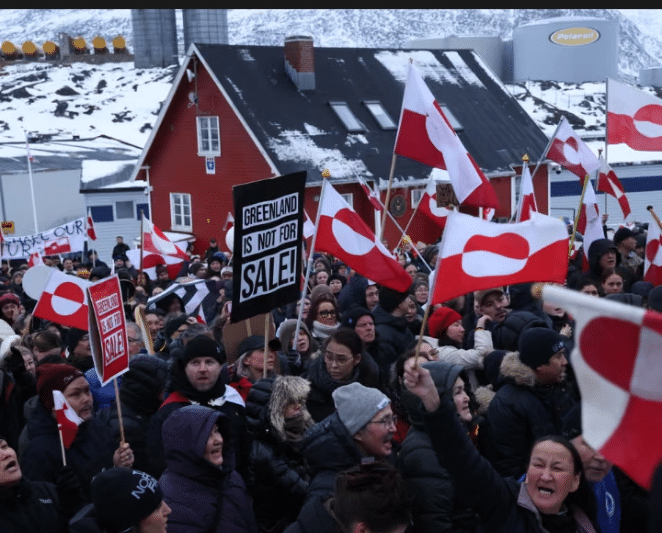
Public reaction across Denmark and Greenland was swift, with protests rejecting any sale of the territory.
“We are not for sale,” one Greenlandic lawmaker said during a televised interview.
Within the European Union, concerns are rising that the dispute could derail broader EU-US trade negotiations.
Some diplomats warned of a retaliatory spiral if economic pressure replaces constructive diplomacy.
Despite rising tensions, EU leaders insisted transatlantic ties remain strategically vital.
Several governments urged Washington to reconsider its approach and return to traditional diplomatic channels.
Sunday’s meeting is expected to result in a coordinated EU statement rejecting the tariff threat.
Whether the crisis escalates further may depend on Washington’s response to Europe’s unified stance.
For now, the confrontation represents one of the most serious strains in EU-US relations in recent years.
About The Author