

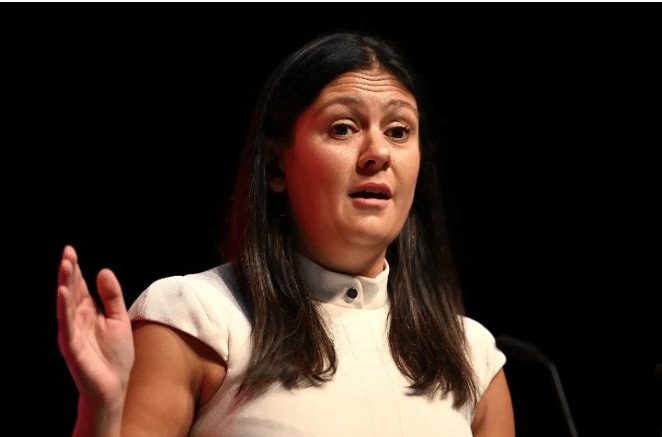
The British position on Greenland was restated forcefully on Sunday as ministers pushed back against US pressure while seeking to avoid an escalation in transatlantic tensions.
Speaking on Sky News, Lisa Nandy confirmed the British position on Greenland would not shift, even as Washington considers punitive trade measures against close allies.
Nandy said the government fundamentally disagreed with the proposed US tariffs, arguing such steps undermined cooperation between longstanding security and economic partners.
She stressed that diplomatic engagement, rather than confrontation, remained the UK’s preferred route for resolving disagreements with President Donald Trump’s administration.
The culture secretary noted that discussions with American counterparts would focus on shared security interests, particularly in the Arctic and North Atlantic regions.
According to Nandy, British ministers believe cooperation with the United States strengthens both countries more than unilateral actions driven by territorial ambition.
Trump has reignited controversy by pledging to impose tariffs on the UK until progress is made toward a deal enabling US acquisition of Greenland.
The renewed remarks echo earlier statements by Trump, who previously described Greenland as strategically essential to American national security interests.
Denmark and Greenland have repeatedly rejected the notion of any sale, insisting the territory’s future is a matter for its people alone.
The British position on Greenland aligns closely with Denmark’s stance, reinforcing European unity against external pressure over sovereignty issues.
Nandy said the UK would not be drawn into a “war of words,” despite sharp differences with the White House over Greenland.
She emphasised that maintaining calm diplomatic language was essential to protecting wider economic and security relationships with Washington.
Prime Minister Keir Starmer had earlier described the proposed US tariffs as completely wrong and damaging to allied cooperation.
Starmer’s intervention underlined the government’s determination to separate trade disputes from broader strategic partnerships.
When asked about possible UK retaliation, Nandy declined to outline specific countermeasures against potential US tariffs.
She also avoided speculation about delaying King Charles’ planned state visit to the United States.
The refusal to outline retaliatory steps reflects the government’s desire to keep diplomatic channels open.
Officials fear public escalation could harden positions on both sides and complicate negotiations on unrelated global challenges.
Security analysts note Greenland’s growing importance as melting Arctic ice opens new shipping routes and resource opportunities.
The island’s strategic location makes it central to NATO defence planning and transatlantic security coordination.
The British position on Greenland therefore carries implications beyond diplomacy, touching on defence, climate, and global trade concerns.
UK officials believe close cooperation with Denmark and European partners strengthens resistance to unilateral pressure.
Within Parliament, opposition figures broadly support the government’s firm stance on territorial sovereignty.
Some MPs have urged ministers to prepare contingency plans should US tariffs materialise.
Business groups have warned that new tariffs could disrupt already fragile supply chains.
Trade experts caution that tit-for-tat measures would harm consumers on both sides of the Atlantic.
Despite tensions, ministers continue to stress the enduring strength of the UK–US relationship.
Nandy reiterated that shared democratic values and security interests remain central to bilateral cooperation.
The British position on Greenland, she said, reflects respect for international law and self-determination principles.
Read also:
US Congressional delegation warns against undermining Denmark over Greenland
Government sources insist there is no scenario under which the UK would support US ownership of Greenland.
As talks continue, London hopes dialogue will defuse tensions before economic measures are implemented.
For now, the government’s message remains clear, measured, and resolute.
The government is also coordinating closely with European allies to ensure a unified response should US trade measures be activated.
Officials believe collective diplomacy strengthens leverage while reducing the risk of individual countries being singled out for economic pressure.
Downing Street sources say discussions with Washington will continue quietly through diplomatic channels in the coming weeks. The aim, they insist, is to de-escalate tensions while firmly upholding the British position on Greenland.
About The Author
