Cyprus military bases protests are intensifying across Nicosia as demonstrators pressure the United Kingdom to withdraw forces following a dramatic drone strike that heightened security fears nationwide.
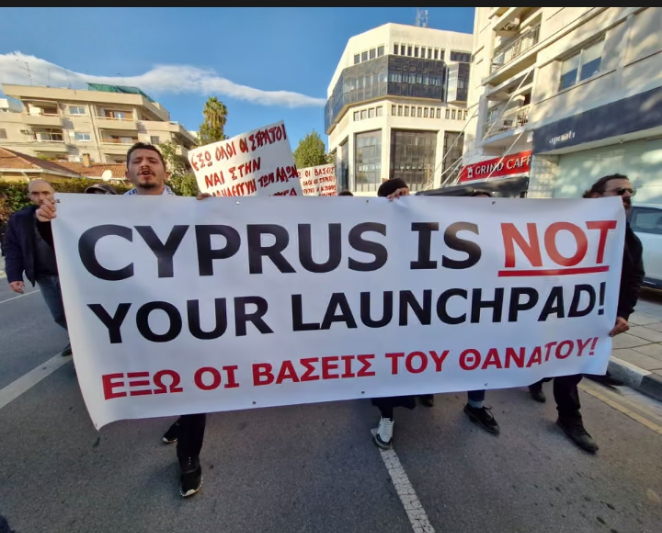
Crowds marched through central districts carrying banners condemning foreign military installations, chanting slogans demanding sovereignty and neutrality while accusing British authorities of placing civilians at risk amid escalating regional hostilities.
The unrest follows a direct strike on RAF Akrotiri, one of Britain’s most strategically significant overseas bases, long viewed locally as symbolising lingering colonial-era defence arrangements.
Many protesters argue the installations make Cyprus an unintended target, fearing spillover from intensifying Middle Eastern confrontations and broader geopolitical rivalries involving Western alliances and regional powers.
Demonstrator Mathaios Stavrinides said the facilities are “a danger to our security,” insisting communities never consented to permanent foreign military footprints embedded within nationally sensitive territory decades earlier.
Protesters gathered near government buildings, waving placards reading “Cyprus is not your launch pad,” reflecting frustration that global conflicts increasingly influence domestic stability and public safety concerns.
Officials confirmed the incident involved an Iranian-designed unmanned aircraft, heightening anxieties about transnational proxy confrontations and raising questions regarding regional air defence readiness and intelligence coordination effectiveness.
Constantinos Kombos stated the drone originated from Lebanon, identifying launch corridors linked to militant networks operating within complex regional security environments.
He warned authorities must examine threats emerging from multiple directions, saying defence planners “cannot exclude anything,” emphasising vigilance as aerial warfare technology evolves rapidly across contested zones.
Security officials reported additional drones were intercepted offshore, reinforcing assessments that hostile actors may be probing defensive capabilities and exploiting geographic proximity between Mediterranean territories and conflict theatres.
Cypriot leaders maintain their nation remains neutral, arguing British sovereign bases, rather than the republic itself, represent primary strategic targets amid widening confrontation involving global alliances.
Diplomatic sources say London previously received warnings about mounting risks, though critics allege insufficient preventative measures were implemented before the unprecedented aerial incursion occurred.
RAF Akrotiri serves as Britain’s principal staging hub for Middle East operations, hosting aircraft, surveillance systems, and logistical infrastructure essential to multinational missions.
The base forms part of territories retained when Cyprus gained independence, an arrangement still debated domestically due to sovereignty sensitivities and historical memories of colonial governance structures.
Foreign ministry officials argue defensive preparations did not fully match evolving risks, stressing expectations that all personnel, including Cypriot employees, deserve maximum protection against emerging asymmetric threats.
Kombos emphasised improving cooperation with British counterparts, stating immediate priority involves strengthening coordination, surveillance integration, and rapid-response mechanisms capable of countering unpredictable aerial incursions.
European partners have since deployed naval and air assets to bolster regional stability, responding to Cypriot requests for precautionary support as authorities seek to reassure anxious communities.
The Royal Navy reinforced defensive capabilities, dispatching helicopters and advanced aircraft designed to intercept hostile systems and deter further attempts targeting sensitive installations.
Additional fighter jets arrived recently to enhance patrol capacity, though critics argue reinforcements appeared reactive rather than preventative, fuelling scepticism regarding long-term strategic planning credibility.
A British destroyer undergoing maintenance in Portsmouth is expected later, prompting debate about deployment timelines and operational readiness amid fast-moving regional developments.
Kombos remarked, “We don’t just want to stockpile assets,” stressing deployed resources must deliver practical defensive value rather than symbolic reassurance during volatile security periods.
Authorities confirmed nationwide defence planning follows a whole-island model, aiming to protect civilian zones alongside military sites to prevent public perception that strategic facilities receive disproportionate attention.
Cyprus continues pursuing closer cooperation with NATO structures despite longstanding political obstacles, seeking integrated systems access without full alliance membership.
Government representatives argue enhanced interoperability strengthens national resilience while respecting constitutional neutrality commitments shaped by decades of delicate regional diplomacy and historical division.
President Nikos Christodoulides insisted Cyprus will not participate in external combat missions, reaffirming defensive posture while acknowledging all strategic options remain under review.
The administration faces its most serious security crisis since 1974, when regional upheaval reshaped territorial realities and entrenched cautious foreign policy doctrines prioritising stability and diplomatic balance.
Defence minister Vasilis Palmas disclosed the drone evaded radar due to low altitude and moderate speed, complicating detection despite layered monitoring frameworks.
Military analysts note such flight profiles challenge conventional systems optimised for higher trajectories, highlighting technological gaps adversaries may exploit using relatively inexpensive unmanned platforms.
Public anger intensified after conflicting explanations emerged about damage extent, fuelling suspicions officials were withholding sensitive operational details regarding infrastructure impact severity.
Initial reports suggested runway strikes, while later images indicated hangar destruction, prompting speculation surrounding the presence of foreign intelligence assets stationed within secure sections.
Some residents believe inconsistent communication erodes trust, arguing transparent briefings are essential during crises where misinformation can spread rapidly across digital networks.
Activists claim historical grievances amplify opposition, viewing sovereign base arrangements as remnants of imperial influence incompatible with modern democratic self-determination principles.
Younger demonstrators link environmental, sovereignty, and security concerns, asserting militarisation contradicts aspirations for Cyprus to serve as humanitarian and diplomatic bridge between regions.
Chants echoed through central avenues as marchers demanded parliamentary debate on long-term defence agreements, calling for referendums to legitimise any continued foreign military presence.
Civil society groups organised teach-ins explaining legal frameworks governing base territories, encouraging informed participation rather than purely emotional mobilisation during tense national discussions.
Read also: Badenoch attacks Starmer’s Iran policy after by-election defeat, warns UK risks falling behind in Middle East conflict
Business owners expressed mixed reactions, balancing economic benefits from military employment against fears instability could deter tourism and international investment vital for growth.
Regional observers warn Cyprus’s geographic location places it near flashpoints, making defence partnerships strategically attractive yet politically sensitive domestically.
Kombos concluded cooperation must evolve with emerging threats, emphasising balanced diplomacy that protects sovereignty while sustaining constructive relations with longstanding international partners.
As Cyprus military bases protests continue, policymakers face intensifying pressure to reconcile national security priorities with public demands for autonomy, transparency, and reduced exposure to external geopolitical confrontations.
About The Author