Canadian Sikh activist– Police in Canada have issued a stern warning to a prominent Sikh leader, confirming a credible threat against Moninder Singh and his family.
Officials visited Singh’s Toronto residence on Sunday, citing information from a confidential informant indicating serious risks to his life. “It kills me to know you’re in this position,” one officer told Singh during the warning, underscoring the gravity of the situation.
This development comes just days before the Mark Carney visit to India, which aims to expand trade ties but raises concerns for human rights advocates.
Singh, head of the Sikh Federation of Canada, expressed deep alarm at the threats, highlighting that they now extend to his wife and two children. “If people like me start going silent, then, you know, these people that are being extorted… what would happen to them?” Singh said.
The activist, a close friend of the late Hardeep Singh Nijjar, suggested that the Indian government could be behind these renewed threats, reflecting ongoing tensions between Ottawa and New Delhi.
The Khalistan movement, advocating for an autonomous Sikh homeland in India, remains banned in Delhi. Singh has long been vocal about this cause, which he claims has made him a target of intimidation campaigns.
Canada’s federal police and intelligence agencies have previously accused India of orchestrating Nijjar’s assassination in 2023, heightening concerns for Sikh leaders abroad. Singh warned that “silence is what they want,” emphasizing the need to continue speaking out despite personal danger.
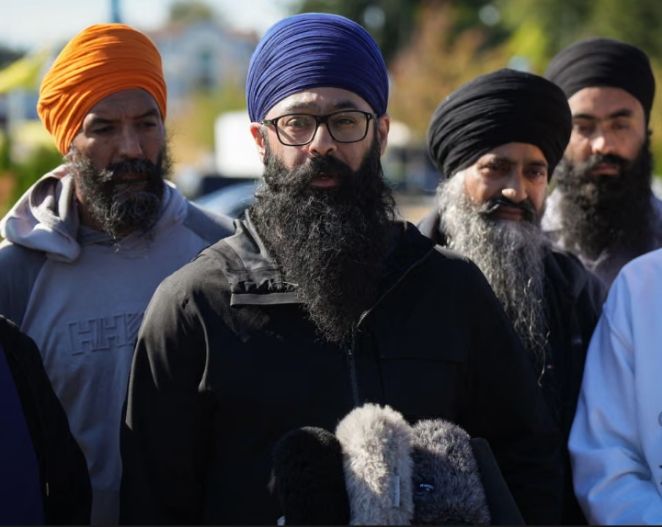
While the Canadian government maintains that India’s campaign of threats has ended, Singh voiced skepticism about this claim.
“Putting trade before Canadian lives is what we’ve been worried will keep happening,” he said, reflecting broader unease over the India-Canada diplomatic tensions.
The activist fears that high-profile visits, such as Carney’s trip, could allow India to escape scrutiny while advancing economic objectives, a concern echoed by community members aware of previous incidents.
Canada’s intelligence reports note multiple credible and imminent threats to Sikh activists, citing surveillance and coercion tactics targeting community leaders. A suspect reportedly linked to India and the Lawrence Bishnoi gang monitored the routines of political figures like Jagmeet Singh, prompting Canadian police to place him under protection.
Singh emphasized that the stakes are high for families and communities advocating for Khalistan, stating, “The difference between India and China… is that India has been singled out as being highly violent in Canada over the last several years.”
The upcoming Mark Carney visit highlights the tension between trade ambitions and security concerns. Singh voiced frustration, claiming that Canada risks normalizing relations with India despite ongoing threats.
He argued that diplomatic gestures could inadvertently embolden the very entities behind the intimidation campaigns. “For activists such as myself, it feels like a slap in the face,” he said, underlining the emotional and political weight of these developments.
Canada’s government has tried to balance economic interests with accountability, asserting confidence in New Delhi’s commitment to nonviolence while negotiating trade agreements.
Recent trips, including initiatives with China, have been framed as models for expanding Canadian markets. Yet, Singh warned that India’s track record of targeted violence against Sikh dissidents in Canada makes such assumptions dangerous.
“Other countries harass or try to silence dissidents – but the actual violence, extortions and murder come from India,” he noted, reiterating a persistent concern among activists.
As the situation unfolds, Singh’s resolve remains firm. Despite threats to his family, he insists that advocacy for the Khalistan movement and awareness of state-sponsored intimidation cannot be silenced.
His warnings reflect broader anxieties in the Sikh diaspora, as well as ongoing diplomatic challenges between Ottawa and New Delhi. Canada’s law enforcement and intelligence services continue to monitor threats closely, issuing duty-to-warn notices to ensure safety while navigating complex geopolitical pressures.
Singh’s predicament illustrates the intersection of international diplomacy, domestic security, and minority rights. The combination of high-profile threats and the Mark Carney visit has reignited debate over how Canada balances economic initiatives with the protection of vulnerable communities.
Singh’s message is clear: “As an activist, as a leader in the community, I’m not going to be thwarted by this.” His stance underscores the human cost behind international trade and political maneuvering, reminding policymakers of the stakes involved.
The situation also sheds light on the ongoing relevance of the Khalistan movement and the risks faced by Sikh activists worldwide. Singh’s advocacy, coupled with credible threats from foreign actors, highlights the persistent challenge of protecting dissidents while maintaining diplomatic relations.
Canadian authorities continue to stress vigilance and intelligence sharing, yet Singh insists that “if people start going silent, then the consequences will ripple through our community,” capturing the tension between public safety and political advocacy.
In conclusion, the renewed threats to Moninder Singh ahead of the Mark Carney visit underline the delicate balance Canada faces between engaging India economically and protecting its citizens.
Read also: Starmer’s urgent plea: Reject ‘toxic’ politics in crucial Gorton and Denton By-Election
The situation spotlights the broader challenges surrounding the Khalistan movement, state-sponsored threats, and India-Canada diplomatic tensions, illustrating that trade deals cannot come at the expense of human lives.
Singh’s determination to speak out despite personal risk reinforces the ongoing struggle for justice and accountability in an increasingly complex international landscape.