

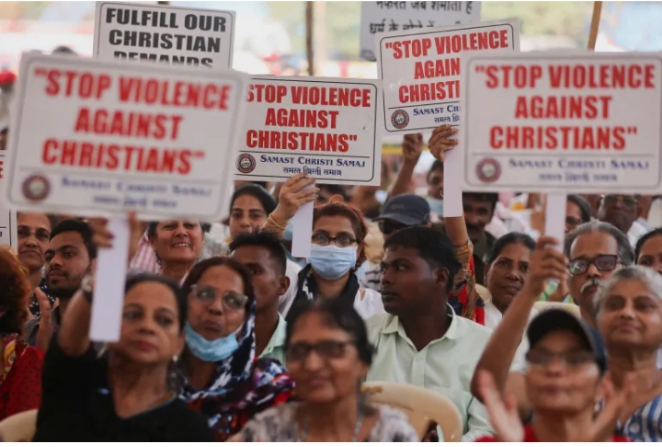
As hate spirals in India, Hindu extremists target Christians in what rights groups and researchers describe as a sharp escalation of religious intolerance under the country’s current political climate.
The latest incidents, which unfolded during the Christmas season, underscore growing concerns that India’s Christian minority is increasingly facing hostility alongside Muslims, long the primary targets of Hindu majoritarian rhetoric.
On Christmas Eve, Hindu hardline groups affiliated with Prime Minister Narendra Modi’s Bharatiya Janata Party announced a shutdown in the central Indian city of Raipur, citing allegations of “forced” religious conversions by Christians.
Such accusations have frequently been levelled against Christian communities despite repeated findings that there is little evidence to support them.

The protest atmosphere quickly spilled into violence, with groups of men armed with wooden sticks storming a shopping mall in Raipur, vandalising Christmas decorations and disrupting celebrations.
Although police registered a case against dozens of unidentified attackers, only six men were arrested. They were released on bail within days and welcomed with garlands, chants and celebratory processions outside the jail, scenes that spread widely on social media and drew criticism from civil society groups.
On Christmas morning, Prime Minister Modi visited a Catholic church in New Delhi to mark the holiday but did not publicly condemn the violence.
For many observers, the silence was emblematic of what they see as a broader pattern of political reluctance to confront religious extremism linked to Hindu nationalist groups.
The Raipur incident was not an isolated case. According to a recent report by India Hate Lab, a project of the Washington-based Center for the Study of Organized Hate, religious hate speech and violence in India intensified significantly throughout 2025.
The report documented 1,318 hate speech events during the year, averaging more than three incidents a day. These events, largely organised or led by Hindu majoritarian groups and individuals associated with the ruling party, targeted both Muslims and Christians.
The findings show a 97 percent increase in hate speech since 2023 and a 13 percent rise compared with 2024.
While Muslims continued to be the most frequent targets, the report highlighted a notable surge in anti-Christian rhetoric.
Hate speech incidents targeting Christians rose from 115 in 2024 to 162 in 2025, representing a 41 percent increase. Researchers noted that Christmas celebrations in particular became flashpoints for intimidation and violence across several states, including Delhi, Madhya Pradesh, Assam, Kerala, Uttar Pradesh, Telangana and Chhattisgarh.
In Madhya Pradesh, a local BJP leader was reported to have led a mob that disrupted and attacked a Christmas lunch organised for visually impaired children. In Delhi, women wearing Santa caps were allegedly intimidated by Hindu supremacist groups.
In Kerala, several schools reportedly received warnings from officials linked to the Rashtriya Swayamsevak Sangh, the ideological parent organisation of the BJP, cautioning them against holding Christmas events.
In one incident, teenage carollers were attacked, prompting the state government to announce an investigation.
Christians make up just 2.3 percent of India’s population, compared with Muslims at 14.2 percent and Hindus at about 80 percent.
Despite their small numbers, Christian communities have increasingly found themselves portrayed as a threat through conspiracy theories and misinformation.
These narratives often claim that Christian missionaries are engaged in widespread forced or inducement-based conversions, allegations that experts and demographic data consistently dispute.
According to census figures and research from the Pew Research Center, the Christian population in India has never exceeded 3 percent since independence.
Nevertheless, accusations of conversion have become central to the rhetoric used by Hindu nationalist groups. Raqib Naik of the Center for the Study of Organized Hate said the hate speech documented in 2025 mirrors the ideological framing promoted by Hindu nationalist organisations for decades, presenting Muslims and Christians as “foreign” or “internal enemies”.
Within Christian communities, the consequences have been fear and anxiety. John Dayal, former president of the All India Catholic Union, said church leaders in some areas felt compelled to take extraordinary measures to protect congregations.
In Raipur, church authorities advised institutions to seek police protection during Christmas celebrations, a step Dayal described as deeply troubling in a country that constitutionally guarantees freedom of religion.
The escalation of anti-Christian rhetoric has occurred alongside a continued rise in hate speech against Muslims. The report found that 1,289 of the 1,318 hate speech events in 2025 included hateful or violent references to Muslims, up from 668 incidents in 2023.
Speakers at these events often invoked conspiracy theories such as “land jihad”, “love jihad” and “population jihad”, portraying Muslims as a coordinated threat to Hindu society.
Researchers noted that many of these events ended with explicit or implicit calls for violence, including boycotts, destruction of places of worship and physical attacks.
Experts argue that such narratives are not random but serve a political purpose. By portraying religious minorities as aggressors, they say, Hindu nationalist groups create a sense of perpetual victimhood among the majority population, which can then be used to justify restrictive laws and policies.
Since the BJP came to power in 2014, several states have enacted legislation criminalising coercive religious conversions. Critics contend these laws are often used to target interfaith marriages and religious minorities rather than address genuine cases of abuse.
International bodies have also raised concerns. In its November 2025 annual report, the United States Commission on International Religious Freedom highlighted what it described as discriminatory legislation in India related to citizenship and religious conversion.
The commission warned that such measures risk undermining India’s secular foundations and exacerbating communal tensions.
The report further found that nearly 88 percent of hate speech incidents occurred in states governed by the BJP or its allies. Among the individuals most frequently linked to hate speech were senior political figures, including Home Minister Amit Shah and several chief ministers.
Mewsmen said it contacted BJP representatives and the Ministry of Home Affairs for comment but received no response.
Political analysts link the rise in religious polarisation to electoral dynamics. Although the BJP lost its outright parliamentary majority in the 2024 general election, it returned to power with allies.
Ram Puniyani, president of the Centre for the Study of Society and Secularism, said this outcome may have emboldened Hindu nationalist groups.
He argued that attacks on Christian missionaries, particularly in tribal and Dalit areas, are aimed at consolidating political support among communities where missionary work has historically focused on education and healthcare.
Read also: China urges Canada to break from US influence as PM Carney visits Beijing
For critics, the warning signs are clear. They argue that unchecked hate speech risks translating into further violence and eroding India’s pluralistic traditions.
As hate spirals in India, Hindu extremists target Christians in ways that many fear could deepen communal divisions unless there is stronger political will to confront extremism and uphold constitutional protections for all religious communities.
About The Author


