Tens of thousands of Brazilians took to the streets on Sunday, protesting rising femicide and demanding urgent action from authorities to protect women.
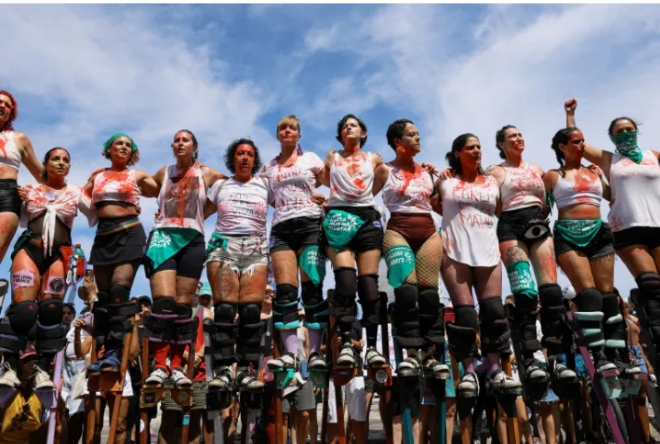
In Rio de Janeiro, Sao Paulo, and other major cities, demonstrators chanted slogans like “Stop killing us” and carried placards reading “Enough of femicide,” expressing outrage at gender-based violence.
Women of all ages, alongside supportive men, joined the rallies, highlighting the collective demand for structural changes and stricter enforcement of laws protecting women’s rights in Brazil.
In Rio’s Copacabana, dozens of black crosses were displayed to memorialize recent victims, while participants bore stickers and banners condemning “machismo” and the culture of violence against women.
Alline de Souza Pedrotti, whose sister was murdered on November 28, said she joined the protest to advocate for new legislation and preventive measures against femicide and harassment.
“I’m devastated,” Pedrotti told the press. “But I’m fighting through the pain, and I won’t stop. Changes in the law are urgently needed to prevent further tragedies.”
Recent cases have sparked public outrage, including Taynara Souza Santos in Sao Paulo, who was run over by her ex-boyfriend on November 28, leaving her with amputated legs.
Video footage of Santos’ attack circulated widely online, intensifying public indignation and inspiring thousands to demand reforms and stricter penalties for perpetrators of gender-based violence.
In Florianopolis, English teacher Catarina Kasten was raped and strangled to death on November 21, shocking the nation and becoming a rallying point for anti-femicide campaigns.
Isabela Pontes, a participant in Sao Paulo, described the recent cases as the “final straw” after years of enduring different forms of abuse, emphasizing the necessity of public mobilization.
Brazil passed legislation recognizing femicide in 2015, defining it as the killing of women in domestic contexts or resulting from societal contempt for women, aiming to prevent gender-targeted murders.
Last year, 1,492 women were victims of femicide, marking the highest figure since the law was enacted, according to the Brazilian Forum on Public Safety, illustrating the persistence of violence.
Juliana Martins, a gender-based violence expert, noted the rising intensity and cruelty of crimes, emphasizing that public awareness alone is insufficient to curb femicide without institutional reforms.
“Social transformations seeking equality of rights and representation generate violent responses aimed at reaffirming women’s subordination,” Martins explained, underscoring systemic resistance to female empowerment in society.
Lizete de Paula, 79, in Rio, highlighted former President Jair Bolsonaro’s policies, which she said empowered men with misogynistic tendencies by dismantling women’s rights programs during his tenure.
“Women are increasingly entering new spaces, and macho men can’t stand this,” de Paula said, stressing the cultural roots of violence that extend beyond individual incidents to societal attitudes.
Joao Pedro Cordao, father of three daughters, encouraged men to confront misogyny daily, not only at rallies, emphasizing that community responsibility is key to reducing gender-based violence.
“Only then will we be able to put an end to – or at least reduce – the current violence against women,” Cordao explained, linking societal awareness with actionable male advocacy.
Public demonstrations featured creative expressions, including women on stilts in Rio, drawing attention to the visibility of women’s struggles and symbolizing the height of societal vigilance required against femicide.
The protests also addressed broader gender issues, including sexual assault, harassment, and systemic misogyny, illustrating that femicide is part of a larger pattern of inequality affecting women across Brazil.
Authorities face increasing pressure to implement robust investigative protocols, improve police response, and strengthen legal frameworks to ensure accountability for perpetrators of femicide and sexual violence.
Advocates emphasize the importance of community education and cultural change, arguing that preventive measures must address both legal structures and societal attitudes toward women and gender equality.
“This movement is not only about victims, but about changing the narrative for future generations,” said Martins, urging comprehensive policies combining justice, prevention, and education to combat violence.
Political analysts note that rising public mobilization may influence upcoming elections, as citizens increasingly demand candidates prioritize women’s safety and legislative reforms addressing systemic gender inequality.
The demonstrations coincided with international observances of violence against women, drawing solidarity messages from activists in Latin America and beyond, reinforcing the global dimension of the fight against femicide.
Experts warn that without sustained pressure, legal provisions alone cannot stop gender-based killings, stressing that public engagement and political accountability are critical to long-term solutions.
Brazilian women continue to use social media, community networks, and public rallies to amplify their voices, ensuring that the message “Stop killing us” resonates across society and compels legislative action.
About The Author