Atiku demands transparency on El-Rufai detention as health concerns mount
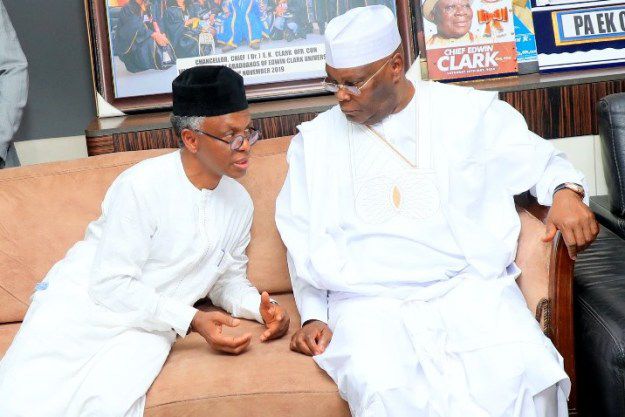
Former Vice-President Atiku Abubakar has called on the Federal Government to clarify the circumstances surrounding the detention of former Kaduna State Governor Nasir El-Rufai, warning that secrecy and procedural ambiguity could erode public trust in Nigeria’s justice system.
In a statement released on Tuesday, Atiku described the situation as one that has generated “grave concern” among El-Rufai’s family, associates, and political allies. He urged authorities to state clearly which security or anti-corruption agency is currently holding the former governor and under what legal authority.
At the centre of the controversy is uncertainty over whether El-Rufai is being detained by the Economic and Financial Crimes Commission, the Independent Corrupt Practices Commission, the State Security Service, or another arm of the security establishment. According to Atiku, such ambiguity undermines transparency and raises constitutional questions.
Questions over due process
The former vice-president stressed that any agency exercising detention powers must operate strictly within constitutional limits. He noted that Nigerian law requires that a suspect be either charged to court within a stipulated timeframe or released on bail, except where a valid remand order has been obtained.
Reports from El-Rufai’s media aide allege that the former governor was interrogated and later granted administrative bail, but remained in custody while his legal team sought clarification on bail conditions. The aide also claimed that family members and lawyers faced challenges gaining direct access to him.
Atiku argued that access to legal representation and family members is not discretionary but a fundamental right. He maintained that authorities have a duty to ensure the safety, dignity, and medical well-being of anyone in detention, regardless of political affiliation.
“Secrecy in matters of detention only fuels suspicion,” Atiku said, insisting that the Federal Government owes Nigerians full disclosure regarding the identity of the detaining authority and the specific allegations involved.
Health concerns heighten tension
The situation escalated following claims that El-Rufai experienced a medical episode while in custody. His aide alleged that the former governor suffered a nosebleed and was later transferred between agencies without prior notice to his family or legal team.
While there has been no official confirmation from any of the named agencies regarding the health claims, Atiku emphasised that authorities must act with urgency if there are legitimate medical concerns. He said that if the state cannot guarantee adequate healthcare within detention facilities, the humane course would be to grant bail pending the conclusion of investigations.
Observers note that high-profile detentions often attract intense public scrutiny, particularly when they involve prominent political figures. In this instance, the lack of coordinated communication from relevant agencies has amplified speculation.
Anti-corruption and political perception
Atiku also warned against the perception that anti-corruption efforts could be weaponised for political purposes. He stated that while accountability is essential, it must be applied consistently and transparently to avoid allegations of selective prosecution.
Nigeria’s anti-corruption agencies, including the EFCC and ICPC, have broad statutory mandates to investigate financial crimes and public sector misconduct. However, critics have frequently questioned whether enforcement patterns are even-handed across party lines.
“The rule of law must apply to all, without fear or favour,” Atiku said, adding that selective prosecution damages institutional credibility and weakens public confidence in governance.
Political analysts suggest that the unfolding developments could have wider implications for Nigeria’s political landscape, particularly as the country approaches another election cycle. El-Rufai remains an influential political actor with strong networks across party structures, making his detention a matter of national attention.
Government silence and public expectation
As of the time of filing this report, there has been no consolidated official statement clarifying the precise legal basis for El-Rufai’s continued detention. The absence of a clear communication strategy has allowed competing narratives to flourish across social and mainstream media platforms.
Legal experts argue that timely disclosure would not compromise ongoing investigations but could instead reinforce institutional credibility. Transparent communication, they say, is critical in politically sensitive cases.
For Atiku, the issue transcends partisan considerations. He warned that any harm to El-Rufai while in custody would place moral and legal responsibility on the authorities. “If anything happens to him under unclear circumstances, this government will be held accountable,” he said.
As public attention intensifies, pressure is mounting on the Federal Government and relevant security institutions to provide definitive answers.
Whether through formal court proceedings or an official briefing, clarity may ultimately determine whether this episode strengthens or strains confidence in Nigeria’s justice system.
About The Author