The AFP journalists arrest in Abuja during the #FreeNnamdiKanuNow protest raises global concern over press freedom and police abuse in Nigeria’s capital.
The AFP journalists arrest in Abuja has triggered widespread outrage among human rights defenders, press freedom advocates, and international media organizations.
The incident, which occurred during the #FreeNnamdiKanuNow protest, once again highlights the escalating threats journalists face while covering demonstrations in Nigeria.
Two media professionals with Agence France-Presse (AFP)—Nick Roll, an American reporter, and John Okunyomih, a Nigerian videographer—were arrested by police officers while filming protesters near the Transcorp Hilton Hotel in the Maitama district of Abuja.
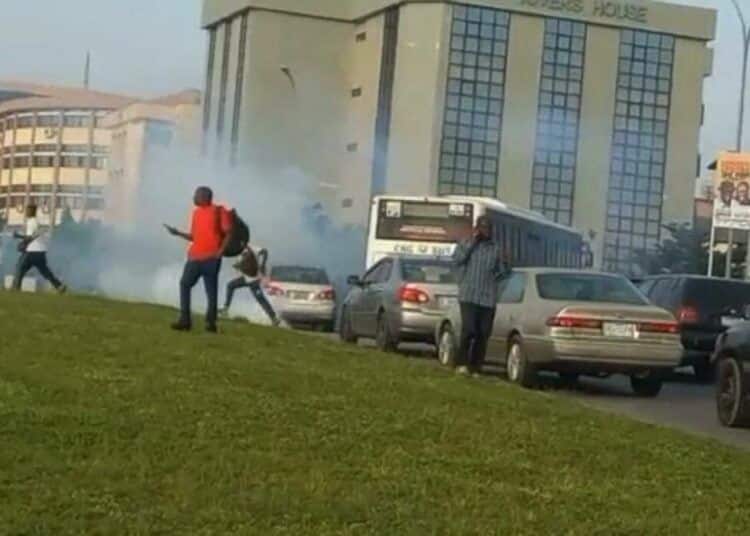
The protest was organized to demand the release of Nnamdi Kanu, the detained leader of the Indigenous People of Biafra (IPOB).
Eyewitnesses reported that the AFP correspondents were recording the tense standoff between protesters and the police when chaos erupted. Officers fired multiple rounds of teargas, dispersing demonstrators and commuters in the area.
In the ensuing confusion, the journalists were assaulted, their camera damaged, and their mobile phones seized. The security operatives also allegedly tore off their protective teargas masks.
One witness stated that both journalists identified themselves as members of the press before the confrontation escalated. Despite showing their identification cards and press badges, officers forcibly detained them, accusing them of recording “restricted scenes.”
The AFP journalists arrest was seen as an unjustified attack on the media’s constitutional right to report freely.
Following the scuffle, Nick Roll was released shortly afterward, while John Okunyomih was taken to the Federal Capital Territory (FCT) Command Criminal Investigation Department (CID) for questioning.
He was released later in the day after intense pressure from AFP representatives and human rights lawyers.
The police also detained Aloy Ejimakor, one of Nnamdi Kanu’s legal counsels, who had joined the protesters at the Central Business District.
According to witnesses, Ejimakor was arrested while addressing reporters about his client’s continued detention. His arrest fueled further anger among protesters, who accused the police of deliberately suppressing voices calling for justice.
The demonstration, led by human rights activist and Sahara Reporters publisher Omoyele Sowore, started peacefully but turned chaotic when police fired teargas to disperse participants.
The protesters had converged to demand Kanu’s release from the custody of the Department of State Services (DSS), where he has been held since June 2021.
The AFP journalists arrest has drawn strong condemnation from the Nigeria Union of Journalists (NUJ), the International Press Centre (IPC), and several international media watchdogs.
In a statement, the NUJ described the act as a “brazen violation of press freedom and democratic values.” It called on the Inspector-General of Police to discipline the officers responsible for the assault and unlawful detention.
Similarly, Lanre Arogundade, Director of the IPC, denounced the attack as part of a disturbing pattern of hostility toward journalists covering protests or politically sensitive issues.
He emphasized that the police’s responsibility is to protect journalists, not persecute them.
“The continued targeting of reporters erodes Nigeria’s democratic credentials and undermines citizens’ right to information,” he said.
Internationally, the Committee to Protect Journalists (CPJ) and Reporters Without Borders (RSF) condemned the incident, warning that such actions could deter foreign media from reporting on critical human rights issues in Nigeria.
Both organizations urged the Nigerian government to reaffirm its commitment to freedom of the press and ensure journalists can operate without fear or intimidation.
Police authorities, however, have remained silent. Requests for an official statement from the FCT Police Command were unanswered as of press time.
Anonymous sources within the command claimed the arrests were made for “security reasons,” insisting the protest was “unauthorized.” But human rights lawyers argue that this explanation violates constitutional rights to peaceful assembly and freedom of the press.
The AFP journalists arrest has revived public debate over press freedom and police accountability in Nigeria.
Legal experts and rights advocates maintain that journalists play a critical role in promoting transparency and democracy, and any attempt to silence them undermines national and international credibility.
Nnamdi Kanu’s continued detention has remained a contentious political issue. Despite multiple court rulings ordering his release, the IPOB leader is still held by the DSS, facing charges of treasonable felony and terrorism-related offenses.
Supporters argue that his prolonged incarceration violates both domestic and international human rights laws.
Activist Omoyele Sowore, speaking after the protest, condemned the government’s repressive tactics.
“The arrests of journalists and lawyers show how far the state is willing to go to suppress dissent,” he said.
“We will not stop demanding justice for Nnamdi Kanu and for every Nigerian whose rights have been violated.”
Civil society groups have urged President Bola Tinubu’s administration to take a firm stand against police brutality and protect the independence of the media.
They argue that such incidents, like the AFP journalists arrest, create an atmosphere of fear that discourages investigative reporting and accountability journalism.
Observers note that Nigeria’s ranking on the global Press Freedom Index has steadily declined in recent years, largely due to increasing reports of intimidation, arbitrary arrests, and censorship of journalists.
The AFP incident adds to a long list of attacks that have gone unpunished, deepening concerns about impunity within the security forces.
As the international community watches closely, the call for justice grows louder. Advocates insist that the government must investigate the AFP journalists arrest, hold perpetrators accountable, and provide assurances that similar violations will not recur.
Only by upholding media freedom, they say, can Nigeria maintain its democratic image and foster trust between citizens and the state.
More news at ireport247news
About The Author