

Former presidential candidate of the Labour Party, Peter Obi, has urged Nigerians to pray for their political leaders, admitting that those in positions of authority bear the greatest responsibility for the country’s persistent challenges.
Obi made the remark on Sunday during a thanksgiving service held to mark Oyo State’s 50th anniversary at the Cathedral of St. Peter Anglican Church, Ibadan.
His comments, delivered in a reflective tone, struck at the heart of Nigeria’s long-running debate over leadership, accountability, and governance failure.
“I want to make a request from Nigerians,” Obi told the congregation. “Please remember us politicians in your prayers. We are the problem of Nigeria, no other person.”
According to the former Anambra State governor, Nigeria’s struggles are not rooted in a lack of resources but in how public power is exercised.
“Nigeria is not a poor country; it is poorly governed,” he said. “Pray that God should touch our hearts so that we will use public money for public good.”
Peter Obi Says Politicians Are Nigeria’s Problem, Not the People
Peter Obi’s statement that politicians are Nigeria’s problem resonated strongly with many Nigerians who have long blamed governance failures for the country’s economic hardship, insecurity, and weak institutions.
His remarks came at a symbolic moment, during a service celebrating Oyo State’s golden jubilee, where political leaders, clergy, and citizens gathered to reflect on leadership, history, and the future of governance.
Obi emphasised that leadership is fundamentally a moral responsibility, arguing that political officeholders must be held to higher ethical standards because of the power entrusted to them.
“When leaders get it right, the country moves forward. When they fail, the people suffer,” he said, reinforcing his long-standing message of accountable and people-centred governance.
Praise for Makinde’s Governance Style
In a post shared later on X (formerly Twitter), Obi thanked Oyo State Governor Seyi Makinde for inviting him to speak at the event. He recalled that early in Makinde’s first term, he had been invited to address the governor’s inaugural executive council retreat.
According to Obi, those early discussions focused heavily on governance principles, leadership discipline, and the importance of institutional frameworks.
“I am glad that years later, that same focus on governance has remained consistent,” Obi said.
He noted that beyond visible infrastructure projects, Makinde’s leadership had sparked conversations among residents about transparency, fiscal responsibility, and continuity in governance.
Obi added that development should not be driven by personalities but by systems capable of sustaining progress beyond a single administration.
A key highlight of the thanksgiving service was Makinde’s emphasis on building strong institutions rather than relying on individuals, a point Obi openly praised.
According to Obi, Nigeria’s development crisis is deeply tied to its overdependence on powerful individuals instead of durable systems.
“When institutions are strong, progress continues regardless of who is in office,” he said. “That is how nations grow.”
Obi described Makinde’s message as reassuring, especially in a political environment where policy reversals often occur with changes in leadership.
Moral Leadership and Public Accountability
The former governor also commended the sermon delivered by Williams Aladekugbe, describing it as timely and deeply relevant to Nigeria’s leadership challenges.
Obi said thanksgiving should not merely be ceremonial but should serve as a moral reminder of humility, accountability, and service to the common good.
“True thanksgiving reminds leaders that power is temporary and that public resources must be managed with care and conscience,” he said.
He urged political leaders at all levels to reflect on their responsibilities, particularly at a time when millions of Nigerians are grappling with inflation, unemployment, and declining purchasing power.
Call for Civic Support and Prayer
While critical of leadership failures, Obi also encouraged citizens to continue supporting their governments constructively.
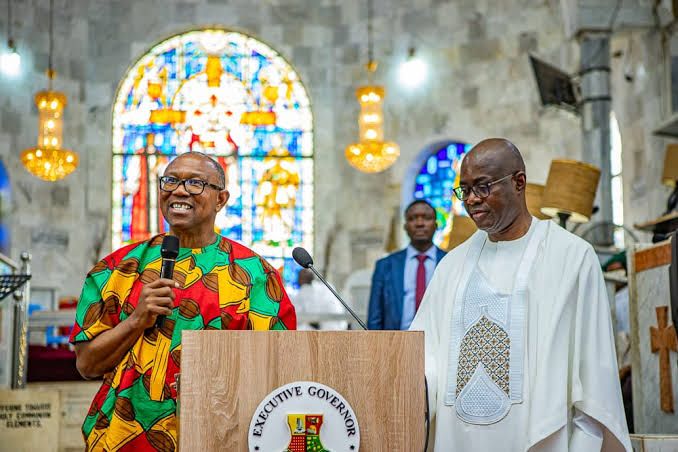
He urged residents of Oyo State to pray for their leaders and to remain engaged in the democratic process, stressing that governance works best when leaders and citizens hold each other accountable.
According to Obi, prayer should go hand in hand with civic vigilance, transparency, and demand for results.
A Broader Political Message
Peter Obi’s comments align with his broader political philosophy, which centres on prudent management of public funds, social investment, and ethical leadership.
Since the 2023 presidential election, Obi has remained an influential voice in national discourse, frequently weighing in on governance, public finance, and leadership accountability.
His statement that politicians are Nigeria’s problem reflects growing frustration among citizens and highlights increasing pressure on political elites to deliver tangible results.
As Nigeria navigates economic reforms, political realignments, and preparations for future elections, Obi’s remarks are likely to fuel further debate about leadership responsibility and national renewal.
About The Author


