The US struck big facility in Venezuela, President Donald Trump claimed, alleging American forces delivered a hard blow, though officials offered no details or independent confirmation.
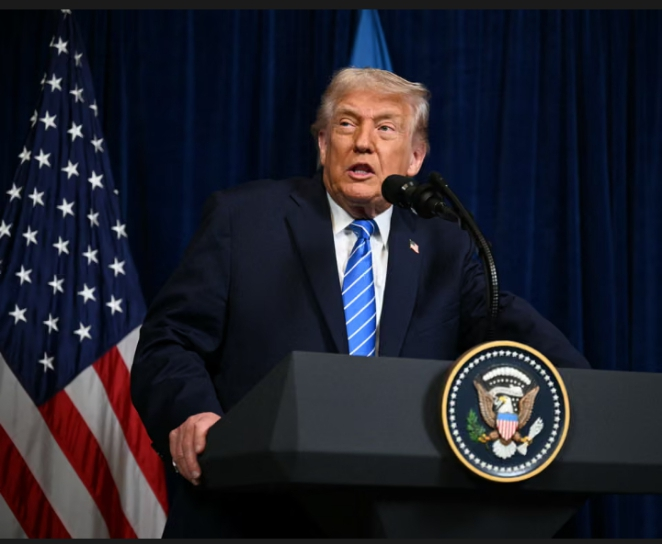
Trump made the claim during a conversation with Republican donor John Catsimatidis, asserting US forces destroyed a large Venezuelan installation linked to maritime operations.
“We just knocked out a big plant, a big facility where ships come from,” Trump said, adding the strike occurred two nights earlier.
The president did not specify the location, nature, or purpose of the facility, prompting questions from lawmakers, analysts, and international observers about the alleged operation.
The White House declined to comment further, and the Pentagon has not confirmed whether US forces conducted a land strike inside Venezuela.
If verified, the operation would mark the first acknowledged US land strike on Venezuelan territory during Trump’s current presidency.
US military officials have recently expanded operations in the Caribbean, citing efforts to combat narcotics trafficking linked to the Venezuelan government.
Trump accused President Nicolás Maduro of directing criminal networks, claiming the Venezuelan state enables drug shipments moving through regional maritime routes.
The US struck big facility in Venezuela amid an intensified military buildup, including naval vessels, fighter jets, and Coast Guard cutters operating near Venezuelan waters.
Administration officials describe the posture as a “maritime quarantine,” though they stop short of labeling it a full naval blockade.
Approximately 15,000 US personnel are deployed across the Caribbean and Gulf of Mexico, including a carrier strike group and advanced surveillance assets.
Officials insist the operation enforces existing sanctions rather than initiating a new military conflict with the Maduro government.
Critics argue the actions resemble a blockade, raising legal questions under international law and US constitutional requirements for congressional authorization.
Trump has repeatedly warned that US forces could strike targets inside Venezuela if maritime enforcement fails to curb illicit activity.
A video circulated online on December 24 appeared to show an explosion in Venezuela’s Zulia state, reportedly within an industrial zone.
The footage has not been independently verified, and analysts caution against drawing conclusions without corroborating satellite or intelligence confirmation.
An administration official later told CNN that Trump was likely referring to a drug-processing facility rather than an oil installation.
That clarification contrasts with Trump’s initial description of a shipping-related site, adding to confusion surrounding the alleged strike.
The US struck big facility in Venezuela as tensions escalated over oil exports and the shadow fleet transporting crude despite sanctions.
Washington accuses Caracas of using unregistered tankers to bypass restrictions, undermining efforts to pressure Maduro economically.
Chevron remains the only company licensed to export Venezuelan oil legally under current US sanctions frameworks.
Energy experts say targeting infrastructure could signal a shift from enforcement to coercion, increasing regional instability risks.
Trump has framed Venezuela’s oil reserves as strategically vital, previously suggesting US access could stabilize global energy markets.
Analysts describe such rhetoric as “resource imperialism,” warning it may inflame anti-American sentiment across Latin America.
Maduro’s government has not officially responded to Trump’s claim, though state media condemned US military pressure as “illegal aggression.”
Venezuelan officials insist the country has resisted foreign intervention and accuse Washington of manufacturing pretexts for escalation.
Regional governments are closely watching developments, concerned about spillover effects on trade, migration, and security.
Colombia and Brazil have previously urged restraint, warning that conflict could destabilize already fragile border regions.
The US struck big facility in Venezuela without congressional notification, according to lawmakers who said they received no prior briefing.
Under US law, sustained military action typically requires congressional authorization unless justified as immediate self-defense.
Legal scholars say ambiguity around the operation complicates oversight and accountability for executive military decisions.
Republican allies largely defended Trump, arguing decisive action deters criminal networks exploiting Venezuelan territory.
Democrats criticized the lack of transparency, calling for hearings to clarify whether US forces crossed a significant legal threshold.
“This is how wars begin,” one senior Democratic aide warned, citing historical precedents of incremental military escalation.
Pentagon officials emphasize that US forces remain prepared for defensive contingencies while avoiding unnecessary confrontation.
Military analysts note that even limited strikes risk retaliation through asymmetric means, including cyber or proxy actions.
Venezuela maintains ties with Russia, Iran, and China, further complicating Washington’s strategic calculations.
Any confirmed US strike could strain relations with those powers, particularly amid broader global geopolitical tensions.
The US struck big facility in Venezuela at a moment when Trump faces domestic pressure to project strength abroad.
Read also: Man charged with murder after devoted grandfather dies following Christmas pub assault in Leicestershire
Supporters view the posture as assertive leadership, while critics see it as risky brinkmanship lacking clear objectives.
International law experts stress that verified evidence is essential before assessing legality or proportionality of any strike.
Without confirmation, the incident remains a claim, underscoring how modern conflicts increasingly unfold through information warfare.
For now, unanswered questions linger over what was hit, why it was targeted, and whether escalation lies ahead.