

The US forces board Indian Ocean tanker defying Trump’s Venezuela blockade, marking another escalation in Washington’s campaign to control the South American country’s oil exports, Pentagon officials said Sunday.
The Panamanian-flagged Veronica III, carrying nearly 2 million barrels of Venezuelan crude and fuel oil, attempted to “slip away” from US-imposed sanctions, the Pentagon said in a post on X. “We tracked it from the Caribbean to the Indian Ocean, closed the distance, and shut it down,” the post read.
According to the Pentagon, this operation reflects the Trump administration’s intensified efforts to enforce a blockade on vessels transporting Venezuelan oil, following the capture of President Nicolas Maduro in January. “The enforcement of sanctioned vessels remains a top priority,” the Defense Department said.
Since December, the United States has ordered a blockade of sanctioned tankers to pressure the Maduro government, preventing oil shipments from entering international markets. The Veronica III left Venezuela on January 3, coinciding with Maduro’s abduction, TankerTrackers.com reported.
The vessel has a history of involvement with Venezuelan, Iranian, and Russian oil since 2023, raising US concerns over the coordination of “shadow fleet” operations circumventing sanctions, a Pentagon spokesperson told reporters.
The US intercepts Venezuelan oil shipments to maintain pressure on Maduro’s regime and assert Washington’s control over global energy flows. Officials say at least nine tankers have been seized so far, though these represent only a small fraction of the total fleet.
US Secretary of Energy Chris Wright told NBC News, “Oil sales from Venezuela, controlled by Washington, have generated more than $1 billion since Maduro’s capture, with another $5 billion expected in the coming months.”
The Panama Maritime Authority confirmed that the ship’s registration had been canceled in December 2024, further complicating the vessel’s legal status. “The Veronica III is no longer a Panamanian-flagged vessel,” the authority said in a brief statement on Sunday.
The Pentagon did not confirm whether the ship was formally seized or placed under US control, stating only that forces had boarded it in the Indian Ocean. The Associated Press reported that no further details were available at press time.
Last week, US forces similarly intercepted the Aquila II in the Indian Ocean, continuing a pattern of operations targeting Venezuelan oil exports far beyond the Caribbean. Officials described the coordinated actions as part of a broader strategy to assert US dominance over strategic resources.
Venezuelan officials have condemned the seizures, calling them “piracy under the guise of sanctions” and accusing Washington of illegally appropriating the country’s assets. “These attacks are a violation of international law,” said a Venezuelan government spokesperson.
The Pentagon defended the actions, emphasizing that the tankers were operating in violation of Trump’s blockade and US sanctions, adding that military personnel acted in accordance with established international law regarding enforcement of sanctioned vessels.
Since the abduction of Maduro, several tankers attempted to flee the Venezuelan coast to evade interception, using false flags and complex navigation routes to enter global markets undetected. The Veronica III was tracked continuously using satellite and maritime intelligence, Pentagon officials said.
The operations highlight the complexity of the global “shadow fleet,” which analysts estimate includes up to 800 vessels engaged in sanctioned oil transport. “These fleets operate in secrecy, often carrying Iranian, Russian, and Venezuelan oil simultaneously,” a US Coast Guard senior officer told newsmen.
US military strikes in the Caribbean Sea have also targeted vessels alleged to be carrying drugs, killing at least 133 people since September 2025. The Pentagon stresses that these operations are separate but part of broader maritime enforcement and regional security objectives.
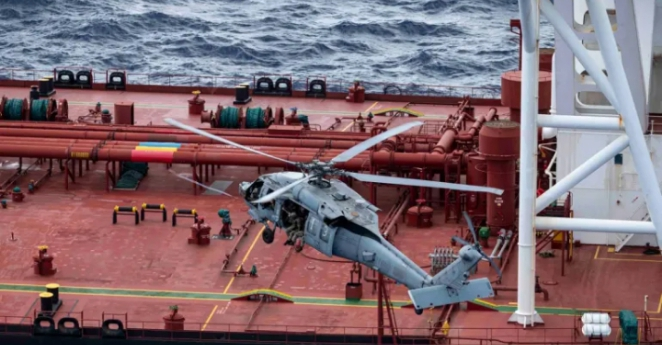
The Pentagon’s post included video footage showing US forces boarding a helicopter, descending onto the tanker, and securing the vessel. Analysts noted that such operations require extensive coordination between intelligence, maritime, and special operations units.
The Trump administration has framed these seizures as both a security measure and a financial strategy. “Securing Venezuelan oil ensures energy market stability and prevents illicit actors from profiting,” Wright said, highlighting the financial dimension of the blockade.
TankerTrackers.com reported that the Veronica III’s cargo consisted of a mixture of crude and fuel oil, with estimated market value in the hundreds of millions of dollars. “This shipment was destined for international markets but was intercepted before it could be sold,” the site noted.
The interception also signals to other operators that US enforcement can extend globally, far beyond the Caribbean or Atlantic. Observers noted that such operations may deter future attempts to evade sanctions, but also risk diplomatic tensions with Panama and other flag states.
Venezuela has increasingly relied on clandestine shipping methods, including vessel renaming and re-flagging, to avoid US sanctions. Yet Pentagon officials argue that persistent tracking and intelligence allow US forces to intercept these operations effectively.
While Washington frames these actions as enforcing lawful sanctions, critics argue the operations constitute an overreach of power and set a precedent for military involvement in commercial maritime activity. “This is a significant escalation with global implications,” said a maritime law expert.
The Pentagon has acknowledged that the total number of sanctioned vessels worldwide far exceeds those seized, meaning these operations target only a small subset of a much larger network.
“We’re focusing on high-value shipments that have a direct impact on US objectives,” the Defense Department said.
The interception of the Veronica III also reflects coordination between multiple US agencies, including the Coast Guard, Navy, and Department of Energy, showcasing the interagency capabilities required for long-range maritime enforcement.
Observers say that ongoing US interventions in Venezuelan oil logistics may influence energy markets, particularly if additional vessels are seized or rerouted. “The global energy supply is sensitive to these operations,” an industry analyst told Reuters.
Despite the high-profile nature of these actions, some critics question the long-term effectiveness, noting that shadow fleets are resilient and often reappear under new flags, owners, or routes. “Sanctions enforcement at sea is complex and never absolute,” analysts warn.
The Pentagon’s efforts, however, demonstrate Washington’s willingness to use military power to enforce economic sanctions far from US shores, signaling that defiance of Trump-era policies will be met with immediate operational response.
As US forces continue to track and board sanctioned tankers, Venezuela’s ability to export oil remains constrained, while Washington consolidates control over high-value shipments. Analysts predict further intercepts are likely in the coming months.
The US operations in the Indian Ocean mark a new chapter in international maritime enforcement, where sanctions and military power intersect in ways previously unseen, with both strategic and financial stakes.
Read also: Ukrainian civilian casualties surged by 26% in 2025 as war intensifies across cities
In the wake of these operations, maritime operators are reassessing their risk calculations. “The Veronica III case shows that no distance or false flag guarantees immunity from US enforcement,” an energy security analyst said.
The situation continues to evolve, with international observers closely monitoring the implications for global oil markets, maritime law, and US foreign policy strategy, especially as Washington maintains a firm stance on Venezuelan oil shipments.
About The Author


