US forces struck another alleged drug-trafficking vessel in the Caribbean, killing three people, the latest in a widening campaign criticized for lacking transparency and accountability.
Since early September, the Trump administration has launched a series of maritime strikes across Latin America, targeting what it calls “narco-terrorist” boats but revealing little verified evidence of actual drug shipments.
At least eighteen vessels have been destroyed, according to officials, yet Washington has not substantiated claims that these boats posed any real threat to the United States or its citizens.
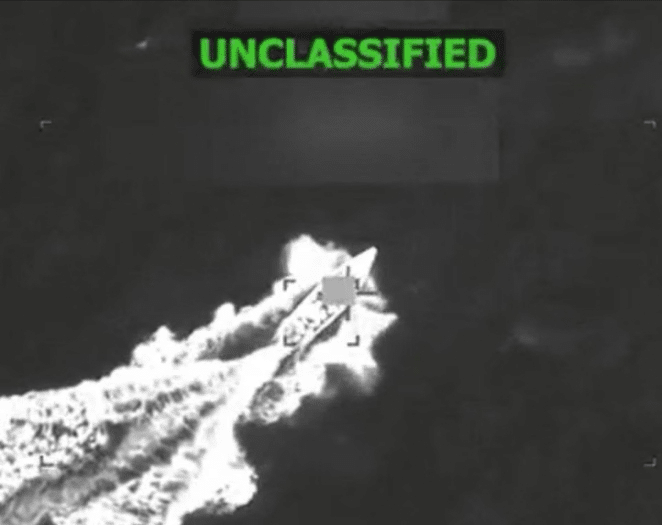
Defense secretary Pete Hegseth released video footage of the most recent attack, stating it was conducted in international waters and aimed at a group designated as a terrorist organization.
He reiterated Trump’s warning that those who traffic drugs toward the United States would be met with lethal force, vowing, “If you keep trafficking deadly drugs – we will kill you.”
Observers have noted that parts of the released strike videos are intentionally blurred, raising questions about what Washington might be concealing regarding the operations’ true targets.
The administration has stationed six naval vessels in the Caribbean and deployed F-35 jets to Puerto Rico, underscoring its dramatic military buildup in Latin America since late summer.
It has also ordered the USS Gerald R. Ford carrier strike group to the region, signaling preparations for expanded operations that some analysts describe as quasi-war footing.
Thursday’s Senate vote blocking a Democratic war powers resolution effectively left Trump free to continue his campaign without seeking explicit congressional authorization.
Critics argue that such unchecked executive power risks setting a dangerous precedent, allowing military force without accountability under the guise of combating drugs and terrorism.
Sources familiar with internal planning say White House advisers are exploring broader strike options, including attacks on land targets in Venezuela, if deemed strategically necessary.
Reports indicate the administration has asked the justice department for legal justifications that would extend the current campaign beyond maritime engagements.
Venezuela’s government and relatives of those killed in recent operations insist many victims were civilians, mostly local fishers caught in crossfire or misidentified as traffickers.
President Nicolás Maduro, long at odds with Washington, accuses Trump of using the drug war narrative as a pretext to destabilize his government and justify regional militarization.
US bombers have conducted repeated “shows of force” off Venezuela’s coast, a tactic drawing comparisons with the prelude to the 1989 invasion of Panama.
Analysts say Trump’s Latin American strategy merges counter-narcotics rhetoric with political objectives, framing the hemisphere as both a security threat and testing ground for deterrence.
Hegseth’s labeling of drug cartels as “terrorist organizations” provides the administration a legal framework for military engagement without congressional war authorization.
However, human rights advocates warn that such terminology blurs lines between law enforcement and warfare, normalizing extrajudicial killings under counterterrorism doctrine.
International law experts note that killing suspected traffickers outside declared battle zones violates multiple treaties prohibiting targeted assassinations in peacetime.
Criticism has mounted among regional governments, some of which accuse Washington of disregarding sovereignty and conducting strikes perilously close to national waters.
Colombian and Panamanian officials have privately expressed concern that civilian fishing communities could be further endangered by indiscriminate US actions.
Meanwhile, domestic support for Trump’s campaign remains mixed: some Americans see decisive action against narcotics, while others view it as reckless militarization abroad.
Independent analysts point out that Washington has yet to produce evidence linking these maritime targets to major drug cartels supplying the US market.
Footage from local witnesses has occasionally contradicted Pentagon accounts, suggesting some destroyed vessels were unarmed and engaged in routine coastal fishing.
Legal scholars stress that defining an “armed conflict” against drug groups is problematic, since most such actors operate as criminal syndicates, not military entities.
Humanitarian groups warn the widening campaign could destabilize fragile coastal economies, displacing small-scale fishers and inflaming anti-US sentiment across the Caribbean.
Observers describe the operation as part of Trump’s broader “hard power” doctrine, extending from Venezuela to Central America under a narrative of national defense.
Despite calls for transparency, the administration maintains operational secrecy, declining to release full after-action reports or casualty assessments from the strikes.
In Washington, Democratic lawmakers are demanding independent investigations into civilian deaths and the legal rationale underpinning what they call an undeclared war.
The Pentagon insists its operations comply with international law, citing classified intelligence to justify each engagement and asserting that all targets are “positively identified.”
However, leaked assessments suggest internal doubts about target validation methods and the accuracy of intelligence used to authorize lethal strikes.
Former officials warn that this campaign risks entrenching US involvement in Latin America’s conflicts, reigniting memories of Cold War-era interventions cloaked as security missions.
Human rights organizations, including Amnesty International, have condemned the killings, urging the US to release verifiable evidence and suspend further attacks pending investigation.
Regional media coverage reflects rising unease, with some outlets portraying the strikes as imperial overreach reminiscent of historic American dominance in the hemisphere.
Trump’s aides continue to defend the initiative, claiming drug cartels represent a direct national security threat equivalent to terrorism networks.
Still, international observers caution that conflating criminal networks with terror organizations undermines diplomatic collaboration essential to effective regional counter-narcotics policy.

For many Latin American citizens, the US strikes underscore a perception of disregard for human life and sovereignty, reinforcing resentment toward Washington’s interventionist history.
Whether the campaign genuinely reduces narcotics flow remains unclear, as drug production and trafficking routes continue to adapt faster than military operations can disrupt them.
As critics press for oversight, the administration’s silence leaves fundamental questions unanswered — about legality, morality, and the human cost of America’s newest shadow war.
—
Meta Description:
US forces have intensified strikes on alleged drug boats across Latin America, killing dozens amid claims of civilian casualties, shaky legal grounds, and widening regional unease.
KEYPHRASEs:
US drug boat strikes, Trump Latin America campaign, Pete Hegseth, Venezuela tensions, extrajudicial killings, civilian casualties, US military buildup, international law violations.
About The Author