Ukrainian children were among several civilians killed in a wave of deadly Russian missile attacks that struck towns and cities across Ukraine on Saturday, officials confirmed.
Authorities in Dnipropetrovsk said two boys, aged 11 and 14, were among those killed when a missile hit a local grocery store, causing an explosion and massive fire.
Emergency crews worked through the night to recover bodies trapped beneath debris, as residents wept and described hearing multiple explosions before flames engulfed the building.
The regional governor called the strike one of the worst in recent weeks, describing the deaths of Ukrainian children as a “painful reminder of Russia’s brutality.”
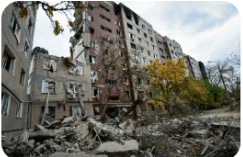
In Odesa region, Russian jets bombed several civilian trucks and vehicles, killing two people and injuring three others, sparking fires that raged for hours across the road.
Local authorities said the victims were not soldiers but regular citizens transporting goods between rural communities, underscoring the civilian toll of the continued missile campaign.
In Kherson oblast, Governor Oleksandr Prokudin said one person was killed and two others injured after drone and artillery attacks struck over twenty settlements in one night.
A ballistic missile believed to be an Iskander-M landed near Mykolaiv, killing a 20-year-old man and injuring nineteen people, including several Ukrainian children and women.
Governor Ivan Fedorov reported that in the Zaporizhzhia region, one civilian died, and three others were injured as attacks hit eighteen villages and destroyed multiple homes.
The latest Russian missile strikes on Ukraine have left thousands without electricity, crippling energy systems and worsening humanitarian conditions across several front-line regions.
Ukraine’s national power company, Ukrenergo, said nearly 60,000 people were without power after “massive Russian missile and drone attacks on energy infrastructure.”
Rolling blackouts were introduced across multiple regions to stabilise the grid, while repair teams struggled to access damaged substations under continuing threat of bombardment.
Officials described the attacks as deliberate attempts to plunge Ukraine into darkness ahead of winter, making it harder for hospitals and schools to function safely.
Energy experts warned that repeated assaults on power facilities could create long-term shortages, forcing Ukraine to rely more heavily on emergency generators and imported electricity.
Meanwhile, Ukrainian forces launched counterstrikes targeting Russian fuel depots and supply lines in retaliation for the latest attacks on civilians and infrastructure.
Ukraine’s military intelligence agency said its troops destroyed three major fuel lines of the Koltsevoy pipeline near Moscow’s Ramensky district in a coordinated operation.
The 400-kilometre pipeline supplies gasoline, diesel, and jet fuel to several major refineries, making it a crucial component of Russia’s military logistics network.
Kyiv said the strike dealt a “serious blow” to Moscow’s fuel supply chain, although Russian authorities have not officially commented on the reported damage.
In the Black Sea town of Tuapse, Ukrainian drones reportedly hit an oil terminal and a tanker, causing explosions and fires that were later contained by emergency crews.
Russian social media channels shared images showing thick smoke rising from the facility, though officials downplayed the extent of damage caused by the Ukrainian strike.
Ukrainian children continue to face grave danger as missile attacks increasingly target civilian areas, schools, and hospitals, violating international humanitarian law.
Human rights groups condemned the strikes, saying the killing of Ukrainian children highlights the indiscriminate nature of Russia’s ongoing assault on populated regions.
The United Nations called for renewed efforts to protect civilians, urging all parties to adhere strictly to international law prohibiting attacks on non-military targets.
International outrage grew as G7 nations denounced Moscow’s latest bombardment of energy facilities and civilian centres, calling the pattern of attacks “inhumane and destructive.”
European Union leaders pledged to supply Ukraine with additional air defence systems and to accelerate sanctions targeting Russia’s oil exports and military industry.
In Washington, officials reaffirmed support for Kyiv, with new U.S. military aid expected to include advanced interceptors to counter Russian missiles and drones.
Ukrainian President Volodymyr Zelenskyy condemned the strikes as acts of terrorism, vowing that every attack that kills Ukrainian children will “strengthen our resolve to defend.”
He said the continued loss of life demonstrates why Ukraine must continue to pressure Russia militarily and diplomatically until all occupied territories are liberated.
The attacks also affected digital security, as Russian hackers reportedly infiltrated Ukrainian insurance companies, stealing private data belonging to millions of citizens.
Cybersecurity officials in Kyiv said the breach represents a growing hybrid war strategy combining physical attacks with digital sabotage aimed at destabilising the country.
In Donetsk and Kherson, civilian casualties continue to mount as Russia intensifies efforts to seize full control of eastern territories through constant shelling and bombing.
Military analysts said Moscow’s recent offensive seeks to break Ukrainian resistance by targeting key infrastructure while exploiting winter conditions to exhaust energy supplies.
Humanitarian groups warn of a worsening crisis, as thousands of displaced families struggle with power cuts, damaged homes, and limited access to clean water and heating.
Shelters in war-torn areas are overflowing, while aid agencies race to distribute blankets, food, and fuel as temperatures begin to drop sharply across the country.
Despite devastating losses, morale among Ukrainians remains strong, with communities uniting to rebuild schools and homes destroyed by missile strikes.
The killing of Ukrainian children has sparked renewed global calls for justice and accountability at international courts for potential war crimes committed against civilians.
Legal experts said evidence from repeated missile attacks on residential areas could form part of future war crime prosecutions at the International Criminal Court.
Russia denies intentionally targeting civilians, claiming that its strikes focus solely on military infrastructure, a claim widely disputed by independent observers.
Satellite imagery and verified footage, however, show widespread destruction of schools, hospitals, and residential buildings far from any military installations.
As the conflict deepens, both sides show no willingness to compromise, with peace talks stalled and hostilities intensifying across the front lines.
Zelenskyy reiterated that Ukraine would not accept any settlement that leaves its territory occupied, saying true peace must include justice for Ukrainian children lost.
The devastating strikes highlight the human cost of war, with the image of Ukrainian children killed in their homes symbolising the ongoing tragedy facing the nation.

While emergency workers continue rescue operations, global attention remains fixed on the humanitarian consequences of Moscow’s relentless aerial assault.
Every fresh bombardment erases more lives, deepening the grief of families who have already endured nearly two years of unending violence and displacement.
For Ukraine, the deaths of innocent civilians and Ukrainian children serve as both heartbreak and motivation to fight on until peace and safety are restored.