

Field Marshal Lord Richards has warned that Ukraine cannot win against Russia, arguing that Western support has offered hope without the decisive power required for true victory.
The retired military commander told The Independent’s World of Trouble podcast that Western nations “encouraged Ukraine to fight” but “failed to provide the means to win.”
Lord Richards said plainly that Ukraine cannot win against Russia because the war has evolved into a prolonged battle of manpower, logistics, and endurance — factors overwhelmingly favouring Moscow’s position.
“They haven’t got the manpower,” he stressed. “Even if Ukraine had advanced weaponry, it would still struggle without direct NATO involvement on the battlefield.”

The former Chief of the Defence Staff described Ukraine’s courage as “remarkable” but noted that Western allies have limits on how far they will risk confrontation with a nuclear superpower.
“This is existential for Russia,” he said. “For the West, it’s a moral and political issue — not one leaders are ready to escalate militarily.”
Richards’s assertion that Ukraine cannot win against Russia challenges the repeated claims from Washington, Brussels, and London that Kyiv can reclaim its occupied territories through continued Western assistance.
“We have inspired them to believe victory is possible,” he said. “But belief alone is not strategy. Hope without commitment is a dangerous illusion.”
His remarks triggered divided reactions online. Some praised his honesty; others accused him of damaging Ukrainian morale and boosting Kremlin propaganda at a crucial point in the war.
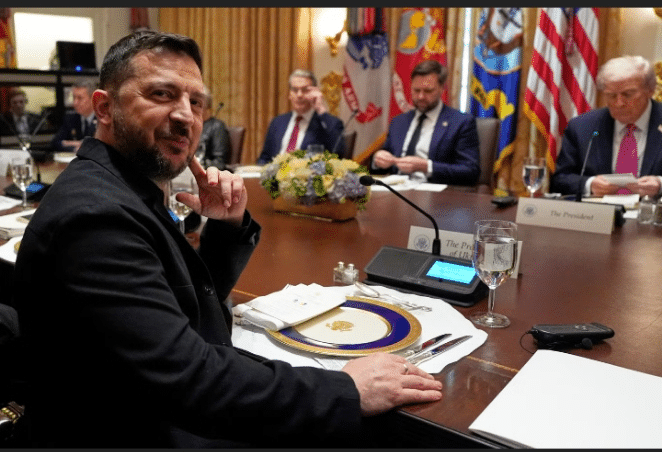
President Volodymyr Zelensky recently visited Washington to meet Donald Trump, seeking renewed military aid and access to Tomahawk cruise missiles to strengthen Ukraine’s struggling counteroffensive efforts.
The White House meeting, however, yielded uncertainty. Trump told reporters the United States must “first secure its own stockpiles” before approving further shipments to Ukraine’s armed forces.
That hesitation, according to Lord Richards, only reinforces the reality that Ukraine cannot win against Russia without stronger and more direct commitments from its Western allies.
“We’re pretending this is enough — but it isn’t,” Richards said. “Aid, intelligence, and training help, but wars are ultimately won by boots on the ground.”
He clarified that his statement was not defeatism but realism, warning that prolonging the fight risks destroying Ukraine’s infrastructure, economy, and generation of young men.
“Ukraine’s leadership has inspired the world,” he said. “But the best they can achieve now may be a negotiated stalemate — a peace without total victory.”
The war, now in its fourth year, continues with punishing intensity. Drone strikes, artillery duels, and missile attacks have caused devastating losses on both sides.
Ukraine’s counteroffensive, once expected to break Russian defences, stalled over the summer. Analysts say Moscow retains control of vast eastern and southern territories despite Western financial aid.
Lord Richards said the outcome was foreseeable, explaining that he previously warned policymakers either to commit fully or avoid fostering illusions of military triumph.
“Partial commitment achieves little,” he said. “Without NATO involvement, Ukraine cannot win against Russia. Instead, the world is watching a prolonged, painful struggle without a clear endpoint.”
His comments echoed lessons from earlier conflicts. As NATO commander in Afghanistan, Richards saw firsthand how political ambition often overshadowed realistic military planning and achievable objectives.
He drew comparisons to Iraq, recalling that as a general, he questioned the legality of British involvement and condemned “political manipulation of military advice for ideological purposes.”
Critics accused him of echoing Kremlin narratives, yet several Western defence experts agree that his warning deserves serious consideration amid mounting battlefield exhaustion.
“He’s not advocating surrender,” said one NATO official anonymously. “He’s highlighting limits — recognising that endless escalation without clear strategy could lead to catastrophic miscalculation.”
Donald Trump, meanwhile, publicly rejected such pessimism, claiming on his social media platform that Ukraine could “reclaim all its original borders” with sustained Western unity and determination.
Yet despite the rhetoric, his administration’s actions tell a different story. Aid packages have slowed, and his advisers propose conditional deals linking weapons to economic concessions.
For Lord Richards, these delays prove once again that Ukraine cannot win against Russia under current political and logistical conditions dictated by hesitant Western allies.
“If you tell a nation to fight, you owe them real backing,” he said. “Otherwise, you condemn them to bleed without hope of success.”
He noted growing “war fatigue” across Europe and America. Public focus has shifted toward domestic problems like inflation, migration, and energy prices, reducing political appetite for escalation.
“Support is finite,” he said. “And when public attention fades, governments lose will. Without sustained public backing, long wars always end in compromise, not conquest.”
Even so, Volodymyr Zelensky insists Ukraine will never surrender. “We fight for survival,” he declared, after meeting Trump. “We will not trade freedom for comfort or peace for silence.”
Zelensky admitted, however, that his conversation with Trump yielded “no concrete promises.” Observers said the optics of the meeting underlined Kyiv’s waning diplomatic leverage.
Back in Ukraine, the situation remains dire. Civilian infrastructure suffers daily bombardment, while recruitment shortfalls and declining morale plague the country’s overextended military.
International analysts estimate Ukraine’s losses are severe. Despite new Western weapon systems, supply shortages and stretched logistics limit Kyiv’s operational flexibility on multiple fronts.
Lord Richards commended Ukrainian bravery but reiterated that Ukraine cannot win against Russia without radical change in Western strategy or willingness to commit troops.
“Courage does not win wars,” he said. “Coordination, logistics, and alliances do. At present, those elements don’t balance in Ukraine’s favour.”
His remarks renewed debate among European leaders. Some advocate for diplomatic negotiations; others demand deeper military intervention despite the risk of wider confrontation.
Richards urged leaders to confront hard truths. “Continuing indefinitely risks annihilation. Negotiation isn’t surrender; it’s the only route to saving what remains of a proud nation.”
For now, the assertion that Ukraine cannot win against Russia stands as both warning and provocation — challenging political illusions and forcing reassessment of the war’s grim trajectory.
.
About The Author


