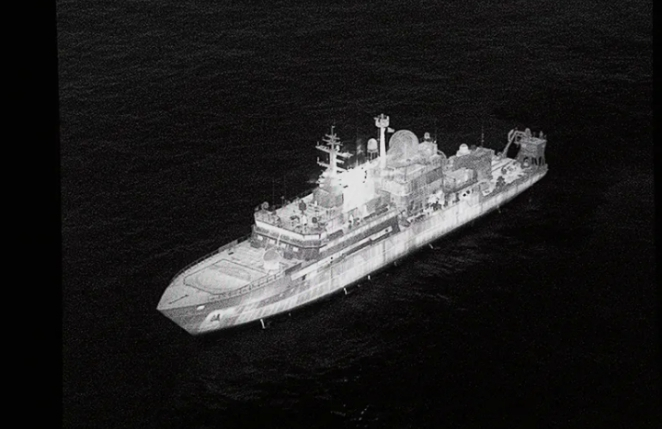
The UK warning over Russian spy ship operations intensified after Defence Secretary John Healey condemned Yantar’s alleged laser targeting of RAF pilots monitoring the intelligence-gathering vessel.
Britain’s defence establishment raised alarms following the reported laser incident involving Yantar, a Russian surveillance ship long suspected of probing undersea cables and testing NATO maritime weaknesses.
Healey addressed the issue during a London speech outlining national security priorities, stressing that UK forces will not hesitate to respond if Yantar threatens critical underwater infrastructure.
Officials say the Russian vessel lingered near the edge of British territorial waters for weeks, prompting round-the-clock monitoring by a naval frigate and two RAF P-8 maritime patrol aircraft.
“It was deeply dangerous behaviour, and we have adjusted our posture accordingly,” Healey declared, describing the episode as unacceptable provocation requiring coordinated military and diplomatic vigilance.
The defence secretary emphasised that the ship’s activities were being watched closely, adding that its movements toward the south would escalate the UK’s readiness to react immediately.
According to British defence sources, Yantar’s capabilities include mapping seabed networks and potentially sabotaging cables that carry energy supplies, financial data, and telecommunications across the continent.
“Our message to Moscow is simple: we see everything, and we will protect our critical infrastructure at any cost,” Healey said, adopting a notably firmer tone than in previous briefings.
This latest confrontation forms part of a broader pattern of Russian naval movements around Europe, with intelligence vessels suspected of conducting hybrid operations below the threshold of open conflict.
Experts warn that Europe’s underwater networks remain highly vulnerable, especially as Russia continues to expand capabilities that allow covert disruption of essential maritime systems.
The Russian embassy in London rejected Healey’s comments, accusing the United Kingdom of manufacturing fear and fostering what officials described as an atmosphere of unnecessary hostilities.
Russian diplomats reiterated longstanding claims that Yantar conducts benign scientific research, insisting the vessel does not interfere with British security interests or underwater communication structures.
“We urge the UK to refrain from destructive steps that intensify divisions on the European continent,” the embassy said, portraying the confrontation as driven by political motives.
British officials remain unconvinced, pointing to previous incidents where Kremlin-linked vessels were detected near sensitive infrastructure, including oil pipelines, energy cables, and naval defence networks.
Analysts believe Russia’s maritime activities underscore a shift toward underwater power projection, with sabotage capabilities forming a key part of Moscow’s modern hybrid warfare approach.
The Yantar controversy follows a January episode where the vessel appeared to “loiter” near UK infrastructure, leading the Royal Navy to dispatch two warships to shadow its movements.
At the time, Healey described Yantar’s behaviour as highly concerning, prompting a surge in allied intelligence discussions focused on reinforcing surveillance of transatlantic cable corridors.
Investigations by European agencies have also highlighted Russian vessels suspected of damaging energy networks, including the Finland–Estonia undersea cable faced with deliberate tampering last year.
NATO officials believe such incidents reflect coordinated testing of collective defence responses, particularly as Russia recalibrates its tactics in the face of sanctions and prolonged conflict in Ukraine.
The rising tensions have fed into renewed debates within the United Kingdom about defence budgeting and readiness across the Royal Navy and RAF, especially in maritime monitoring roles.
Healey used his speech to push for increased defence spending ahead of the country’s new budget, arguing that Britain must invest heavily in countering threats from Russia, China and Iran.
He noted that the government intends to raise defence investment to five percent of GDP by 2035, aligning with NATO partners and responding to a rapidly changing global security landscape.
Plans include creating thirteen new manufacturing sites for munitions and explosives as part of a multibillion-pound industrial expansion boosting production and generating more than one thousand jobs.
“We are entering a new era of threat, and we must rise to meet it,” Healey said, framing the confrontation with Yantar as symbolic of broader international volatility.
Security analysts agree that Britain’s underwater infrastructure has become a prime target, with more than ninety-five percent of digital data travelling through subsea cables vulnerable to disruption.
They argue that nations must adapt to evolving tactics capable of inflicting economic and political damage without triggering traditional military responses, complicating deterrence strategies.
Former naval commanders warn that Yantar’s movements cannot be dismissed as routine, stressing that its design and history highlight its role in Russia’s intelligence-gathering doctrine.
One retired admiral described the current situation as “a dangerous game of underwater chess,” where miscalculations could escalate into serious confrontations affecting global communications.
Members of Parliament from both major parties urged transparency and coordination, pressing the government to ensure adequate protection of maritime infrastructure connecting the UK to Europe and beyond.
Opposition defence spokespeople backed calls for stronger surveillance, though they criticised what they said were years of underfunding causing gaps in naval readiness.
Across Europe, several governments have increased maritime patrols amid concerns that Russia may broaden operations using vessels disguised as commercial ships or scientific research platforms.
Intelligence agencies warn that hybrid tactics are likely to intensify as Moscow searches for leverage while confronting economic pressure and battlefield difficulties in Ukraine.
The UK’s response, officials say, aims to balance deterrence with restraint, avoiding escalation while showing resolve against actions deemed hostile or destabilising.
As tensions continue, maritime analysts stress the importance of international cooperation, especially through NATO channels coordinating data, patrol schedules, and detection technologies.
Healey insisted Britain will act proportionally but firmly, underscoring the commitment to defend national interests as the situation involving Yantar evolves in unpredictable ways.

The dispute has now become a defining moment in Britain’s maritime security narrative, symbolising both technological vulnerabilities and the political complexities shaping interactions with Russia.
While the UK maintains vigilance, experts caution that the broader strategic landscape demands adaptability as underwater warfare becomes a frontline for twenty-first-century geopolitical competition.
About The Author