Turkey’s proposed participation in the Gaza stabilisation force has sparked fresh diplomatic tensions as Israel made clear it would not accept Turkish troops among the multinational peace mission.
The Gaza stabilisation force is planned as a 5,000-strong multinational deployment aimed at preventing a postwar power vacuum in the enclave, but Israeli objections threaten Ankara’s hopes of joining it.
US Secretary of State Marco Rubio said the Gaza stabilisation force must comprise nations acceptable to Israel, noting that its consent was vital for the mission’s legitimacy and operational coordination in Gaza.
“Israel must feel secure about the participants of any stabilisation mission,” Rubio told reporters. “No arrangement can succeed without full regional confidence,” he added emphatically this week.
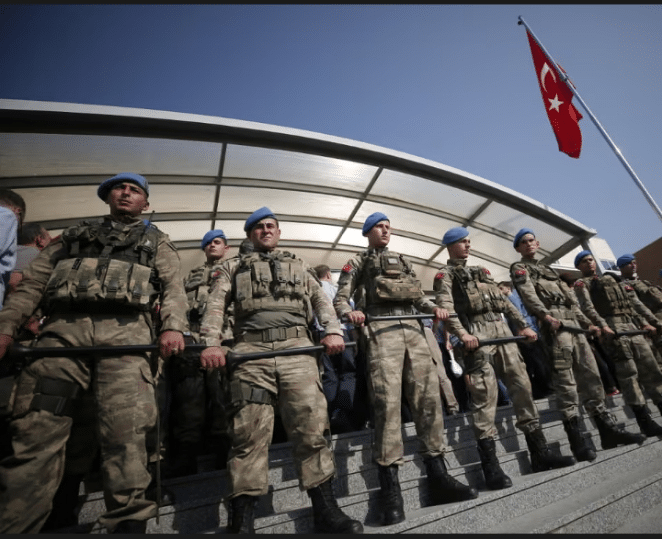
Tensions between Turkey and Israel have worsened in recent years, particularly over Syria and Ankara’s perceived closeness to Hamas. These rifts now jeopardise cooperation over the Gaza stabilisation force.
President Recep Tayyip Erdoğan, long critical of Israeli policies toward Palestinians, is viewed by the Israeli government as aligned too closely with Islamist movements, especially the Muslim Brotherhood and Hamas itself.
Analysts believe excluding Turkey from the Gaza stabilisation force would be politically sensitive, given that Ankara is a guarantor of the Trump 20-point ceasefire and fields one of the region’s strongest Muslim militaries.
Egypt is expected to lead the force, with other contributors including Indonesia and the United Arab Emirates. These nations favour giving the Gaza stabilisation force a formal UN Security Council mandate.
However, the United States reportedly prefers a regional framework over direct UN control. Instead, it will link the mission to a US-led Civil-Military Coordination Centre (CMCC) based in southern Israel.
That CMCC, recently inaugurated by US Vice-President JD Vance, includes British, French, Jordanian, and Emirati advisers and will coordinate aid, logistics, and postwar governance efforts in Gaza.
“The CMCC is about creating stability, transparency, and humanitarian access,” said a senior American diplomat. “It’s not just a military hub but a bridge for civil recovery,” he explained.
Despite those assurances, aid groups remain frustrated. Key humanitarian crossings into Gaza remain closed, slowing the delivery of medical supplies and essential food items even after the ceasefire agreement.
Erdoğan, speaking to reporters in Ankara, demanded Washington use its influence. “The US must pressure Israel to respect its obligations under the Trump peace plan,” he said, urging sanctions and arms restrictions.
Rubio responded sharply, reiterating that there would be “no role for Unrwa” — the UN’s Palestinian relief agency — in the territory, calling it a “subsidiary of Hamas.”
That remark drew widespread criticism. The International Court of Justice (ICJ) ruled this week that Unrwa remained indispensable for distributing aid, rejecting Israel’s claim that it had been irretrievably infiltrated by Hamas.
European diplomats privately expressed concern that the Gaza stabilisation force might be compromised by Washington’s stance on Unrwa, which could limit international humanitarian coordination in the devastated enclave.
A senior EU official said, “Without Unrwa’s experience, aid distribution will collapse. Politics cannot substitute for logistical capacity built over decades,” highlighting the growing strain in transatlantic diplomacy.
The joint US-Israeli opposition to Unrwa poses a policy dilemma for the Trump administration, which in its 20-point plan had accepted UN oversight for aid flows but appears intent on excluding Unrwa itself.
Norway, which initiated the UN resolution leading to the ICJ opinion, said it would now draft a new resolution demanding Israel ease restrictions on aid entering Gaza, in line with international law.
Under the Trump ceasefire plan, Israel had agreed to allow 600 aid trucks daily into Gaza, yet UN data shows the average remains around 89 per day — barely 14 percent of the commitment.
Unrwa criticised Israel’s approach, warning: “The continuing blockade and expansion in the West Bank violate international law. Families live in fear and uncertainty — this must stop immediately.”
The humanitarian chief of the UN Office for the Coordination of Humanitarian Affairs, Tom Fletcher, said after touring Gaza, “It felt like driving through Hiroshima, or Dresden. The devastation is total, unimaginable.”
The Gaza stabilisation force discussions continue amid these humanitarian warnings. A separate Palestinian dialogue is also unfolding in Cairo, where delegations from Hamas and Fatah met to shape a transitional governing arrangement for postwar Gaza.
Hamas officials said mediators guaranteed the war “has effectively ended” and agreed that an interim technocratic committee would manage daily governance and basic services with Arab and international cooperation.
The Palestinian factions’ agreement could pave the way for smoother coordination with the Gaza stabilisation force, though Israel has ruled out any involvement by the Palestinian Authority in Gaza’s reconstruction phase.
Israeli Prime Minister Benjamin Netanyahu remains firm. “There will be no return of the Palestinian Authority to Gaza,” he said. “Security control must stay in responsible hands,” he insisted.
Observers note this insistence reflects Israel’s deep mistrust of Fatah leadership, even as global partners argue inclusive governance is necessary for long-term peace and for the Gaza stabilisation force to succeed.
In Cairo, Egyptian diplomats are urging both sides to maintain dialogue, aware that Egypt’s leadership role in the Gaza stabilisation force depends on Palestinian unity and Israeli cooperation alike.
“Egypt’s participation is not symbolic,” one Egyptian official said. “We are ensuring the peace holds and that Gaza’s reconstruction can begin under Arab and international supervision,” he stated.
Meanwhile, Turkey’s frustration is rising. Its foreign ministry accused Israel of “politicising security cooperation” and warned exclusion from the Gaza stabilisation force would weaken regional legitimacy for the mission.

Ankara also cited its proven experience in multinational operations — from Somalia to Kosovo — as evidence of its reliability and capability in stabilisation roles under complex political conditions.
Despite Israel’s objections, some diplomats believe backchannel discussions could still find room for a limited Turkish role, perhaps in humanitarian logistics or reconstruction rather than direct deployment.
Such a compromise, one European envoy suggested, “would maintain Turkish involvement without provoking Israeli veto — a delicate but necessary balance for credibility and cohesion.”
Inside Israel, hardliners remain sceptical. They view Turkey’s regional ambitions as threatening and argue that allowing Turkish troops near Gaza could embolden Hamas or undercut Israeli deterrence capabilities.
Yet some Israeli analysts concede that excluding Turkey from the Gaza stabilisation force may alienate key Muslim allies and complicate coordination with the Arab League and Organisation of Islamic Cooperation.
Former Israeli diplomat Alon Liel said, “Turkey’s exclusion sends a message that regional cooperation has limits. It narrows diplomatic channels precisely when Gaza needs broad consensus.”
Erdoğan’s domestic critics, however, warn that his pro-Hamas rhetoric isolates Turkey from Western partners, risking economic strain and limiting its influence in international coalitions like the Gaza stabilisation force.
Political scientist Ayşe Karahan noted, “Ankara’s assertive foreign policy plays well at home, but it often backfires abroad. Strategic patience, not posturing, might secure Turkey a seat at the table.”
In Washington, policymakers remain divided. Some view Turkish involvement as too risky, while others believe engagement could anchor Ankara within Western frameworks rather than push it closer to Moscow or Tehran.
For now, the fate of Turkey’s participation in the Gaza stabilisation force hangs in delicate suspense — suspended between geopolitical rivalry and the urgent humanitarian need for collective reconstruction.
Diplomatic observers expect the final composition of the force to be announced within weeks, once Israel formally endorses participating nations and the CMCC finalises operational guidelines for Gaza’s future.
Until then, the humanitarian toll in Gaza continues to mount, while political calculations — and the struggle over who gets to rebuild — dominate the corridors of power in Jerusalem, Cairo, Ankara, and Washington.
“Without genuine cooperation,” warned one senior UN official, “even the best plans for a Gaza stabilisation force will falter. Stability demands inclusion, not exclusion,” he concluded.
About The Author